
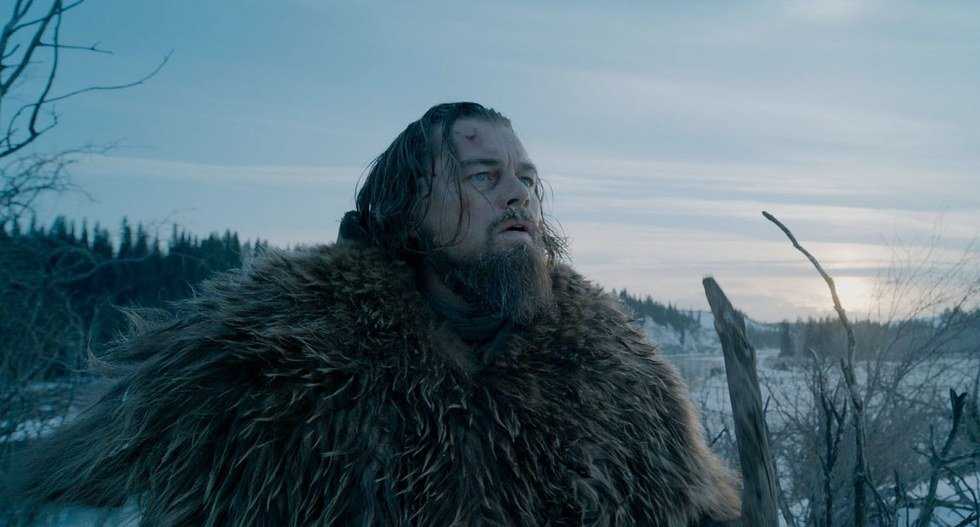
In the time leading up to its release, television and movie theater trailers proudly touted Leonardo DiCarpio's The Revenant with riveting scenes and beautiful shots; extremely effective marketing, the trailers accomplished their goal. After viewing the trailers for the film, I immediately wanted to visit the theaters to watch the new release. Although a self-proclaimed movie fanatic, i rarely ever find the time to sit down and watch a movie, let alone a short TV series, regardless of how interested I am. In the end, I never arrive at the local cinemas, and my list of movies to watch grows longer and longer. however, the producers of The Revenant excelled at their tasks; the pitch to the viewers hit its target. The movie seemed breathtaking, inspiring and powerful; I was determined to see it. Yet I repeated that to myself for nearly half a year-that I should go watch the movie. Having been warned that the movie was extremely graphic, I attribute some of the delay to the doubt I held- whether I would, in fact, enjoy the movie. In the end, I was so set upon watching The Revenant that the cautionary advice of others proved ineffective.
Within the first ten minutes, I discovered that i underestimated the level of violence in the film: a battle ensues between fur-trading colonists and Native Americans. Arrows pierce the heads of petrified men; the butts of guns bruise and bloody bodies. The blood and innards are gushing from the wounded and deceased. Occasionally glancing away from the screen and muting the audio, I try to make it through the intense scenes all the while questioning whether i can handle the level of violence depicted. Then i came to an understanding of the movie: this is reality. The Revenant, although inherently glorified and dramatized for the audience, portrays the truth in the dynamics between nature, humans and human nature, and that itself is repugnant.
From the most violent to the most reflective scenes the film captures all sides of human nature, including the most repulsive to the most heartwarming. The collection of flashbacks, which start at the beginning of the movie, serve as insight into the main character's family life with his now deceased wife and son, revealing to the audience the power of love. The protectiveness of a father, the revenge of a widow and the vengance of a childless man demonstrate the extent of one's love. Not only does the movie illustrate the main character's love, but also it shows the love of another suffering parent. The juxtaposition of the two characters who finally meet in the last scene underscores the power of a parent's love; with both characters journeying across the wilderness for the sake of a child. Both actors perform their roles so skillfully that close up scenes of dialogue are touching and poignant.
Another aspect of human nature is morality and one's conscious. The question of morals is presented, especially in this film in which the majority of the characters engage in conflict, bearing guns and arrows, anticipating violence at any given moment. Two exceptions are archetypes of benevolence and magnanimity. Convinced by Fitzgerald, a fur trader, that a group of pugnacious Native Americans were approaching, Bridger is reluctant to leave behind Glass, the main character who is wounded and immobile. Torn between remaining with Glass and leaving, considering his own survival, his orders and his morals, Bridger ultimately leaves with Fitzgerald, but not before leaving behind his flask for Glass- a gesture so small but so powerful. As the truth unfolds that Fitzgerald had falsely pressured Bridger to abandon Glass, Bridger becomes evidently and genuinely heartbroken.
Another character, whom Glass meets briefly, bestows upon him the gift of words, telling him that revenge is with the Creator, an ideal that is reiterated at the end of movie. Despite losing his entire family to murderous white colonists, the Pawnee man whom Glass meets choses peace rather than vengeance. These traits that these characters possess are rare gems among the belligerent crowd of fur traders, which is very much a similar case in reality. People are generous, forgiving and benevolent, but they are seldom and rare to find. In fact, most of the characters exhibit qualities of deception, greed and apathy which is most accurate of the human condition. The cruelty of humans is exemplified in scalpings, decimated villages, rape, discrimination and hangings, to name a few of th many instances. Watching the digits of a man being pierced by a knife is certainly shocking and disturbing; however, the audience realizes the extent of human's cruel behavior.
Interestingly, as the blood and organs of men and women spill in The Revenant, the camera fixates on the natural landscape which is detached and serene and sometimes directly interacting with events of the story. The blanketed fores and the fluttering snowfall, the winding river slicing through an empty expanse and the mountainous slopes, the beauty and serentity of the nature shots contrast with the intensity of the fights. In one minute, men are burning down villages, and, in the next, coniferous trees tower above the ground. These shots show how pure and harmonious nature is. Humans and nature, which are set upon their own paths, frequently collide: the blood of the murdered men taint the clear blue waters; the fire from burnt settlements engulfs a nearby tree which, in turn, collapses on top of several individuals. Natures plays its own role int he movie, as a formidiable yet serene entity which can be attributed to nature int he physical world, outside of the movie. The harmony of the vast landscape of earth is ruptured by the transient feuds of people, a produce of the human condition.
Critically acclaimed, The Revenant was tastefully and powerfully conducted and performed, but its success comes from its ability to portray reality.
















