

My grandfather, in a move that confused my entire family, recently sent me an email with a single line: “State the purpose of science in 10 words or less.” After comparing notes, my father and I eventually concluded that the idea had probably been my father’s fault; they had been discussing books. The idea was interesting, and he was my grandfather, so I decided to put some serious thought into the question.
The first problem I had to solve revolved around the word purpose. Purpose can be a hard thing to pin down because it isn’t really intent and it really isn’t action, but somewhere in-between. The intent of someone using a chainsaw is to cut apart a tree. What a chainsaw does is use a motor to spin a chain at high speeds. But a chainsaw’s purpose isn’t either of these things. The intent has as much to do with the wielder as it does with the object; a description of what the object does is simply implementation. Many things use a motor to spin a chain at high speeds. The purpose is closer to the original problem or the reason the object was needed in the first place.
Unpacking this definition resolved one problem but left me with another; science doesn’t seem to have a moment of inception. Unlike a product produced by a human being, possibly with the help of a production team, it is almost as if science has existed as long as we have. After all, even small children will perform experiments by dropping spoons on the ground to check on the existence of gravity. Because I wasn’t going to be able to read the meeting notes from the firm that developed science, instead I thought about how it exists today.
I felt torn between the products created as a result of scientific progress, and the progress itself. What was more important, the drug or the advance that lead to the drug? The drug felt more important, but it also felt like more of an incentive than an end goal. The advance leads to more advances and is part of the movement that we perceive as “Progress,” and as part of that movement the drug is simply an incentive for a large pharmaceutical company to spend piles of money; it is the result of supply and demand - not science.
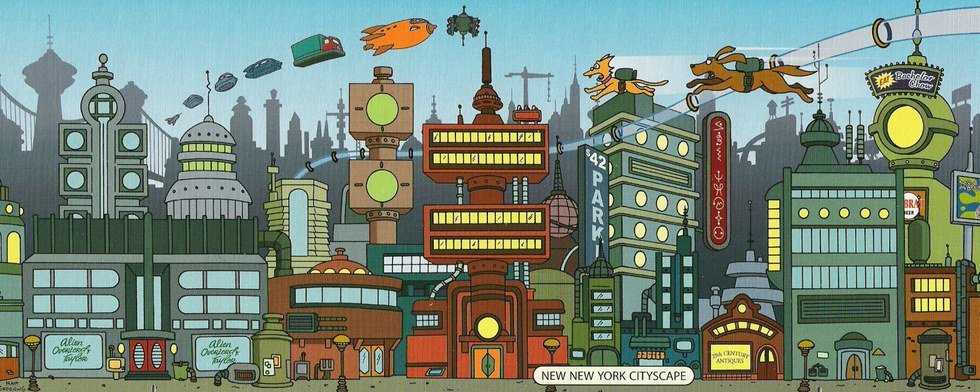
Of course, progress has to be even more abstract then science, and has the benefit of being a lot of things, many of which are equally slippery ideas. Progress probably changes depending on whom you ask. For me it always has conjured an image I probably stole from a TV show; tall white building, dark green lawns, hover cars, and a population that for some reason all has the same terrible taste in clothes and that has no visible health problems. For others I’m sure it conjures an image of smoking craters and horribly twisted mutants. Both images were probably taken from Futurama and so everyone has only three fingers and oddly shaped noses. But that’s the thing about progress; it implies some ultimate destination and that destination can be whatever the speaker or listener wants it to be. If you believe that our current trajectory will result in dystopian catastrophe, then craters are for you. If you believe that we are headed to some reason-based utopia where the grass is always greener, take the hover cars. The answer is probably somewhere in the middle, so we’ll have hover cars, but the grass will all be a sickly green and it’ll be a little mutant-ish around the fringes.
Still, the relationship between science and progress, or at least the progress of utopias and dystopias, is a little tenuous. That progress exists more in the land of politicians as they argue for larger military research grants or abstinence-only education. A more realistic version of progress, the progress science deals in every day, is a smaller, far less certain thing. It takes three steps forward, only to learn that a mistake has been made and take two and a half steps back. In a physical sense, this progress often takes the form of scientific papers, which allow information to be disseminated and also tested and reviewed. This form of progress doesn’t lead to towers or explosions, just to more knowledge. The nature of the knowledge itself isn’t even important. Companies may place value on things they can sell, but that is simply capitalism, not science, and the scientists themselves may want to make the world a better place, but that is a personal decision.
The goal or destination of this progress is more easily seen not in fields like medicine or physics, which require more structure, but the way open-source has structured how software engineering evolves. Cost limits choice, which is why some diseases are studied constantly, and some not at all. The particle colliders built around the world are incredible pieces of technology, but can only be used to run so many experiments at a time, so priorities are set. These choices are not inherent in any scientific process, which is why open-source is so interesting. Many people experience technology advancements in the form of products released from large companies, but a great deal of that progress happens through a global network of developers. Because all that is required is a computer and an Internet connection, the entry cost is much lower than developing a new cancer medication or doing experiments with subatomic particles. Open-source design allows anyone to take part in any project by simply download a version, and when your piece is done ask to include your feature or improvement. The result, the movement, is more haphazard. But many times the largest projects are those used in the development of other applications. Today (7/16/16), three of the top five trending github repositories are tools for development, and the other two are a book and legacy code related to the Apollo 11 mission. The goal of people who develop software is better software, so the things that further that goal are the things that receive the most attention.
The goal of science is similarly self-serving. The destination isn’t a place, it is more knowledge, which allows for the collection of more knowledge, and so on to infinity. Science is the endless search for knowledge through experimentation, regardless of that knowledge’s value. More broadly, science is the endless quest to understand the world around us. The world is of infinite complexity, so we are forced to isolate and understand the smallest portions of it, one gene, one physical law, at a time. So I had my purpose, some editing to bring my definition down under eleven words, and I sent my grandfather my answer: “Science understands practically infinite systems through isolation and experimentation.”
The next day, my grandfather sent back his definition, “The purpose of science is to understand and manipulate the natural world.” My grandfather was a doctor, and in his late 90’s he still keeps up with research, checks his own medication, and keeps an eye on his friends. He doesn’t care about the purpose of science, not what it could do, might do, where it might lead us. What he cares about is here and now: the car he drives, the computer he uses, the medication that keeps his son’s blood pressure in check. I’m not sure what he sees when he imagines tomorrow, I’m not even sure it matters much when compared to the things he knows are here today (so I don’t think he is impressed by visions of tall towers or smoking craters). He is a man who has no time for faith, and so is probably far closer to science, with its empiricism and its skepticism, than I am.