


From the moment we are born, we become subject to influences. These influences mold our beliefs, shape our ideas, and teach us how to see the world.
When we are young, these influences are more often than not our parents. As we grow up, additional influences such as friends, teachers, and popular culture augment the lens through which we receive and perceive information.
As we navigate through our elementary years, we become increasingly aware of how the world works. We learn how to read, to write, and to think. We learn how to reason and how to tell right from wrong.
And while much of what we learn growing up about how the world works is relatively congruent across the board, the dichotomy between our individual understanding of right and wrong, of truth, of life's purpose, is rapidly expanding.
Here’s the problem, though.
(Please note that while the following illustrated points are sweeping generalizations, I use them solely to represent the more extreme ends of what I'll refer to as the "biased spectrum.")
Some of us are taught that this is right:

Others of us are taught that this is right:
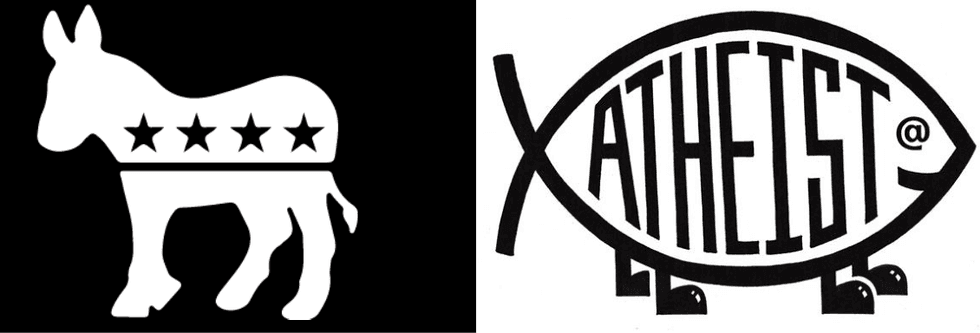


We tend to cast quick judgment and brashly assert our opinions on—and furthermore actually see—the issues we face as a society as either black or white. And no, I'm not talking about racial lenses, but lenses that force us to see an issue, an idea, or a person, as black or white, good or bad, this or that, wrong or right.
The dangers of a System 1 way of thinking.
In his incredible work "Thinking, Fast and Slow," Nobel laureate psychologist Daniel Kahneman fleshes out two primary ways that the brain processes and reacts to information. System 1 is the brain’s fast, emotional, automatic, and intuitive approach to thinking, while System 2 is the mind’s more analytical and "in-depth" approach to sorting through information.
Kahneman argues that “System 1 is... more influential… guiding… [and] steering System 2 to a very large extent." Kahneman says that this can be incredibly problematic as our more "reasonable" way of thought is incredibly influenced by our gut and more emotional reactions to the way we process and understand information, organizations, and people.
On the whole, society has become addicted to a System 1 way of thinking and talking about the most controversial issues we face today. I think that a lot of the impetus behind this falls on the over-stimulated and highly distractable technological age we live in today.
We are consuming content at such an incredible rate that we actually prevent System 2 from ever having the time to process, contextualize, and analyze the commentary, opinions, and schools of thought that we're taking in.
And as a result, we see an issue through the lens we are most comfortable with or most often identify with, because it’s easier than taking the time to actually think about, and grapple with, the issue analytically.
So what do we wind up doing?
We don’t take the time to actually look at the issue or even consciously choose which lens to look through, it “just happens”—and we’re okay with this, because it “makes sense." There are “two sides to every story” after all, right?
We assume that “the other guy’s” media has some hegemonic agenda to distort reality and spew forth a flawed ideology—so we make sure to scoff at anything and everything said when we accidentally stumble upon one of "their articles" on our newsfeeds.
We fear isolation for we think it makes us vulnerable, and therefore we buy into the popular notion that we must become an “either” or an “or”— we must join one way of thought and action or another. Naturalization has convinced us that by not grounding our socio-political identity to one way of thought, our identity is in some way lacking.
We become experts in seeing the wrong in another’s belief system or way of thought—and we tend to see only the flaws.
We create our own public spheres and—like the bourgeois—fill the space (whether it be coffee shops, cocktail dinners, or political forums) with people who look like, think like, and act like us.
How do we overcome this and why does it matter?
We have all been socialized—that is fact, not fiction, and it is of the utmost importance to realize this.
But we are all also at an age and time in our life when we are free and capable of recognizing the ways in which we have been socialized and choosing how we respond to this socialization. We can no longer play the “this is how I was raised” card as a valid excuse.
We must choose to expand our lenses and refuse to see an issue, a person, or way of thought as only black or white.
It's about seeing a person as a person. It's about seeing people, not merely "issues." What happens when we befriend someone from "across the aisle?" What happens when we meet and grow to love someone that personifies a side of one of the very issues we so passionately abhor?
To be clear, I'm not arguing that society needs to embrace a more relativistic or "to each his own" posture. I'm not saying that we can't or shouldn't have varying opinions or beliefs on issues, but rather that we must humbly strive to see the issues that divide us as more intricate than merely "right or wrong."
While culture change takes time, here are some practical ways I believe millennials can help to promote a swifter adaptation of this sort of mindset:
We Must Strive To Muffle System 1
We refuse to allow our initial thoughts, preconceived notions, or socialized beliefs prevent us from humanizing an issue and taking the time to see it from another’s perspective.
We carefully evaluate the damage our words, actions, or beliefs could inflict on another—especially on another in a marginalized group.
We Must Promote Participatory Culture
We work to allow all voices, opinions, and ideas an equal opportunity to be shared, thought about, and discussed.
We commit to engage civically so as to ensure that all people, regardless of class and social or economic status, have the chance to engage with culture and join the conversation surrounding an issue.
We Must Abolish Slacktivism
We tweet about our opinions on issues, which is incredibly important, but we must also decide to go a step further and use social media as a stepping stool to social action and social change, not an exhaustive platform for it.
We Must Utilize This Digital Age to Birth Unity
We commit to not settle for a culture of relativism, but a culture of unified diversity.
We refuse to settle for “what’s true for you isn’t true for me," but rather work to understand why others believe the things they do before forming an opinion on how they see the world. We utilize digital media to bring about this unity and promote this way of thought.
We Must Stop Blaming the Media for Biases and Start Blaming Ourselves
We need to stop putting the blame on the media for being corrupt and biased and take a look in the mirror. The media has become what we’ve allowed it to become. If we want “truer” popular media, it’s time we change the way in which it’s viewers think, discuss, and act on issues.
Some call Millennials "entitled narcissists," but I think we will be the ones who show the world that society is not black and white.
Society is multi-colored—and beautiful at that. It is time we stop pointing the finger and identifying as “this or as that." We must be okay with admitting our ideologies, working to muffle our System 1 way of thought, and striving to humanize political issues.
We have never been more divided as a nation than we are today. I believe the mission for the millennials is to believe in, and fight for, a unified tomorrow. This unity will require sacrifice—sacrifice that will be uncomfortable in one way for some and in another way for others. But I believe that it is this sacrifice that will restore the mindset our forefathers had, to create a culture where “liberty and justice" was truly available for all.
















