

The King of the Planets has recently gotten a lot of attention, so I thought I'd share a little bit about good ole Jupiter.
It took me a while to sort through all the awesome facts and info about Jupiter, but I tried my best to narrow it down.
I think space stuff is the coolest.
Jupiter is the largest planet in our solar system, being large enough to engulf 1300 Earths. Yeah, it's large. It's appropriately named after the king of the gods of Roman mythology, Jupiter, or Zeus in Greek mythology. As well as being the largest planet, Jupiter has the most moons, 67 to be exact. The four largest of them, the Galilean moons, were discovered independently in 1610 by Galileo Galilei and Simon Marius. Named Lo, Europa, Ganymede, and Callisto. In Greek mythology, Europa, Callisto, and Lo were all Zeus's (Jupiter's) lovers. Juno, the spacecraft, was named after Zeus's wife, who's known in Greek mythology as Hera.
So NASA basically sent Jupiter's wife to check up on him and his lovers.
Space humor.
Now back to Jupiter.
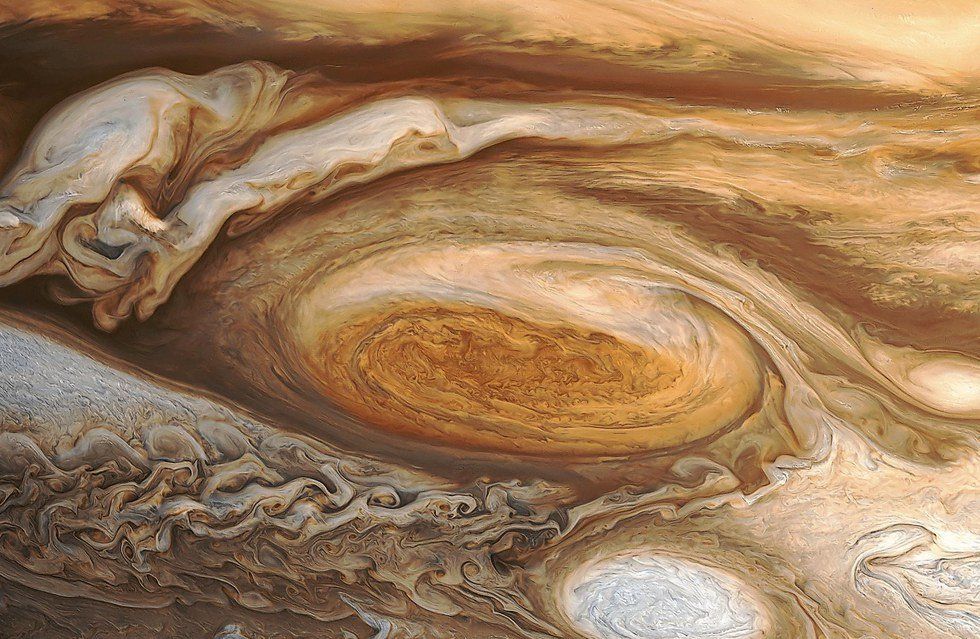
Jupiter has no surface but is in fact a ball of gas held together by gravity. It's famous red spot is actually a massive, long-lived storm that is three times bigger than Earth. Around 150 years ago, the storm used to be twice as big. Imagine a storm big enough to swallow 100,000 hurricane Katrinas, so big it only fully rotates every six days, days on Jupiter being 9.93 hours instead of our 24.
The first spacecraft sent to Jupiter was called Galileo in honor of the man who first discovered it's moons. Galileo studied other Solar System bodies as well as Jupiter during its mission. It was launched on October 18, 1989 and arrived at Jupiter on December 7, 1995. It spent a total of 14 years in space and 8 years in Jupiter's orbit collecting data that supported the theory of a liquid ocean under the icy surface of Europa, as well as similar liquid-salt waters under the surfaces of Ganymede and Callisto.
On August 5, 2011, the Juno spacecraft was launched from Cape Canaveral Air Force Station on a mission to Jupiter. After an almost five year journey, it entered Jupiter's orbit, going faster than any human made object has ever gone. It will orbit the biggest planet in our solar system for the next twenty months, studying the planets composition, gravity field, magnetic field and polar magnetosphere. It will also search for clues to how the planet formed, as well as whether it has a rocky core and the amount of water present within it's deep atmosphere
Hope you enjoyed this little study in Jupiter!