

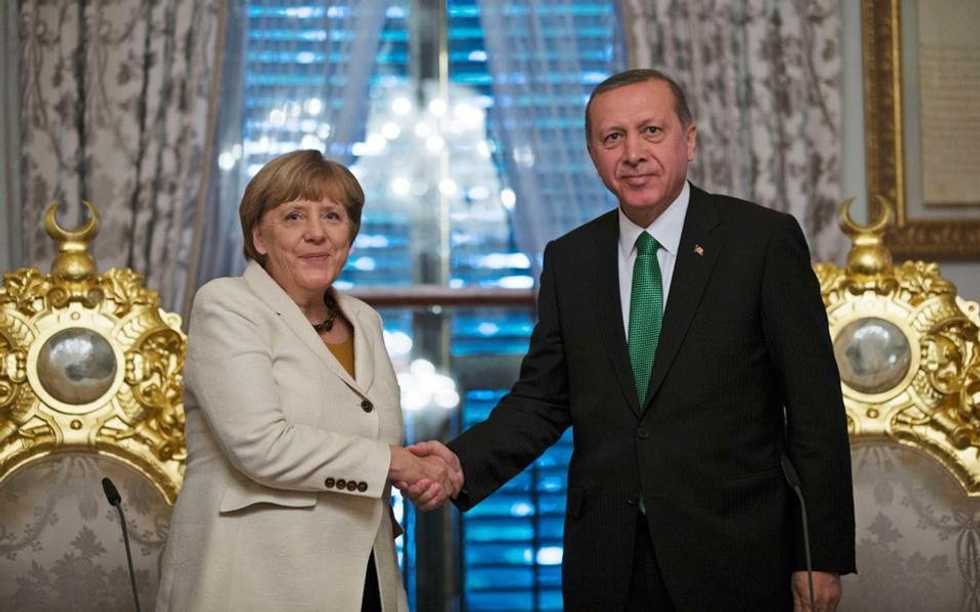
Someone needs to inform Recep Erdogan that he is, in fact, the President of Turkey, and not Sultan of Germany.
Someone also needs to inform Angela Merkel that she is, in fact, Chancellor of Germany, and not Erdogan's subordinate.
You would think these facts to be apparent, but they don't seem to be for Erdogan and Merkel.
I bring this up because of a recent incident concerning a German Comedian, the Turkish Government, and a poem that was called "A crime against humanity".
This may sound like the opening to a bad joke, but these are the circumstances surrounding the prosecution of German comedian Jan Boehmermann for his recitation of a satirical poem insulting President Erdogan, calling him out for his increasing authoritarian leadership and his oppressive policies towards Kurds and Christians. Boehmermann also made crude jokes about Erdogan's penchant for bestiality and pedophilia (which was completely satirical).
While one can decide for him or herself whether or not the poem was actually funny, the Turkish government certainly didn't think so. The Deputy Prime Minister of Turkey, Numan Kurtulmus, called the poem a "serious crime against humanity" (as you can see, the Turkish Government has its priorities straight).
President Erdogan called for the prosecution of Boehmermann, to which Chancellor Angela Merkel willingly complied, as per Section 103 of the German penal code. According to this law, anyone who insults a foreign leader is subject to up to three years in prison if the German government allows prosecution to take place.
The details of the case are still pending, as prosecutors are still making final decisions over whether or not to prosecute Boehmermann.
Keep in mind that Boehmermann was deliberately trying to push the envelope concerning the limits of free speech in Germany, so he knew what he was getting into.
Merkel defended her decision to give Erdogan permission by saying that the law was the law, and that even though she claims to not particularly like the law, and in fact has made formal plans to abolish it, the German government must carry it out as a matter of justice.
I don't find this reasoning particularly convincing. According to the law, the decision to prosecute ultimately lies within the German government. Merkel could easily have denied Erdogan permission to prosecute Boehmermann. Not only did she grant Erdogan permission, however, she defended his decision to prosecute by calling the poem "intentionally hurtful" (she later regretted such remarks). A spokesperson for Merkel said that "satire takes place within our country's press and media freedom--which, as you know--is not unlimited." The statement drew criticism from many freedom of speech advocates. While Merkel claims to not like the law, she seemed to be more than willing to make Erdogan feel justified in his tantrum.
The Guardian did an interesting piece about this affair, tracing the "insult law" back to the 19th century. They observed that the "insult law" is really one of those obscure laws that, while still technically on the books, is never really enforced or taken seriously anymore. A comparable example is the Massachusetts law banning tattoos. While the state can still enforce it, no one takes it seriously, and it would be considered ludicrous to do so. In fact, the only times Section 103 of the Penal Code has ever been used is when it has been politically convenient to infringe on free expression.
So what are Angela Merkel's reasons for allowing the prosecution to take place?
Obviously, the Chancellor has made no definitive statements, but the speculations of several analysts and commentators based upon recent events provide a pretty interesting answer. Recently, the EU has struck a highly debated deal with Turkey over the refugee crisis. Turkey promises to take in Syrian refugees that have recently arrived in the EU. In return, Turkey gets billions of dollars in aid per year, a slicker path to EU membership (which may or may not conveniently look away from the Turkish government’s multiple human rights abuses), and visa-free travel for Turkish citizens to Europe.
For many reasons, this deal is hotly contested. Is it fair for Turkey to gain an easier path to the EU, with its leader, Erdogan, now pressing charges against literally of journalists, lawyers, even children, in prison for insulting him?
Multiple human rights organizations also warn of Turkey's treatment of refugees. Amnesty International points out that if any refugees in Turkey try to escape to Europe, they are captured, thrown into prison without any contact to their families, and are told they must either stay in Turkey, or be sent back to Iraq or Syria.
Merkel, however, faces a dilemma. With over a million refugees pouring into Europe last year alone, and a rise of mass gang rapes perpetrated by young migrant men, Germany has certainly bitten off more than it can chew in the refugee crisis. Add to this a concerning rise of anti-immigrant groups that could cause further tension and violence, and one can easily see why Merkel would do anything to solve the problem, including striking dubious deals with temperamental heads of state.
My own opinions on the deal itself are still not fully formed and are for another article, but is it really worth Merkel bending over backwards for Erdogan, even at the expense of her citizens' basic rights?
While the results of the Boehmermann affair are still pending, it's clear that we are witnessing the rise of one of the strangest political alliances in recent years. On the one hand, Angela Merkel, the EU's strongest defender, and on the other, President Erdogan, a wannabe Sultan.
It will be interesting to see how the alliance will turn out.