
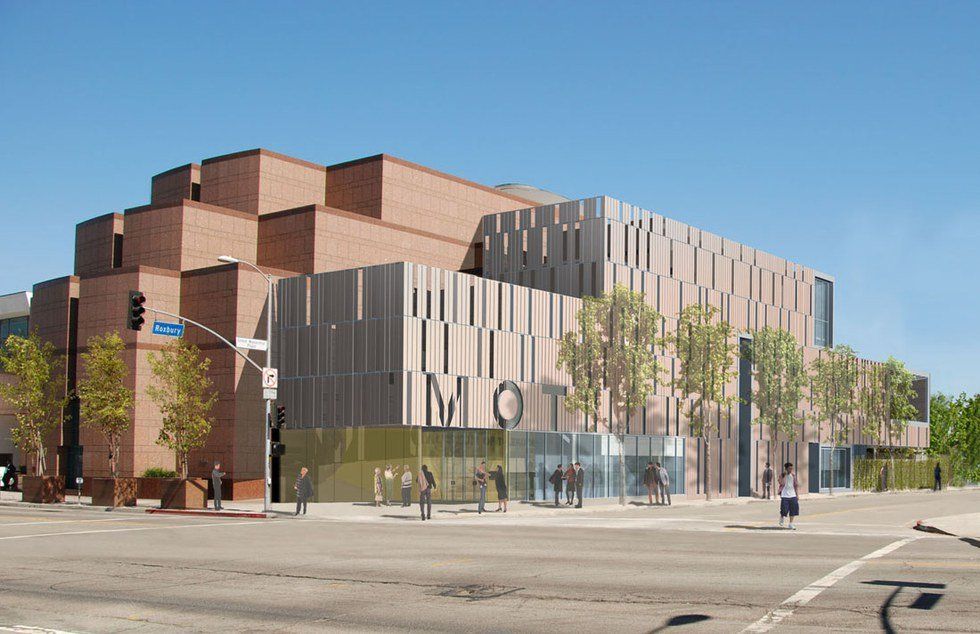
Last week I was able to visit one of Los Angeles’s many institutions of public history; Nestled in the center of city life lays the Museum of Tolerance, a part of the Simon Wiesenthal Center.
The Museum boasts “high tech” exhibits that allow visitors to examine racism and prejudice around the world while emphasizing tolerance in future generations, as well as providing a tribute to survivors and promoting themes of acceptance, change, survival, strength and the involvement in history.
The Museum of Tolerance has three main exhibits running right now: the Tolerancenter, which focuses on intolerance in America with emphasis on race relations surrounding the Civil Rights movement and the aftermath of the terrorist attack on 9/11, the Holocaust Exhibit, which takes visitors “back in time to become witnesses of events in Nazi-dominated Europe” from the 1920s to 1945 and lastly an Anne Frank exhibit that provides visitors a chance to see rare artifacts and unique documents from the life of Anne Frank.
These exhibits combine to create an interesting educational experience for visitors, though the larger meaning of “tolerance for all” is buried under the more dominant message of “tolerance for Jews.”
The Museum of Tolerance is actually more of a Holocaust museum when it comes down to it, seeing as the museum is funded by wealthy Jewish Americans, this doesn’t come as a surprise. The entranceway toward all of the exhibits is a long spiral ramp lined with pictures of Holocaust survivors and little blurbs about their experiences.
This definitely sets a precedent for the rest of the exhibition.
The Tolerancenter highlights race relations in American history, with several hands- on exercises that aim to get visitors involved in the history.
While I suppose the exhibits are still effective, they are slightly disconnected from the main themes of the exhibit as a whole and painfully out-dated.
The single shining star in a sky of mediocrity is the 9/11 exhibit. It’s really just a large viewing station where visitors can watch an insightful video about the terrorist attacks in 2001 and their aftermath in America, and all over the world. With Islamophbia as rampant in this country as ever, this exhibit is especially powerful. Visitors can leave that portion of the exhibition confident that they have learned something about the way we look at race and religion in this country.
Leaving the Tolerancenter, museum visitors are plunged straight into the Holocaust exhibit where they are invited to watch an eighteen-minute movie about Jewish culture at the outbreak of World War II and are then given plastic cards with the name of a child that lived during that time. These cards act as a sort of passport into the past, and when inserted into the museum's computers, they display information about that individual’s life. More information stations are set up through out the rest of the exhibit so you can follow their journey.
It is after this display that the true Holocaust experience begins.
Visitors are shuffled into a dark space while the doors close behind them ominously. After a few seconds of silence there is a whirring sound as a disembodied voice begins the tale of how one goes about planning a Holocaust exhibit, and then the spotlights kick in belatedly projecting light onto a trio of figurines in the shape of a historian, researcher and designer.
These figures present a strange sort of dissociation with the rest of the exhibit. Visitors are transferred from window to window where the strange figures narrate their research.
The different window displays probably used to work in perfect sequence, but now are slightly out of synch so that visitors hear about Nazi propaganda and Hitler’s Mein Kampf in complete darkness while the ghostly white figure of the Historian is lit up in the window they just left.
After this strange setting, guests are filed into a room with six large screens displaying another film about German expansion in Europe. Little is mentioned about the other groups targeted during the Holocaust other than that there were other groups. It would have perhaps added more depth to the exhibit to discuss other people's devastations during the Holocaust, such as Gypsies and the disabled.
This provides a sort of turning point in the exhibit; there are no more moments where visitors are not completely immersed in the atrocities that occurred. There is of course the famous recreation of the Auschwitz-Birkenau death camp complete with fake people hanging from the miniaturized gallows.
All of this culminates into the guests being lead into a recreated gas chamber. As the guests walk through the tunnel to the gas chamber proper, they play eerie choral singing. It is probably the most powerful sensory experience of the entire exhibition and can have a harrowing effect of museum visitors.
Overall, the Holocaust exhibit far over shadows the other exhibits with it's intensity.
The Museum of Tolerance also offers museum-goers to search through museum databases to trace their lineage back to the Holocaust, and daily live speeches by actual Holocaust survivors.
While I was impressed by the museum in the long run, I was slightly disappointed. The main tactic the museum utilizes to promote tolerance is to highlight all the ways Americans are not tolerant, and while this is an important tool to educate visitors, I’m not sure it is effective in prompting change.
I encourage you to visit the museum and experience for yourself the living history of the Museum of Tolerance.
VISIT:
http://www.museumoftolerance.com/site/c.tmL6KfNVLt...