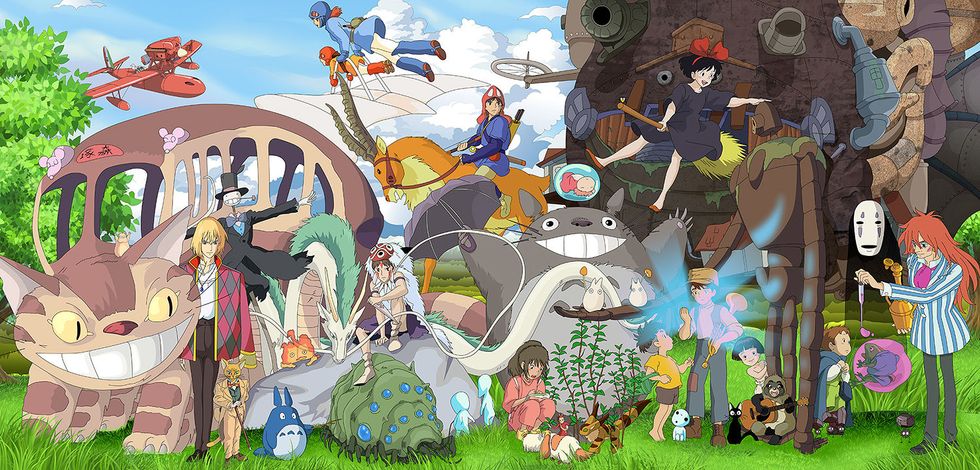
Acclaimed Japanese film director Hayao Miyazaki retired in 2014 after directing 21 films and writing 23. He left behind one of the most immaculate legacies of any filmmaker. His films are beautiful, awe-inspiring, progressive works that have won international acclaim. They're also animated and mostly targeted toward children. So how did an animated Japanese director leave such an indelible mark on cinema? Watch any of his films and you'll see his artistry and passion. Like Pixar, Miyazaki made mature films that express important ideas through whimsical, fantastic stories. All directors put a bit of themselves into their films, but Miyazaki consistently fills his movies with recurrent themes and motifs that, like the animation and music, distinguish him.
The first thing you'll notice about any Miyazaki film is how beautiful it is. Whether you start from the beginning or walk in at any point of the movie, you'll be treated to lush landscapes, fluid animation, and creative designs. His animation is most beautiful when depicting nature, which revels in vibrancy and luxuriance. His gardens are filled with flowers, his forests are huge and dense, and the rain is more solemn and delicate than a piano sonata. This is because Miyazaki is an environmentalist and animist, so he reveres nature in both senses of the word.
Nature is pure, so humanity's attempt to consume it through industry or war is a prevalent conflict. Princess Mononoke, Nausicaa, and Ponyo are driven by the conflict between the natural and industrial worlds. In Mononoke, nature is personified through animal spirits who nobly, but vainly fight off human expansion into the forest. However, Miyazaki is nuanced in his approach and presents his idea realistically. Humans aren't the "bad guys" [1] because harvesting resources from nature isn't evil. Humanity's motivation is to grow and survive, so while Mononoke has opposing factions, there's no villain.
Miyazaki said in an interview, "I think that in the essence of human civilization, we have the desire to become rich without limit, by taking the lives of other creatures." He's concerned that people have lost their respect for nature and forgotten the humility of being creatures of this world. We could live in harmony, but human nature is to grow and that means to take wherever we can; this underlying violence is why he also opposes war.
When Spirited Away was nominated for an Academy Award, Miyazaki refused to fly to America and attend the show. He eventually explained why, “The reason I wasn’t here for the Academy Award was because I didn’t want to visit a country that was bombing Iraq” [2]. Pacifism is very important to him, as seen in Castle in the Sky, Howl's Moving Castle, Princess Mononoke, and Nausicaa. In all of these films, the primary conflict is between a protagonist trying to find peace in the midst of war. Ashitaka wants to stop people from fighting the forest, Howl uses his magic to hinder the war, and Pazu wants to stop Col. Muska from weaponizing Laputa's magic.
Pacifism and environmentalism are two of Miyazaki's most recognizable themes, but his most prevalent and subtle is feminism. All of his films feature a well-developed female character who furthers the plot, shows courage and dedication, and matures and changes. Some of his films have female protagonists and most of his films have many female characters with varying motives and personalities. Some are villainous, some are naive, and some are compassionate. Also, when they interact with each other, it's rarely about men (take that Bechdel test!). He's also one of the few directors to show female workers, as seen in Porco Rosso and Princess Mononoke.
So, Miyazaki makes beautiful films that: respect women, honor nature, strive for peace, and portray coming of age. As most of his films are for children, most of his protagonists are children. Kiki's Delivery Service, Spirited Away, My Neighbor Totoro, and Secret Life of Arrietty are all about girls who are either thrust into situations that require them to mature or simply develop through the events of the story. This type of story is called coming of age or Bildungsroman, which is German for "formation story."
What distinguishes Miyazaki? More than just his themes, art, music, or motifs, it's his sense of awe and wonder. When he writes about his passion for flight, he shows his favorite planes bending in the wend, carrying the viewers into the vast openness of the sky. The sweet exhilaration of creativity intersperses the war and tragedy of The Wind Rises, while family and love provide solace from the curses and violence of Howl's Moving Castle. In a daunting, frightening world, his stories are romantic and optimistic.
“I would like to make a film to tell children 'it's good to be alive'.” - Hayao Miyazaki.