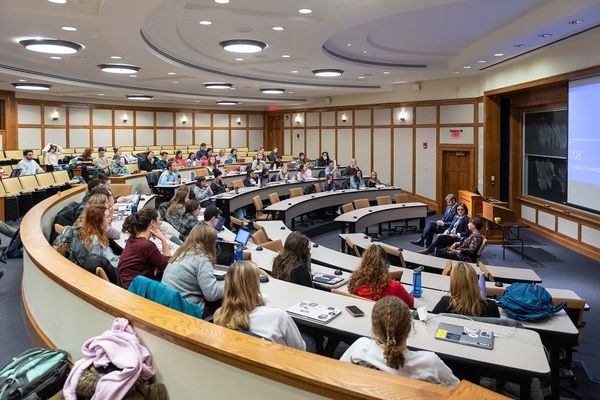


So many of us stress over minuscule classes and tests and making sure we know everything about unicorns, or weather, or the culture of Nicaragua. I myself am guilty of over-stressing about my classes and learning all the information so I can pass the test. But that’s the problem in itself: I’m learning this information merely to pass a test, not because it’s necessary or I want to learn it.
Our entire life has been based on passing one test so we can move on to the next: to get good grades, to get into a good program/college/grad school (whatever it may be) just so we can get a high-paying job and spend the rest of our life working. This vicious cycle may be a productive, and often expected one, but is it a happy one — even the best one?
Some of the most successful people didn’t attend college or didn’t finish college. Bill Gates, Mark Zuckerberg, Steve Jobs, Oprah Winfrey, Ralph Lauren, Walt Disney and Coco Chanel, for example. Many of these people moved on to become some of the wealthiest, most well-known minds of our time. It’s interesting to think how being street-smart, following an instinct or chasing an idea could be far more productive than following the conventional path. In the “real world,” no one cares what your GPA was or what your test average was: they care about what you can do.
Out of classroom learning, life lessons, pursuing a hobby, or finding something you're good at, could potentially lead to greater success than anything you learn in a lecture at school. While I don’t undermine the importance of school to teach hard work and perseverance through subjects that are challenging or unappealing, I merely challenge it. If we as a society spent more time teaching classes that were more fixed on personal interest or allowed students to be creative rather than just intellectual, maybe we’d see a greater flourishing and drive towards societal advancements.
Sometimes conventionality and following a perfectly laid out path works for people, and I do believe it’s important for specific careers like doctors or engineers. But for the kids like me, the creative-minded, we’d thrive in an environment where we could use our imagination and learn things that challenge conventional wisdom — learn to challenge the “norm.”
The out of classroom learners are the creative minds of the future, like the creators of Apple, or Microsoft, or a leading fashion brand like CoCo Chanel. These things aren’t taught in a classroom: they're imagined, tested out and pursued.
Don’t become trapped by conventionality. If you find a passion, intuition or an idea pursue it. Pursue it 120 percent, and if you’re doubted, be willing to pursue it anyway.