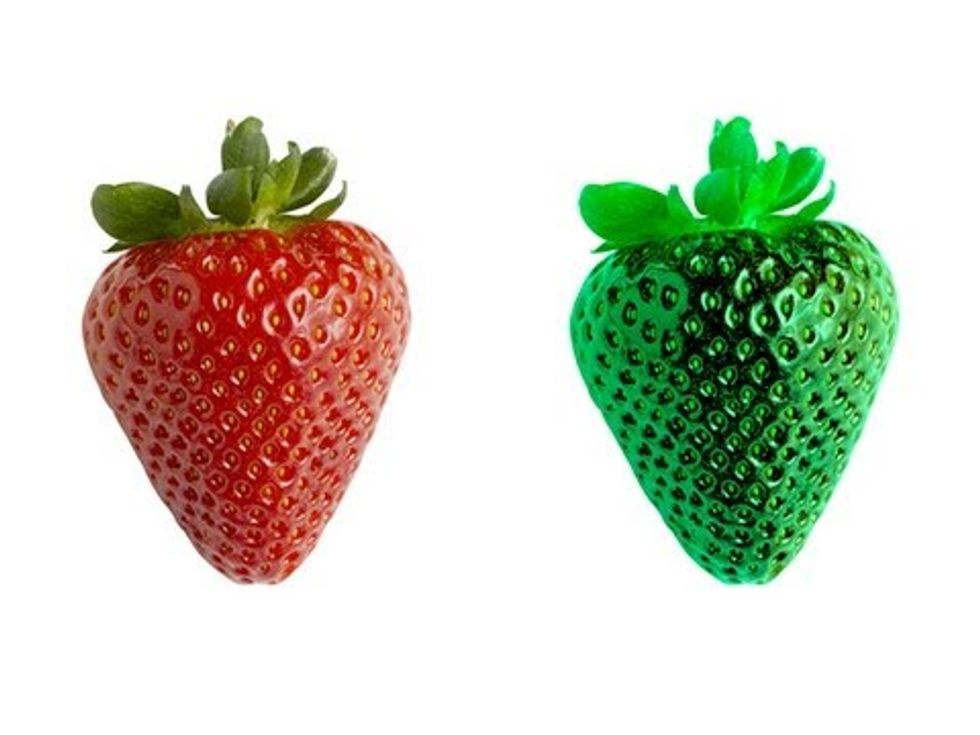
Most people believe that objects exist outside of themselves. They have the ability to interact with us, independent of our control, and we have the ability to act upon them as well. However, how do we reconcile the fact that sometimes our perception of the objects around us is different from that of others when we know that these objects exist?
A common thought experiment that demonstrates this is related to color. Imagine that for your whole life, while you have been referring to 700 nm wavelengths of light as "red," others have been seeing 400 nm and calling that "red." Now, what makes this scary is that they could be perceiving 400 nm light from something that you perceive to be as 700 nm light, so they would technically be right in calling that "red," having learned it that way. There's no way to tell if they're perceiving a different color. After all, how do you describe blue to someone who's never seen blue before? So, everyone technically could have been seeing and referring to different colors without knowing it because they learn through the unique lens of their visual sensory system.
Locke's answer to this is a primary-secondary quality distinction. According to Locke, primary qualities are objectively true and mind-independent, meaning that they exist in the object itself. As examples, Locke identifies qualities like shape, mass, solidity, motion, and texture to be primary. On the other hand, secondary qualities are subjectively true and mind-dependent, meaning that they have the ability to spur ideas in us depending on the observer and are not innate in an object. Locke identifies color, taste, sound, smell, and temperature to be secondary qualities. We'd like to think that objects exist outside of our immediate perception of them, that this chair will still exist in the room after I leave the room, and primary qualities sort of account for that because they give us reason to believe that the chair holds properties of its own that are independent of us. However, we'd also like to think that certain kinds of perception differ for observers, like the color in the example above, which is accounted for by Locke's definition of secondary qualities.
However, Locke's primary-secondary quality distinction is flawed because the primary and secondary qualities that he listed above can be interpreted to be the other as well. Take shape, for example. Although we know that the true shape of a rectangular table is rectangular and we can see that from certain angles, we do not necessarily see that from all angles. In fact, from most angles you'll see a trapezoid. Since no two observers can simultaneously observe an object from the same perspective, two observers will always see different trapezoids. Doesn't this sound more like a secondary quality now?
Conversely, color can be a primary quality. Objects, depending on how they are organized on an atomic level, have structural properties that cause them to absorb certain wavelengths of light and reflect other wavelengths, determining the color that observers perceive. No matter the circumstances of perception, if two people use a spectrometer on an object to study the wavelength of light that it reflects, they would inevitably detect the same wavelength of light, which translates to a specifically defined color on the visible light spectrum. Doesn't this sound more like a primary quality now?
Furthermore, I'm confident that a primary-secondary quality distinction cannot be made at all because, on an atomic scale, all qualities can be both primary and secondary. Take smell, for example. The smell of an object is generated as an idea in our mind through the interaction of certain chemicals that are emitted by the object and the receptors that control our olfactory senses. Although every observer may possess olfactory systems that function differently, the fundamental chemicals in the objects that cause us to perceive smell are innate within the object itself. Therefore, while smell is a secondary quality according to Locke, it can also be seen as a primary quality.
On the other hand, mass can be also interpreted to be a secondary quality. According to Locke, all primary qualities are innate in an object. Since no two objects are identical in atomic structure, all objects possess unique sets of primary qualities. Therefore, when using a scale to measure the mass of an object, all scales must be a little different as to evaluate slightly different values for the mass of an object. If that’s true, then mass can no longer be considered a primary quality because it differs with each system that is used to measure it and it cannot be confirmed through repeated empirical measurements. It may hold that the same scale can get the same reading every time, but that is similarly arbitrary to how an individual can perceive a secondary quality like smell consistently because of the makeup of the individual’s unique olfactory system.
Similar to how a scale is a system that is used to perceive an object's mass, our senses are systems used to perceive an object's smell, taste, texture, sound, and dimensions. Although all objects have qualities derived from atomic structure that are innate to them, our perception of these qualities varies depending on how similar the systems that we use to perceive these qualities are. A scale is relatively standard and reliable, so we generally tend to trust it, but our sensory systems vary a lot more. If we use a spectrometer to perceive color instead of our eyes, we start to get readings that a lot more consistent and similar to those that we get from a scale.
So, in conclusion, primary and secondary qualities don't exist. Humans just have flawed sensory systems that are used to perceive the world that needs to be improved upon.