
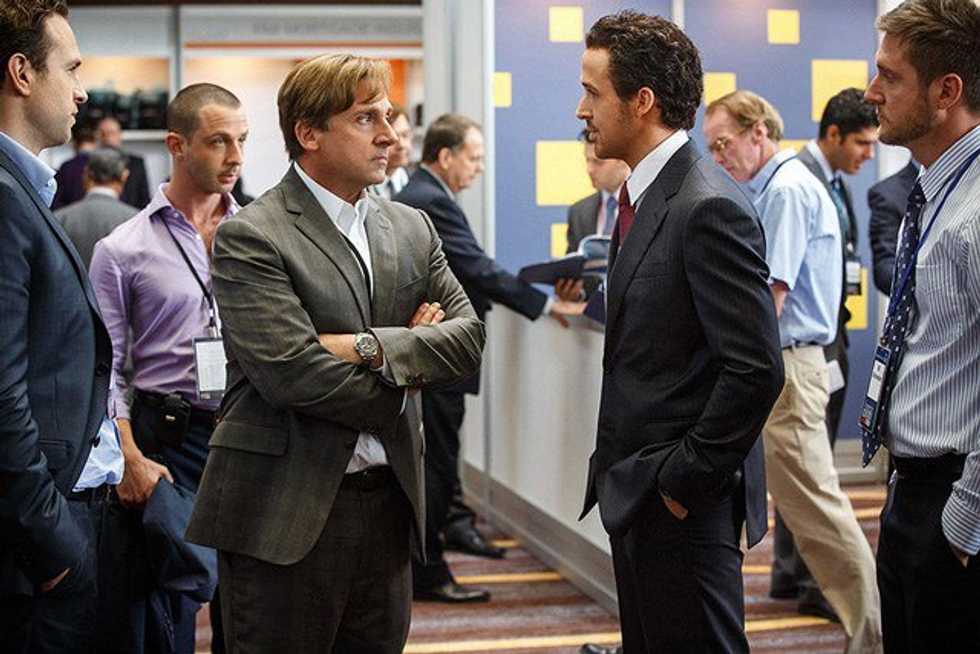
I have never come out of seeing a comedy film feeling so angry before. Except maybe Will Ferrell’s "Land of the Lost," and that was because the only thing lost was an hour and a half of my life. No, I walked out of Adam McKay’s "The Big Short" angry. Perhaps it is unfair to label "The Big Short" a comedy when it's actually much more than that. Shot in an almost documentary-like style, the film is more of a drama than anything else, and a change of pace for McKay, who typically does favor comedies.
What makes "The Big Short" most unique is its overly-conscious awareness of the audience. While 2015 brought us major films produced specially for the audience ("Jurassic World," "Star Wars," etc.), "The Big Short" produces a film to tell a story about the audience itself and one of the greatest injustices committed against them.
The film starts out with Ryan Gosling’s character breaking the fourth wall. Talking directly to the audience is a very specific way for a film or a play to inform the audience that this work pays definite attention to the audience. Several times throughout the film, Gosling explains overly complicated banking jargon by actually letting Margot Robbie explain them while she soaks in a bathtub drinking a glass of champagne (a much-appreciated tip of the hat to "The Wolf of Wall Street"). Later, Selena Gomez explains another term too long and complicated for me to remember while a very well-established economics professor sits next to her.
The movie does this for a very specific purpose. It recognizes that the audience will have no clue what these terms mean, and so the movie must talk down to us, at least in a comedic way. It justifies treating the audience in a child-like manner because that's what the banks have done to us. By creating such complicated and incomprehensible language, banks are able to shut out the public, not allowing them to understand exactly what they're doing. So "The Big Short" lays it out simply; so simply, in fact, it's not only comical but also infuriating.
The film follows three groups of people who have uncovered the serious corruption behind the housing market crash of 2008. With this knowledge, they're able to exploit the situation by effectively betting against the American economy in hopes for serious financial gain. The maddening part is what they uncover. I would highly recommend watching the film, as they do a fantastic job explaining what happened. What was uncomfortable about the film was what happened to every single person who was sitting in the room. During the end titles, the movie states that over three trillion dollars disappeared from the American economy. People lost homes, their retirement savings; they lost their future, and no one was held responsible for it.
The government bailed out the banks and left the very men who caused the problem to remain in control, allowing the banks to use the money to give their CEOs big bonuses and to lobby for no new federal regulation. No change, and the movie leaves the audience with one last key piece of information: The banks have simply relabeled "the bad bonds" that lead to the economic disaster in the first place.
So where does this leave the audience? This last piece of information made many in the audience laugh. Others clapped as the film finally faded to black, because it was hard not to. Just as nothing has changed in the world of Wall Street, nothing has changed in the world of the audience, either. Instead, we are content to sit through the two-hour run-time that simply entertains, and yes, the movie does a marvelous job doing that. But what will change? The movie held the biggest possible mirror up to the audience and said, "Look what happened to you," but the best you can do is laugh and clap your useless hands together before you go home to watch yet another mindless Netflix original show that is “so good.”
What can we possibly do? I don't know. The movie offers no hope in a brighter future. It refuses to conjure up any, such as the bankers have done with their fraudulent mortgage bonds. Instead, it turns to anger, in the hope that we use this emotion to rise up and hold the people who ripped off the entire American populace responsible. Those men and women sleep comfortably in the most expensive beds that their corrupt money can buy.