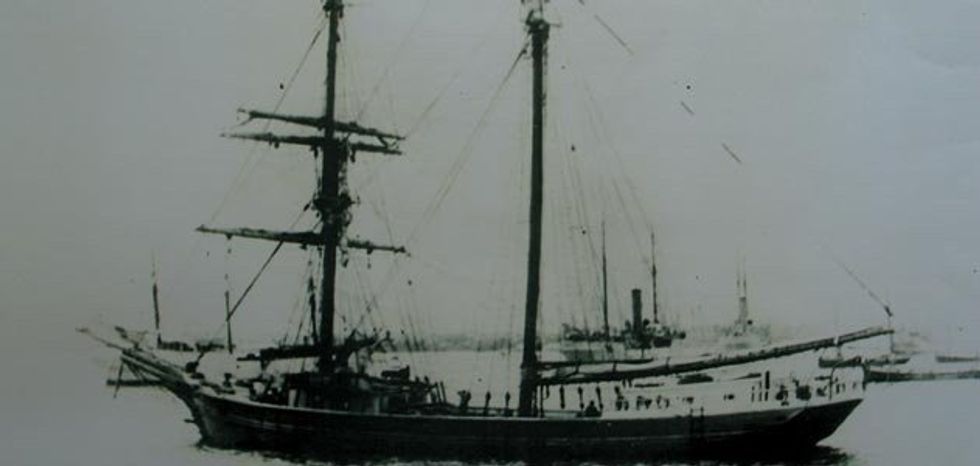
On December 4, 1872, the Nova Scotia freighter, Dei Gratia, was sailing in the North Atlantic when she first encountered the American brigantine, Mary Celeste. The crew of the Dei Gratia watched the Mary Celeste drift aimlessly through the water for hours before finally intercepting her, realizing that something must be terribly wrong after signaling the ship and receiving no answer. They were right to worry.
The captain of the Dei Gratia, David Reed Morehouse, sent three members of his crew in a lifeboat to investigate the Mary Celeste. They found an empty ship – not another soul was onboard. Just as surprising, they couldn’t find signs of damage or any other reason that could have caused an entire crew to abandon ship in the middle of the ocean.
Personal possessions had been left behind, including pipes, photographs, and letters from family. Barrels of alcohol had leaked in the hold of the ship, and in one bunk, the mattress was soaked, and the form of a sleeping child was imprinted in it. The Dei Gratia crew also found the Mary Celeste’s logbook – its last entry was from ten days prior and gave the ship’s position as more than 300 miles west of where the Dei Gratia encountered her. The log itself was completely routine and gave no hints as to how or why the crew had disappeared.
Benjamin Spooner Briggs had just become the captain of the Mary Celeste. His first voyage aboard her was simply to deliver a load of alcohol to Italy and return home to New York. The trip was so standard that Briggs saw no trouble in bringing his family along – his wife, Sarah, and their two-year-old daughter, Sophia. Briggs came from a long line of seafarers and was a respectable, experienced sailor when he took command of the Mary Celeste.
The crew’s disappearance a month after setting sail for Italy caused quite a bit of controversy. New speculation about their fate began showing up in newspapers and magazines on a monthly basis, each more sensational than the last. Many theorized an attack by pirates, mutiny, or insurance fraud by the Mary Celeste’s owners. Even the crew of the Dei Gratia was very nearly arrested for murder.
Perhaps the most well-known theorist over the fate of the Mary Celeste’s crew was a young Arthur Conan Doyle – who would later go on to create the famous detective character, Sherlock Holmes. Conan Doyle’s fictional account of what happened onboard the Mary Celeste to cause the crew’s disappearance was taken by many as fact, and several elements from his story have become quintessential parts of the legend, such as untouched lifeboats and a spool of thread balancing on a table. Others have added on where Conan Doyle left off, and the claim that there was even a hot meal found in the galley has also become well-known.
Ultimately, we will probably never know the true fate of the crew of the Mary Celeste. Regardless, it has been for almost 150 years – and likely will remain so for quite some time to come – one of the greatest maritime mysteries.