
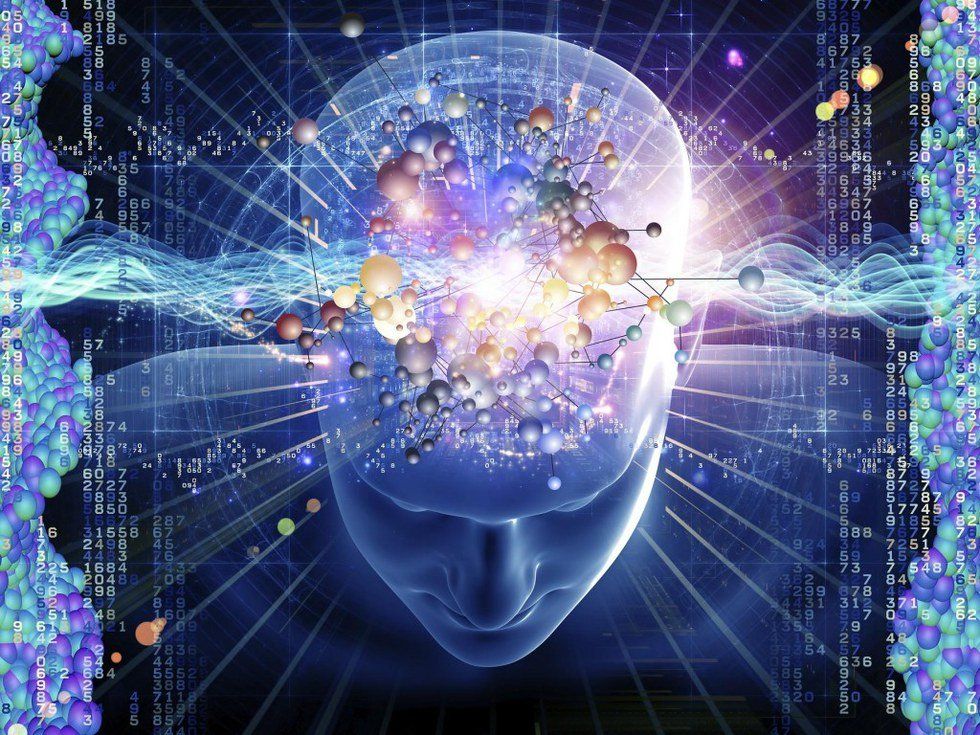
Biocentrism, a theory coined by Robert Lanza M.D, states that biological organisms give rise to reality via consciousness. The laws of quantum mechanics could be the foundation of our internal, conscious, matrix; the universe could be the product of our collective imagination.
In his novel, Biocentrism, Lanza explains that “we wake up and the universe is simply, there”(25). We bring the universe to life, and all life has a very different perspective of reality. For example, with a little genetic engineering, someone who sees a blue sky, can be engineered to see red where they once saw blue; Voila, an adjustment of reality. A schizophrenic, consciously observes imaginary people, and even fathoms harmful situations and conditions. Their altered perception of reality is the byproduct of damaged, biological, hardwiring.
If the universe exists because we consciously bring it to life, where are we, and where is here? What does our world really, look like, and what are we missing? The theory of everything has been sought out by physicists and chemists, under the common belief that life is just the accidental byproduct of the physical tendencies of the universe around us. Biocentrism challenges this paradigm, it suggests that physical laws of the universe, such as time, and space, are nothing but tools; the conscious tools we use to interpret the world around us (Lanza, R. P., and Bob Berman. Biocentrism: How Life and Consciousness Are the Keys to Understanding the True Nature of the Universe)
Natural systems are extremely complex and efficient; nothing goes to waste, and everything has a job. There must be some solid reason why our brains are hardwired to interpret reality in the way that they do. We are blind to the reality undetected by our senses. You would not expect an organism placed in a pitch-black environment to thrive, yet life seems to be sustaining itself well, given its unintentional blindness.
This means that there must be some evolutionary advantage for us in this conscious matrix; what is it protecting us from?
Dr. Donald Hoffman, a cognitive neuroscientist who appeared in the TEDTalk, “Do We See Reality as it Really Is,” confirms that there is an evolutionary advantage to the matrix we may be consciously creating for ourselves.
When we see a glass of water, we do not see the trillions of H20 particles composing the substance, or the glass particles composing the glass. Instead our visual system picks up on a solid glass, housing clear liquid, and that alone, is our reality. Over the course of our lives we learn to associate that liquid with water, which we need to survive. If we had not developed scientific gadgets to further analyze this reality, our perception of the substance would end with “clear liquid.”
Hoffman compares this phenomenon to a laptop desktop. Envision yourself preparing to write a paper for English. You open the laptop, wait for it to load, and then search for the “Word” icon on the desktop. You have learned to associate this icon with the Microsoft word program which will allow you to efficiently write your paper for class. The result is a simple algorithm that ensures your academic survival.
If instead of a Microsoft word icon, you saw the actual coding sequences associated with the software, in addition to the other sequences encoding the other software applications present on the laptop, it would be extremely confusing, and would result in informational overload, and academic failure.
The matrix, if it exists, prevents informational overload.
It provides an easy interface for life to interact with the world we, theoretically, consciously create. Though we know matter is composed of various physical, chemical, and biological components, we are not gifted with biological “X-ray” vision that allows us to see these components with the naked eye; we see a construable image, that can be easily broken down and interpreted with our visual pathway (Hoffman, Donald. "Do We See Reality As It Is?").
As groundbreaking as the theory of Biocentrism may sound, it is not an entirely new concept. Ancient Hindu scriptures pin emphasis on “Ahm Brham Dwistio Nasti;” “I am nothing but the universe.” Hindus believe that within each of us, lies a universe. They were the first to discuss the idea of a conscious matrix; the universe is not outside us, but within us. Professor Richard Bogartz, who teaches a course on consciousness at the University of Massachusetts Amherst, shares a similar belief in the idea that “we are the universe, acting on itself.”
We must explore the eerie, existential wonders that compose our universe; are we the components of some supreme being’s consciousness? Are we all inside someone else’s brain? Are we variables in some controlled experiment, exposed to only a specific subset of senses to interpret our intricate world? The fathomable theories are infinite, and the wise are never so quick to doubt an absurdity, over what they think they know.