

I’ve always found it funny how looking back on the history of technology can bring a sense of superiority and egotism on how much better things are right now. We’ve all been to an older relative’s house and, on some level, felt that their landline telephone or turn dial TV was an indication as to how backwards they were living. Sure, the first car was created in 1886 and the first television in 1925, but purely from an overview of human history…that wasn’t that long ago.
We often hear about the exponential advances in modern technology, but it can be difficult to grasp what that really means. In the grand history of things, we are living in a very…VERY narrow slice. Here is a representation of how long modern societies have existed.
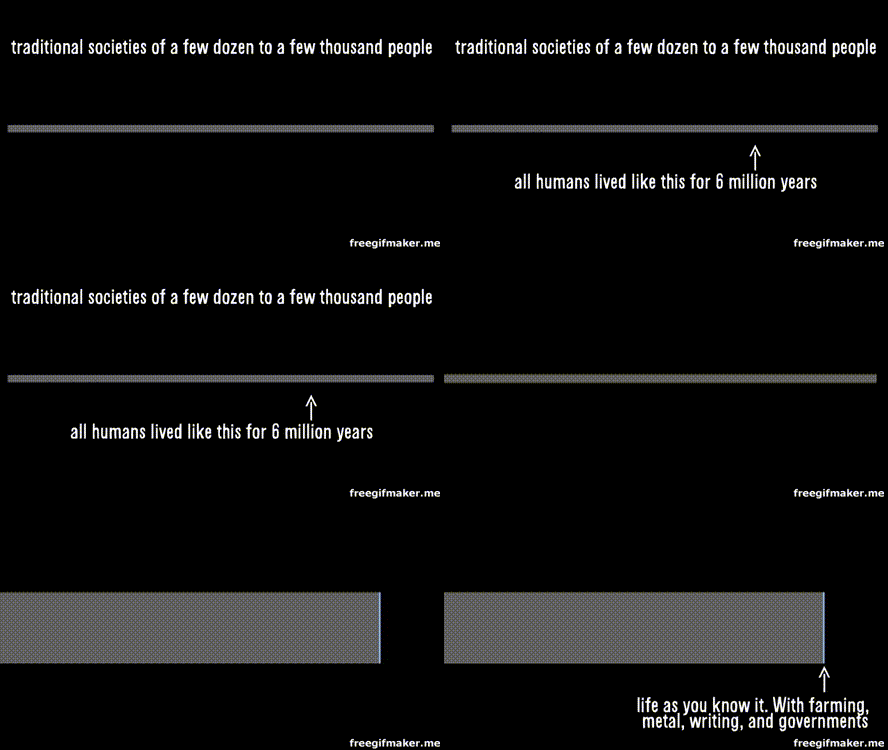
And here is a representation of how long the internet has been around.

As Michael Stevens of the YouTube channel Vsauce put it, “we went from Custer’s last stand to Armstrong’s first steps within the span of a single human life.” There is a generation of people who are turning 60 this year who have lived through the invention of the TV remote, video games, the internet, and of course, Google. And while they couldn’t look up Quizlet answers back in the day, all of us, right now, are living in an era of technological advancement.
But what does that actually mean? Well, to put it simply, we can continue to expect incomprehensibly big strides in technology in the years to come. Three laws come into play when talking about the advances in technology.
The first law is known as Moore’s law, named after Gordon Moore. This law states that the processing power of our computer chips doubles about every 18 months. Back in the early 90’s, processing power was a major concern for many people, since it determined whether or not certain software could run on their computers. However, today, with processors such as Intel’s core series (i3, i5, i7), we can watch movies, type papers, and browse the web all at the same time without having to worry about whether or not our computers can handle running all of those activities. The same holds true with smartphones. In fact, today’s cell phones have more computing power than all of NASA during the 1969 Apollo mission.
The second law is known as Kryder’s law, named after Mark Kryder. This law explains that the storage capacity of devices double about every year. I don’t know about you, but just about seven years ago, I thought that an iPod that had 8Gbs of storage was insane. Now, we have iPhones that are capable of storing 128Gbs of data. That’s a 1,600% increase! In addition to our phones, we also have laptops that can hold 4 Terabytes (4,000Gbs) of data. That’s equivalent to storing 4,000 hours of video, or 68,000 hours of music! That’s a whole lot of Frank Ocean songs.
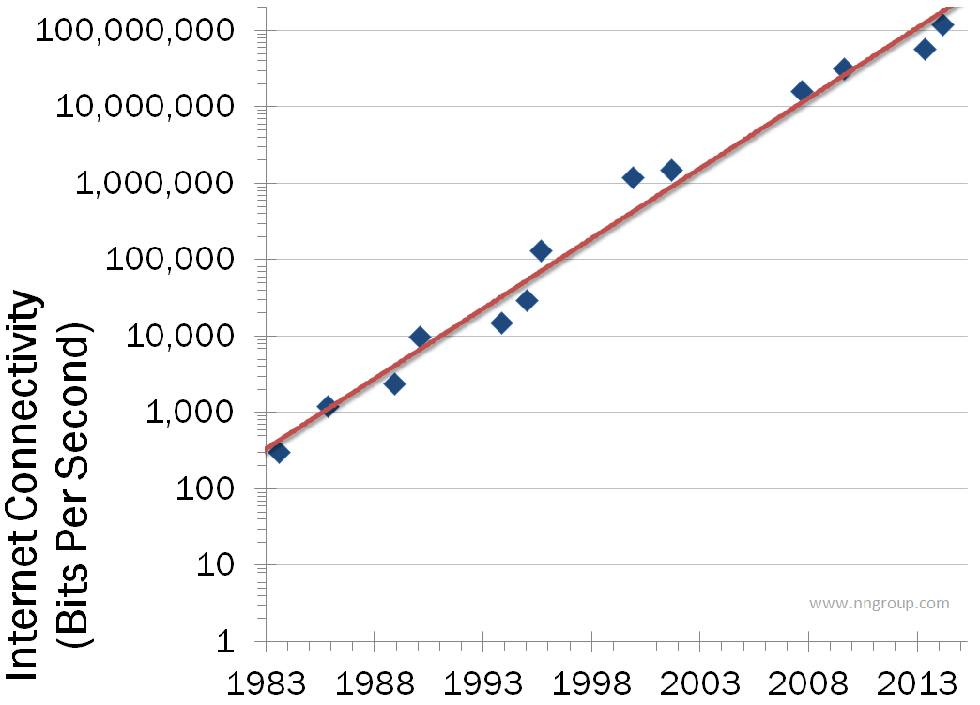
The last law is known as Nielsen’s law, named after Jakob Nielsen. This final law states that bandwidth (internet) speeds double about every 21 months. Two words: Google Fiber. Thanks to the brilliant minds behind Google, certain areas around the world have access to incredibly high internet speeds. To put its speeds into perspective, the average speed in the U.S. is at 11.5 Mbps. Google Fiber? 1,000 Mbps. Speed is without a doubt the future, and with Google Fiber, slow connections will no longer be a worry.
Advances in technology don’t stop there, however. Self-driving cars are roaming the streets, 3D printers are in most schools and business, and the founder of Pokémon GO even stated that he wanted to create augmented reality contacts so that people can actually see Pokémon without having to look at their phones!
The point is simple. We cannot predict what technologies tomorrow will bring. We can, however, understand that the world we live in right now will only continue to get more intricate and complicated. And someday in the distant future, we’ll look back and think of how primitive things were. We might even be a little scared of what more there is to come. The best thing we can do is to embrace this exponential change, seeing as how there really is no stopping it.