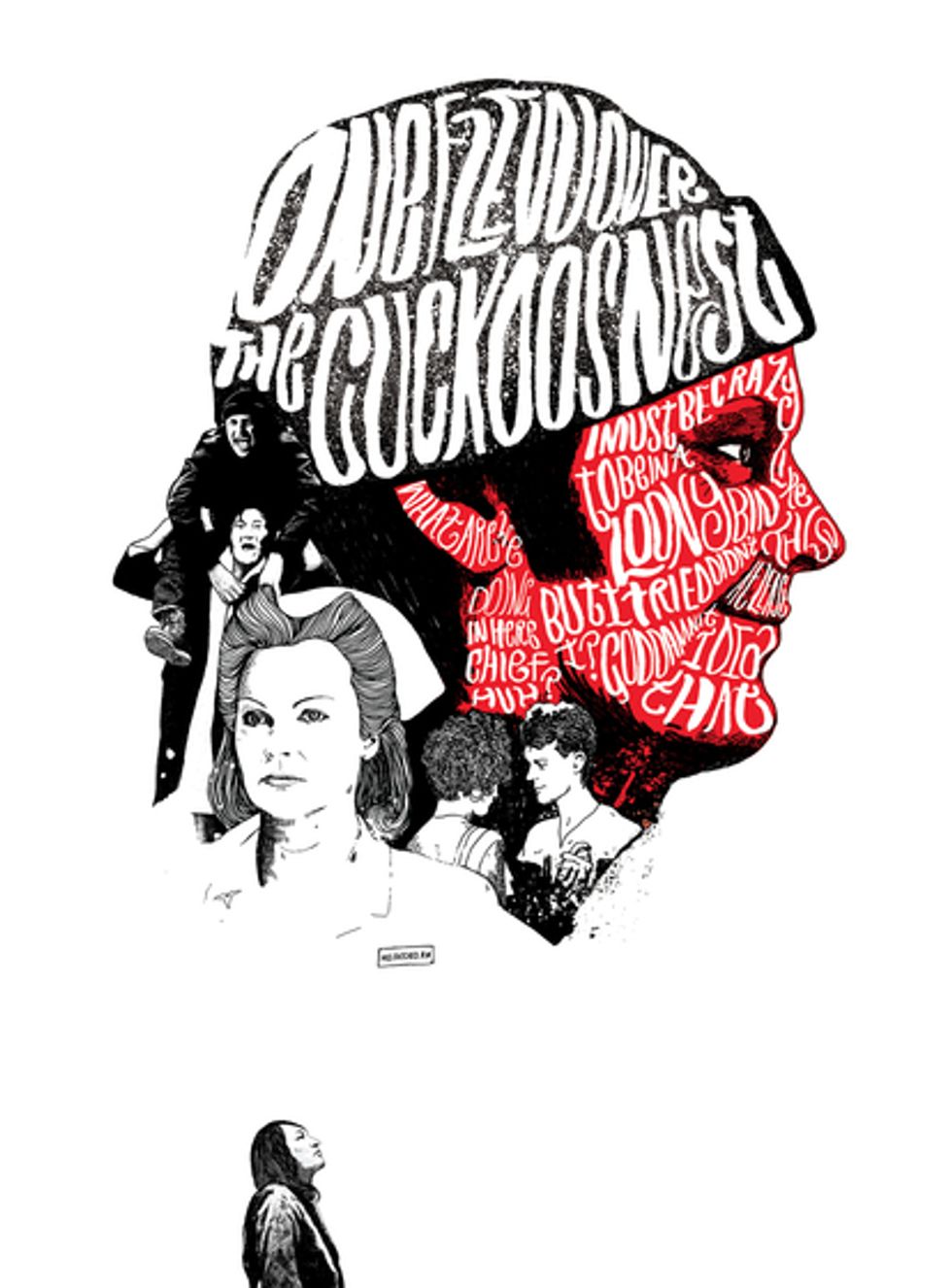
It was no secret that renowned author of One Flew Over the Cuckoo’s Nest, Ken Kesey, held no respect for the 1975 Best Picture and Screenplay film. While retaining many themes and motifs, the film adaptation failed to recognize the major purposes for the novel and supporting details. While it is true that it is quite difficult to bring such a complex, controversial piece of writing to the screen, the movie did maintain many impressive qualities that made it recognized for over three Academy Awards. Although it was a quality stand-alone film, it never accomplished the original goals of the author.
The most recognizable fault in the screenplay was the point of view in which the story is told. In Kesey’s novel, Chief Bromden is the narrator who through hallucinations and conspiracy theories reveals the true character of Nurse Ratched and the inner workings of the mental institution as well as its influence in society. Undergoing substantial changes to become “as big as a damn mountain,” much like his father, Bromden is seen as the hero. Bromden’s position is supported by being told through an internal voice–allowing the reader to experience the mental and emotional development.
Situations that held the deepest, richest symbolism that introduced the ideas of the Fog and Combine, were the hallucinations that Chief experienced. By eliminating Chief’s narration, the film lost the essential reason for the novel–the idea of the Combine. The Combine was a metaphor for the conformity and its detrimental effects on society, making the biggest of men into “rabbits.” The idea of addressing conformity and the loss of originality–as well as the government’s involvement in this, such as the MLKUltra projects–was the sole purpose for which Kesey wrote this novel. He sought to uncover the ugly truth in society that the population is being slowly brainwashed. The films discard for this theme was the central reason as to why Kesey refused to see it.
The movie adaptation-directed by Milos Forman–completely disregards Bromden as the narrator, giving the story a Third Person narrator. This creates for the loss of background for Chief, immense symbolism, and position as the hero–incidentally putting the “bull-goose-looney,” McMurphy in a heroic light (when in reality, he was a catalyst for the growth of Chief).
The discard of Chief’s experiences served to expand McMurphy’s character, which changed substantially in the film. McMurphy takes on a hero role in the film, noticeably expanding on his generous, charitable habits. However, in actuality McMurphy possessed many objectionable characteristics. He is a renowned con-man, frequently scamming the “chronics,” and “acutes,” in the mental institution. He commonly cheated his fellow admittees for financial gain, but in the film he only gambles for cigarettes.
Some detrimental scenes were left out entirely, such as Cheswick’s death in the pool. In the novel, this serves to symbolize the slow destruction of Ratched’s empire and how sacrifices must be made in order for change to occur. Initially, Cheswick served as invigoration and inspiration for McMurphy to “put a bug up Ratched’s ass.” McMurphy begins to straighten out in the novel, conforming to Ratched’s demands, in order to be released from his confinements. At this moment, Cheswick-feeling abandoned by McMurphy–drowns. Following along the lines of removing key scenes pertaining to societal conformity, the disregard for Cheswick’s death further separates the novel from the film.
Although the film fails to interpret the novel accurately, it still retains themes of creative nonconformity, rebellion against autocratic authority, and the degradation of mental institutions. It also keeps up the idea of Nurse Ratched being a “ball cutter,” and the motif of unbalanced gender dominance.
The film is certainly regarded a legendary work, with notable acting, creative adaptation, and substantial ch of the novel was lost to accurately confront mental institutions and sociontent, but it in no regards fulfills the purpose of Ken Kesey’s novel. Too mucetal issues. It can be understood why the author chose to never view it; It did not do justice to the mastermind theories and reasoning behind such an influential work.