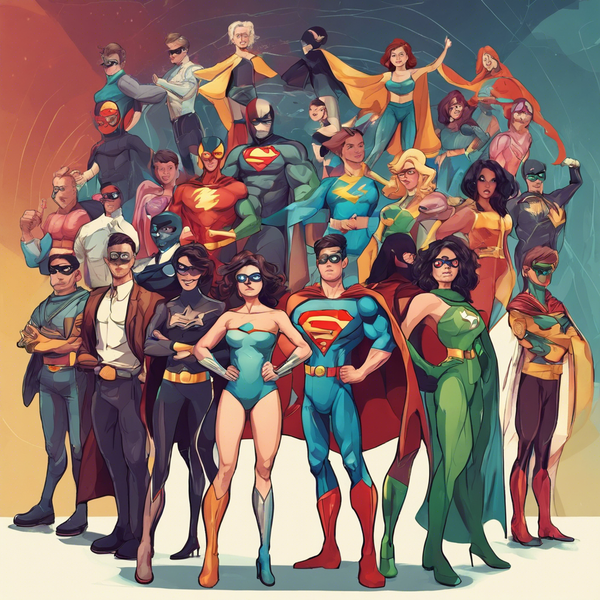

Welcome to Liberty City! Meet the superheroes. This team of inhabitants of Liberty City is seen as almighty because of its members' peculiar powers. You see, these superheroes are in control of the shape of their bodies, which they can twist and crush just like modeling clay. Thanks to this special ability, the superheroes span the entire population. That is, given any inhabitant of liberty city, they can each take the shape of a specific part of the inhabitant's body so that, together, they ultimately form a particular clone of the inhabitant. By this unique property of theirs, these superheroes are adored by the entire population. Indeed, while all inhabitants can also shape their bodies to some extent, none can effectively span every single inhabitant the way the superheroes do.
Meet the radioactives. These renegades of Liberty City live in the undergrounds, hidden from the rest of the world. Their regrettable appearance combined with an intense toxicity compel them to comply with an unbreakable rule: through no combination of their bodies, through twisting and crunching, can they model one of the radioactives. Hopefully, for now, they simply don't have the means to achieve such a combination. If it ever happened that some radioactives combined into another one of their own, the universe would come to an end through terrible suffering and utter misery. The big bang would pale in comparison. You don't want that to happen.
Now that our protagonists have been introduced, it is time for me to tell you a tale about superheroes and radioactives. On one sunny day, a radioactive walked into the superheroes' monthly reunion. Because that's what they do, the superheroes combined their twisted bodies, each embodying a specific region of the radioactive's organism, to form a perfect replication of the visiting radioactive.
More than any other inhabitant of Liberty City, radioactives have always aspired to join the ranks of the superheroes. They believed that the gained prestige would compel ladies to look past their irremediable ugliness and onto their heart, or so they said. As the visiting radioactive looked at the superheroes' combination, he had a brilliant idea.
Here goes: in front of him stood a clone formed by the combination of n parts, where each part resulted from the contribution of one of the superheroes. But then, what if he subtracted all but one of the superheroes' shapes from his own organism? That would result in a combination identical to the shape of the remaining superhero. Think about it this way: if quarters 1, 2, 3 and 4 of an apple can be combined into a whole apple, then every time we want to use quarter 3, we can instead use a combination of the whole apple minus quarters 1, 2 and 4.
Call the superhero whose shape was replicated superzero. Applying this reasoning to our situation, we can see that every time the superheroes would need a shape from superzero, they could instead use a clone formed with the help of the radioactive! Thus, superzero was no longer needed in the ranks of the superheroes, and was promptly replaced by the euphoric radioactive. Because the contribution of superzero could always be taken care of, the spanning property that made the superheroes so powerful was still in place.
The tale of the radioactive's rags to rich story quickly spread across Liberty City, and through the undergrounds. Soon, another ambitious radioactive rang at the superheroes (plus the radioactive member) headquarters. The newcomer radioactive's case was the following: if the current spanning group formed a clone of his appearance, then surely he could combine with all but one of the spanning members to replace one of the superheroes. The newcomer radioactive had gone to Law School. He won the case, and another superhero left the ranks of the spanning group, which now contained two radioactives.
The process went on and on, and radioactives integrated into the spanning group through the exact same logic as above, taking the place of one superhero every time. But lo and behold: Remember the crucial rule of the radioactives? They cannot by all means combine to form one of their own. Such a combination would result in the most atrocious ending humanity could conceive in a concerted effort, worse than the most terrible apocalyptic scenario. No one wants that to happen.
Now, think about it: the process has been going on for a while, until the very last superhero in the team has at last been replaced by a radioactive. Beyond the geopolitical repercussions of being governed by a group of incredibly ugly and toxic individuals, let us focus on the essential: the group remains a spanning team, because we have carefully verified at each step that were a gone superhero's part to be needed, it could certainly be constituted by the members of the current team. But then, the radioactives are no longer unable to mold into one of their own, since their span the entire population. Guess what happens if there is still another radioactive out there, about to walk into the headquarters, eager to be represented by the team of radioactives only? BOOM! No more Liberty City. No more earth and no more Milky Way. The universe would be doomed. Game over. Absolutely no one wants that to happen.
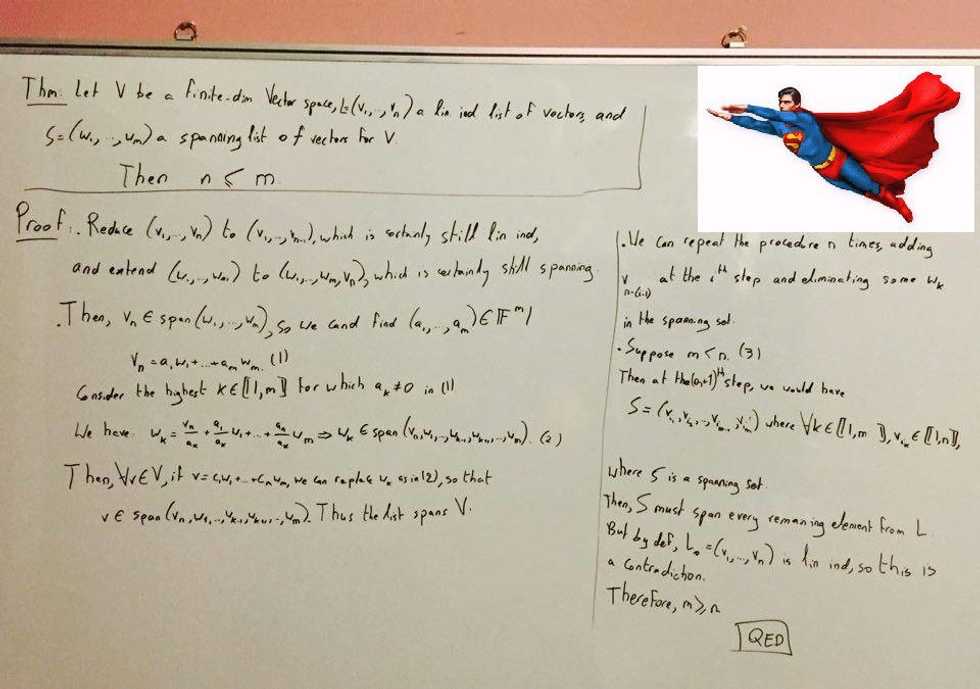
Conclusion: There cannot be more radioactives than there are superheroes in any given city. Although presented in a very conversational way, the result we have demonstrated is an absolutely essential theorem of Linear Algebra, whose proof is known as the "Steinitz Exchange." The theorem links spanning sets of vectors (the superheroes) and linearly independent sets (the radioactives) of any given finite-dimensional vector space (Liberty City), stating that the length of the linearly independent set cannot exceed that of the spanning set. The equality of these two lengths gave rise to the concept of dimensions, with which I believe everyone is familiar.
With this modest attempt to narrate once again the proof of an important theorem, I have in mind the very same motivation: to represent Mathematics in the most accessible of ways, denuded from scary symbols and intricate formulas, in order to flesh out the appealing harmony of Mathematical demonstrations. A Mathematician I admire, Edward Frenkel, often makes the analogy between the Mathematics taught in high school and the knowledge of how to paint a fence. Certainly, few people in their right state of mind would recognize the beauty of art if all they are ever shown is how to paint a fence. I hope that in the light of these occasional articles, I succeed in sketching before you simplified representations of the great artists' paintings.