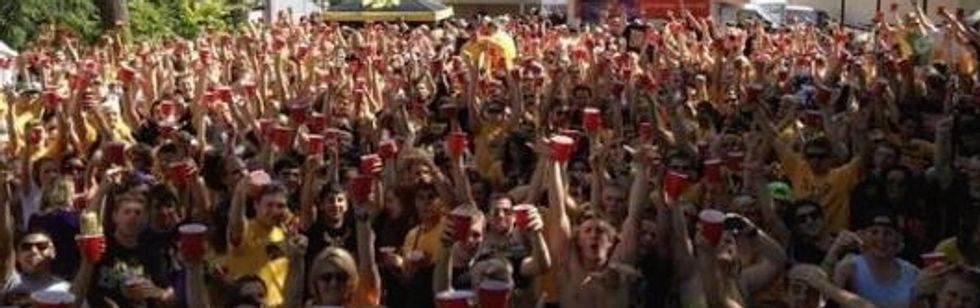
It’s a crisp autumn morning. Brightly colored flags can be seen against the crimson leaves. The aroma of sizzling hot dogs is lightly masking the potent smell of beer. While the chants grow louder with time and alcohol, you can look around and easily justify the otherwise disgusting environment. It’s tailgating season.
It’s officially October and that means one thing. Football season is in full swing and it’s the heart of tailgate season. Whether that means having a small group of people over to eat junk food in your backyard or going all out in face paint and traveling with beer bong in hand, tailgate season has something to offer everyone.
The entire idea of college is based off of tradition. From the formal applications to the tedious homework, everything seems to be on a constant pace. But no college website is going to advertise the long tradition of day drinking to celebrate a football game. While every school has their own spin on tailgating, one thing remains constant; every college student loves a good tailgating party.
No student questions getting up at 8 a.m. to crack a beer, but the moment that this became the social norm is unclear. Who was the first person to think to grill a hot dog out of their trunk or who thought it was a good idea to party outside for hours in the anticipation of a big game? While many of the top teams may be coming to mind, the actual start to this phenomenon is still in debate, but it started before any modern day rivalries started.
Although the exact origin of tailgating is unknown, the first signs of tailgating in history started long before crazed football fandom was in existence. The first theory of the first “tailgate” dates back to the civil war, the Battle of the Bull Run in 1861 to be more specific. Civilians traveled out from Washington D.C. to Manassas, Virginia to watch their soldiers battle while enjoying picnic baskets and beverages from afar. Although the civilians were not on the battlefield, the lack of accuracy of guns in that time period still posed a threat. This practice seems a little more dangerous than today’s parking lot tailgates.
The second theory of how tailgating started is less violent but originates in the same time period. This theory states that tailgating started in 1866 in Texas. A wagon filled with food and the cooking equipment would travel around the state to feed traveling workers and travelers known as cowboys. This wagon quickly got the nickname chuckwagon because the slang term for food at this time was chuck. This was believed to start tailgating because it was the first time anyone thought of bringing food on a road trip for the purpose of cooking it and eating it out of the same vehicle. This theory states that this inspired the tradition of grilling food and eating around open trunks now in modern tailgates.
The start of tailgating used as a football tradition has an even more questionable start than the contents of a red solo cup at a house party. But football tailgates can be said to be traced back to Ivy League, particularly Yale University, football games in the early 20th century. Where parking was scarce so travel by train or bus was common. Students from the opposing school would arrive early to the stadium and bring their own food and drinks to help pass the time. Over time, the home team caught on to this idea as well and would show up to partake in the pregame festivities as well.
These tailgating parties transformed over time and continue to evolve into more extravagant parties. As the tailgating tradition continues, the definition alters from campus to campus. Whether it be wearing your Sunday-best at The Grove cheering on Ole Miss or being an Ohio State student and jumping in a freezing lake when your team plays their rival, every school has their own spin on how to celebrate, arguably, America’s new favorite sport.