


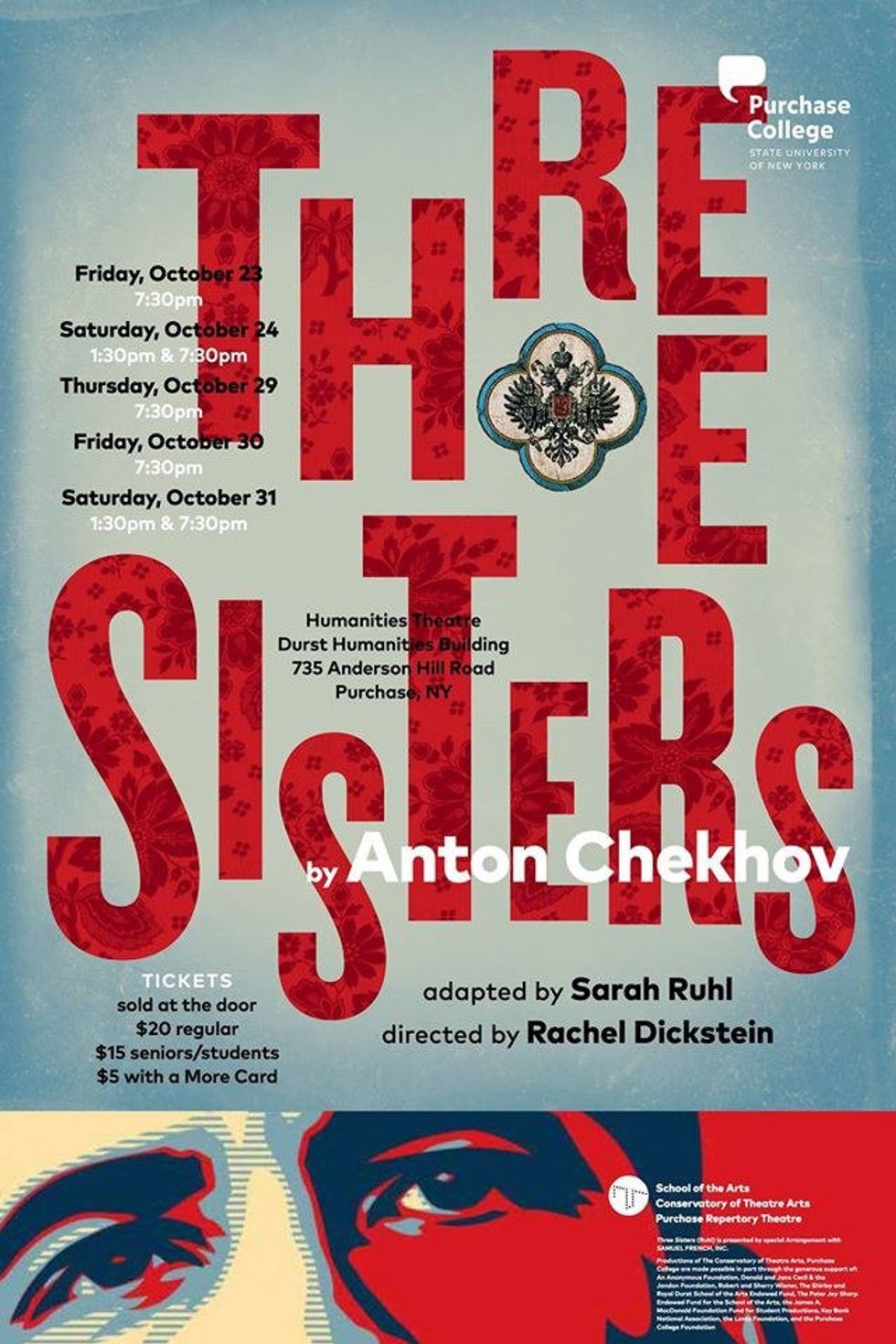
On Friday, October 23rd, SUNY Purchase’s BA Theater and Performance program had their opening night of the mainstage production of “Three Sisters.” This show is the first to be put up in the brand new Humanities Theater and it performed in front of an almost completely full house. Written by Anton Chekhov, “Three Sisters” shows the lives of three women living in Russia one year after the death of their father. These women, and their deflated brother, are left to fend for themselves and dream of a better life in Moscow, which is a dream that grows less and less likely to come true as the play progresses.
Directed by Rachel Dickstein, the SUNY Purchase production of this tragic play was adapted by Sarah Ruhl in 2011. Good thing, too. Since “Three Sisters” is already a depressing play, it is difficult to comprehend how little today’s theatergoers would react if it was any more outdated. Its characters neither develop nor learn from their mistakes throughout all four acts, which is incredibly frustrating. They all have aspirations for a better life, but none have the ability to actually obtain it.
Each character in this play is used to convey the theme of lost hope and isolation, but none of them actually progress themselves. For example, Masha, the middle sister (portrayed by Theater and Performance major Aya Saleh), finds herself caught between the husband she hates and the unhappily married Lieutenant-colonel Vershinin with whom she shares a passionate love. In the end, Masha must stay with her husband when Vershinin (played by senior Theater and Performance major Amine Kassaoui) leaves and displays how true happiness is not attainable; something Vershinin consistently declares throughout the play. The same goes for every other character, none of whom grow themselves, but clearly show the idea of unachievable happiness.
Visually, this show is stunning. Rachel Dickstein’s direction clearly shows the mundane lives these individuals lead. The walls and floors are a dreary grey with dim lighting making the home, and its occupants, exist primarily in the darkness and the shadows both physically and metaphorically. In Act 3, when even more tragedy strikes, the large panels that align upstage, spin to convey the actual physical damage that has been done to the home in which the three sisters live. The scenic choices for this play capture Chekhov’s dismal narrative perfectly. However, the audio, which appears to last the duration of the play through either piano playing or recorded music, is another story. Another way in which theme takes precedence in this play is the fact that melancholy music is played incessantly to show just how sad the events occurring are. The audio even plays during the most dramatic moments of the production, which takes away from the actor’s performances. Themes of depression are displayed even in the scenic and sound aspects of the production. None of this is the fault of the director or performers. There is just not much else to work with in this lacking script.
“Three Sisters” is a play filled with characters with intertwining stories, common aspirations, and complicated love triangles. There is a significant amount of potential in the characters that make up this production, but they have no room to grow and transform with a script that does not allow them to. They exist simply to further the ideas of depression and isolation that make up the plot. Perhaps another show should have been chosen for the mainstage if there was hope to display the actor’s talents. “Three Sisters” is both a disappointing and lacking script. No matter how talented those at the helm are, they cannot make something out of nothing.
















