
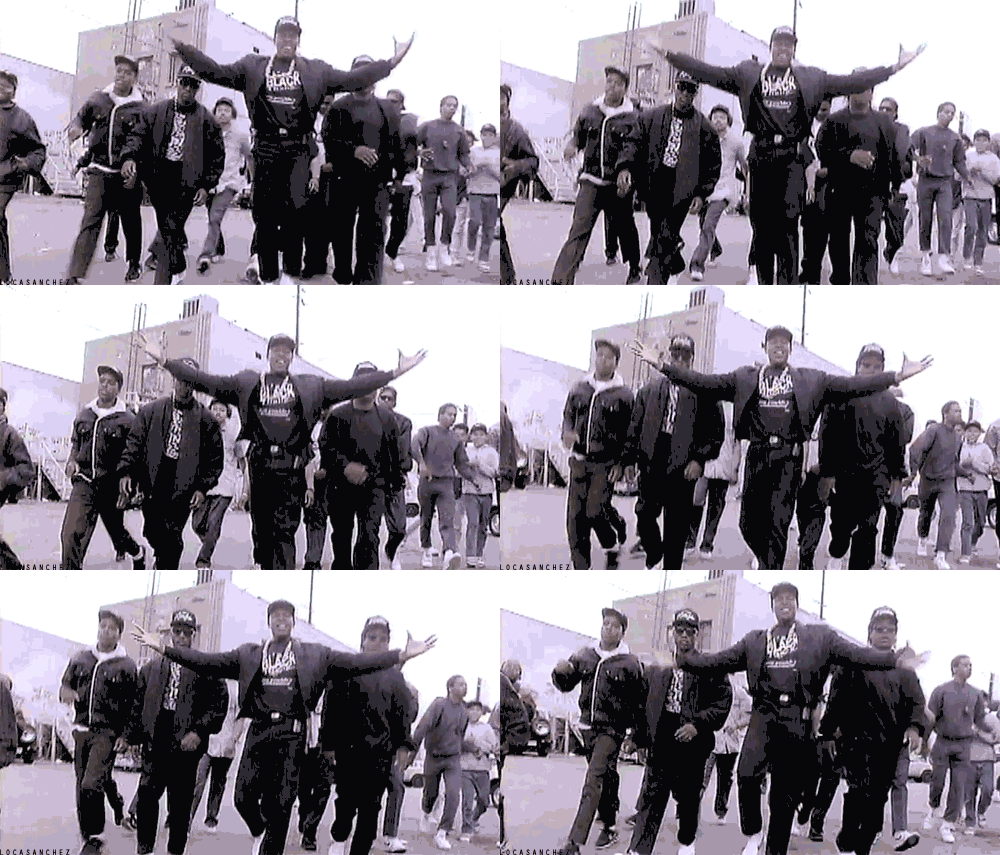
n the second week since its release, "Straight Outta Compton" has, contrary to popular prediction, caused not a single violent incident among its viewers. Instead, the N.W.A. memoir has grossed record box office and captivated audiences from all walks of life with its detailed account of the reign of one of the most influential music groups our country has ever seen.
In its first weekend in theaters, "Straight Outta Compton" brought in about $60 million, more than double the entire cost of the project. That benchmark set a record for an R-rated film released during the month of August. Despite increased police presence at theaters and rumblings of the film's gang-related subject matter, the film brought nothing but long ticket lines and ridiculous box office numbers. As a matter of fact, there wasn't a single officer in the theater during the showing I attended last week.
The first time my friends and I saw the movie's trailer being played during a commercial break on TV, our jaws touched the floor. Being a longstanding devotee to old school hip-hop and early rap, I was especially excited.
"Straight Outta Compton" chronicles the rise, fall and temporary rebirth of N.W.A., the founding fathers of the gangsta rap subsection of the hip-hop music genre (If you want to know what N.W.A. stands for, please Google it or see the movie). The group originated out of Compton, California and included Eazy-E, Dr. Dre, Ice Cube, MC Ren and DJ Yella. Arabian Prince was also part of the original lineup, but left the group before they came to prominence and played a minimal role in the film. The real-life Dr. Dre and Ice Cube even aided in the film's production to ensure all events and accounts were factual.
The depictions of the challenges that N.W.A. encountered on their way to fame were quite moving. They were famous for what they called "reality rap," music that they wrote about their real-life experiences growing up in the hoods of Los Angeles and the surrounding area. They were the first real group to ever write songs about topics such as gangs, guns and drugs. But as the first group to ever break this barrier, they were met with much opposition as they swept the nation into condoning their music's alleged glorification of gangs, disrespect to women and vilification of law enforcement, among other touchy subjects. Their music was censored entirely from American radios and they gave birth to the "Parental Advisory: Explicit Content" label still slapped on sensitive music albums today.

As one scene during the move depicts, the group was even denied police security during performances that included "F*** Tha Police," one of their most widely acclaimed hits, as part of the track listing. Faced with a firestorm, Ice Cube put it best in the film when reporters asked about their lyrics at a press conference: "Our art is a reflection of our reality." Despite their questionable lyrics, N.W.A. took the nation by storm and made their voices heard through their music, a platform which they used to enact peaceful protest.
As the movie progresses through the golden years of N.W.A., challenges within the group start to come to light. As they continue on their path of great fame and success, money begins to play a greater part in the group dynamic. Early rumblings about royalty disputes within the record label eventually culminate in Ice Cube's departure from the group in 1989 and subsequent pursuit of a solo career. Immediately after, Ice Cube and his former posse exchanged a few diss tracks aimed at one another in regards to the hard feelings that surrounded his departure from the group.
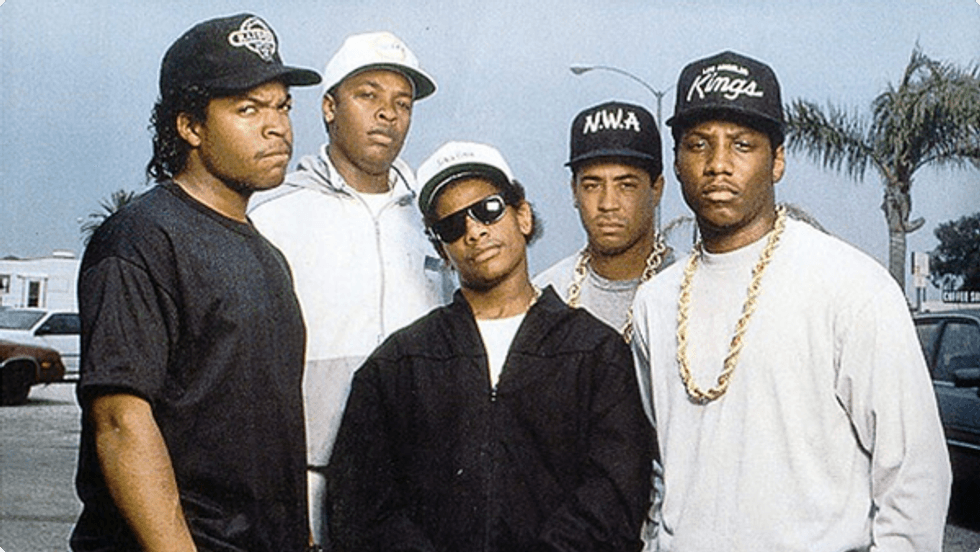
Furthermore, N.W.A. disbanded altogether in 1991 after more massive contract disputes prompted Dr. Dre to sign with Suge Knight's Death Row Records. Bad blood ensued between Dre and Eazy-E which included dozens of disses over the next few years. All the while, Dre got to work with some of the best artists in hip-hop history in Tupac and Snoop Dogg.
Over time, though, tensions eased, and the group talked about resuming their career together. One scene toward the end of the movie even shows Cube and E together in the club making up for lost time and discussing a potential revival of N.W.A. However, the movement never materializes. In easily the toughest sequence of the movie to watch, E falls ill just as the group reconciles for the first time and ends up in the hospital, only to be diagnosed with AIDS and told he can be kept "comfortable" for up to six months. A month after his diagnosis, he passed away, and with his passing, came the final diffusion of any outstanding bitterness between members of N.W.A. It was the hardest movie scene of any movie I've watched in recent memory.
Of course, the flick also included plenty of lighter moments, too. My favorite scene depicted the initial studio recording of one of my favorite old school hip hop songs and N.W.A.'s first classic hit, "Boyz-n-the-Hood." It was Eazy E's first ever appearance on the mic, and he couldn't hit the beat to save his life at first. But once he got the first line down, I encountered an attack of flashbacks in the theater. I thought back to about 2001 or 2002 when I had first heard the song, and it had become the only song I wanted to listen to for the rest of my life. I even pledged to myself that I would one day "cruise down the street" in my very own "six-fo" once I grew old enough to get my license and own a car.
Being a fanboy of old school hip hop, I found the film's soundtrack to be nothing short of remarkable. It featured some of my all-time favorites like Craig Mack's "Flava in Ya Ear," Tupac's "Hail Mary" and "California Love," and the Wu-Tang Clan's "C.R.E.A.M." In addition, N.W.A. hits like "Express Yourself," the aforementioned "Boyz-n-the-Hood," and the originally titled track "Straight Outta Compton" also made the movie's cut.
Aside from the hip-hop history lessons, "Straight Outta Compton" truly tells an amazing story about a few young men with a dream of making their way out of the hood through their expressive music. During their active years, N.W.A. had the country swept off its feet with their breakthrough style of new music bringing attention to the atrocities of ghetto America.
Though their reign was met with much opposition and scrutiny, Eazy-E and Ice Cube said it themselves, "All publicity is good publicity." By that logic, publicity changed the game of hip-hop music forever, and this monumental music revolution is now depicted from start to finish in a thrilling and captivating film. Viewers unfamiliar with the landscape of hip hop's origins may have trouble understanding the full plot scale of this movie, but the content certainly shouldn't deter avid moviegoers just because they don't like rap music. If you have a pulse, go see this movie, and prepare to be moved.

















