


“Steven Universe? Isn’t that, like, for kids?”
That's when I knew I made a mistake. Small talk has never been my strong point, and I especially find it hard to answer deeply personal inquiries, such as, "What's your favorite TV show?"
The worst part is I can’t defend myself because in short, yes, “Steven Universe” is, on a basic level, for kids. That isn’t a wrong assumption. “Steven Universe” is a mostly kid-friendly cartoon about the magical “Crystal Gems,” a group of mysterious super heroes, and their efforts to defend the Earth while trying to move past an incredibly dark past involving a violent genocidal rebellion, totalitarian authority, and the traumatic disappearance of the mother of the half-gem, half-human protagonist, Steven.
The problem is that having children as part of the target audience creates a stigma that the media is inherently “immature.” It’s easy to mistake simplicity for shallowness, but "Steven Universe" is neither of those things.
Steven and the Crystal Gems’ backstories are gradually fleshed out throughout the series, and as of season three, the overarching story becomes clearer every episode. It’s so simple and organic, and that’s what makes it so captivating and dramatic.
“Steven Universe” symbolizes a step forward into creating a different reaction. It displays an astonishing amount of emotional depth, complexity and mature characterization that is not only tastefully handled, but also captivating for audiences of all ages. “Steven Universe” is a positive force in animated media, on the forefront of representation, providing a breath of fresh air in the medium that is animation. Several contemporary animated series’ follow similar beats, such as “Over the Garden Wall” and 2003’s “Teen Titans” which both contain plot-heavy story arcs and a thought-provoking motif that can be enjoyed by any demographic.
But yet, people can’t seem to take any of it seriously. Because for every “Steven Universe” or “Gravity Falls” we get, a hundred “Pickle and Peanut” or “Sanjay and Craigs” rise to prove skeptics right. The problem is, animation can captivate such a wide spectrum of people, but the “normal” thing are these low-budget, surface-level stories with fart jokes. It’s not a perfect situation for the animation industry, but this is the current state of animation.
And its situations like these where Steven’s dad would proudly proclaim, “If every pork chop were perfect, we wouldn’t have hot dogs.”
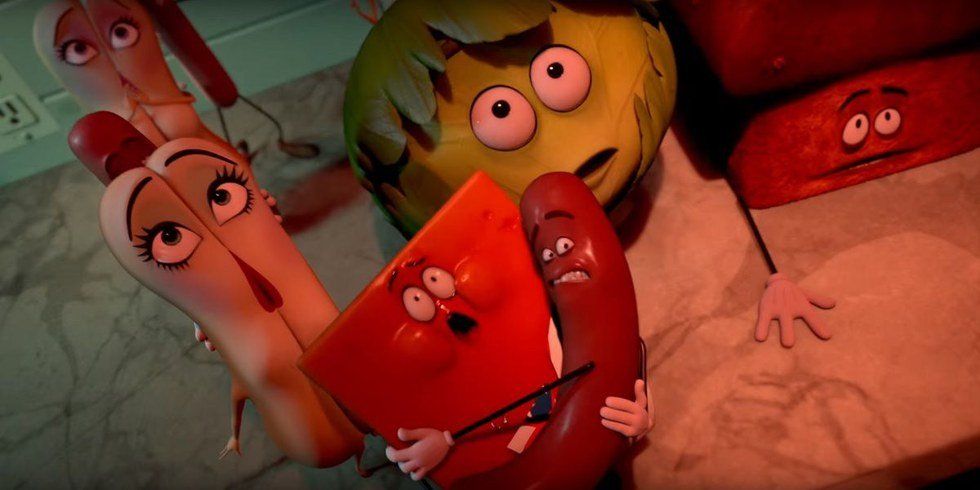
In a strangely literal case, the imperfect “pork chop” that is mainstream animation has been violently processed and mutilated into Seth Rogen’s newest project, “Sausage Party,” one of the first mainstream R-rated animated feature films. Channeling Pixar’s specialty of breathing life into seemingly inanimate objects, “Sausage Party” illustrates the absolute horror that would come with the hypothetical life of food.
“Sausage Party” is crude, excessive, over-the-top adultery, and unfortunately, it might be what the animation industry needs.
The problem with mainstream audiences is that it’s clearly not enough for an animated feature to be thematically complex to be taken seriously in mainstream media. Even iconic Disney movies are dismissed as guilty pleasures, or ironic enjoyment for college kids to indulge upon. So for an animated feature to be taken seriously in this day and age, Rogen and Co. had to bring all of the guns to the table.
Instead of gradually bringing in one specific trait, such as adult humor, controversial subject matter or adaptive language which might legitimize animation as a medium, “Sausage Party” bets all of its adult tokens and shoves it into one raunchy mess.
On top of all the blatant sex jokes, over-the-top explicit dialogue and hyperrealistic violence, the narrative of “Sausage Party’” tackles heavy topics such as the folly of religion, and even tapping into the Israel-Palestine conflict as a side story. In any other movie, this would be a mess, but “Sausage Party” does everything it has to to be taken seriously as legitimate adult entertainment. There is absolutely no denying that whatever “Sausage Party” is doing is working. "Sausage Party" is holding its own, being certified fresh on Rotten Tomatoes and earning $33 million on its opening weekend.
It’s horrifically ambitious, but “Sausage Party’s” very nature is to get attention. Rogen and Co. worked for 10 years to ensure the movie would be received as legitimate entertainment. And with successes with unconventionally R-Rated movies like “Deadpool” on the rise, this is a perfect opportunity for “Sausage Party” to have its time in the sun.
It’s definitely not what one would expect to be on the forefront of mainstream animation, and to be fair, “Sausage Party” does feature a “diverse” cast with numerous cultures and identities “represented” (and by represented, I mean ridiculed and stereotyped to death). While it isn’t on par with the social progressiveness of the likes of “Steven Universe” or “Gravity Falls,” “Sausage Party” is innovative in its ability to start the conversation of animation as a medium.
I wish we didn’t need “Sausage Party” to happen, but now that it did, I hope the industry takes advantage of this incredible step in the right direction for animation as a whole. It’s breaking down barriers that have otherwise hindered the art form, and if it takes one problematic to revitalize the art form, it might be worth it.

















