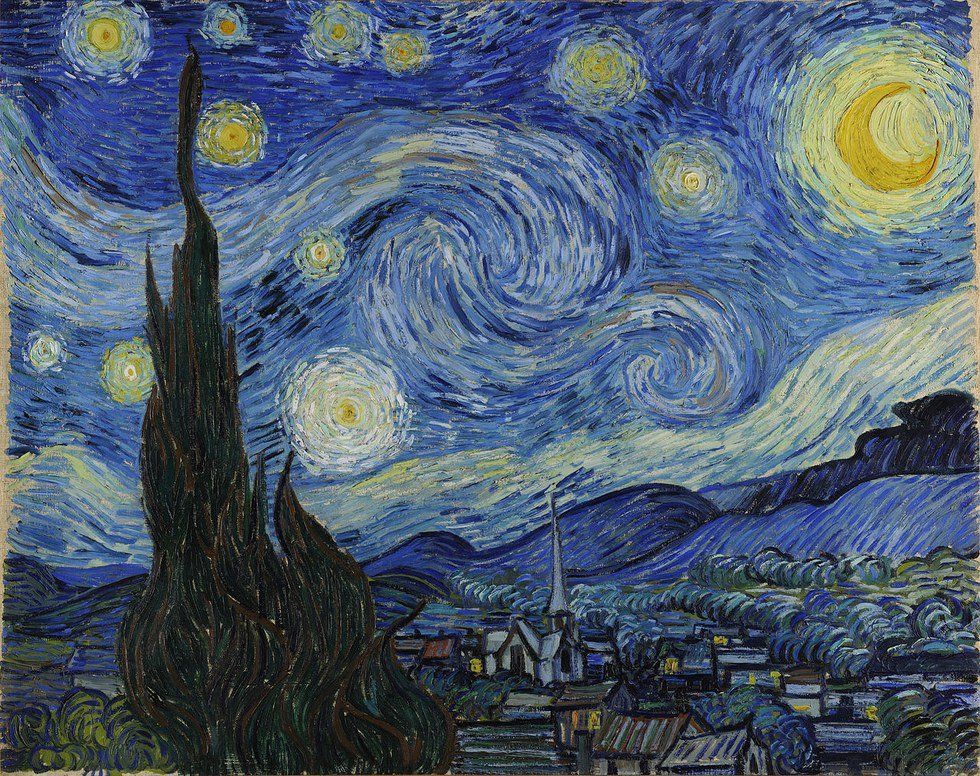
Vincent Van Gogh, Johann Sebastian Bach, and King David. Those three famous figures are from very different times and had quite dissimilar callings for their lives. One was an artist born in the Netherlands, another was a composer grew up in Germany and lastly a king in ancient Israel. However, these past weeks, they simultaneously captured my attention from my conversations with friends and family, and readings about their life and their own personal writings.
As many of us know, Vincent Van Gogh is well known for his very expensive paintings that are being widely appreciated by his enthusiasts and taught to the students of arts through many art-history textbooks. However, he was not a well-known artist until recently and certainly not in his days. Records indicate that he had sold only one piece of art throughout his lifetime and he was not received well even by his fellow contemporary artists. He suffered from unfortunate circumstances, including poverty, mental illnesses and failed relationships with a woman. He took his own life at the age of 39, overcome by the suffering of depression.
Although some of his works seem to be commonly visible around bookstores and museums, people who profoundly understand the passionate meaning of his works are rarely seen. In fact, some professional artists and art critics confess that they mistook and even underestimated the intentions and character of Vincent Van Gogh and his paintings until they read the letters he wrote to his brother Theo. Inevitably poor as Vincent was, it has been known that his brother Theo occasionally helped Vincent with provisions and money. Unlike Vincent, Theo was an art dealer, someone who sells and collects artworks, instead of creating their own work of art. However, in his letters, Vincent often chimed and persuaded his brother to renounce the job of merchant and find his vocation in painting. Vincent Van Gogh was a devout Christian who followed God who speaks through the Scripture. His letters to Theo illuminates how many of his paintings were inspired by the themes in the Bible such as salvation, love, grace and mercy. Most certainly, he was driven to live passionately the life that is set upon him by God. It seems that he took the commandments of Jesus very seriously, one of which is to “love your neighbors as yourself.” He was known by his acquaintances that he strictly disciplined himself, which I can tell from his writings to his brother after a recovery from pain; “the fault is not from the circumstances or other people but from within myself.” Theo, his brother, was often astonished by Vincent’s love for others and wrote to their sister saying, “Through him I came into contact with many painters who held him in high regard…Moreover, his heart is so big that he is constantly trying to do things for others. So much the worse for all those who cannot or will not understand him.” Other people around him thought of him as weird and he was hospitalized due to his mental illnesses, but his response to them was an “affinity with the world around him.” His quotes say, “I put my heart and my soul into my work, and have lost my mind in the process,” and “The best way to know God is to love many things.” There has been some underestimation regarding his work because of the wrong impression about the sufferings and illnesses in general. His journey towards God had times that were not pretty or normal in the eyes of other people, but it was, perhaps, that he considered our “present sufferings not worth comparing with the glory that will be revealed in us.”(Romans 8:18) One of the famous hits by Don Mclean, Starry Starry Night(Vincent), says, “Now, I understand, what you tried to say to me and how you suffered for your sanity and how you tried to set them free, they would not listen, they did not know how, perhaps they'll listen now.” While listening to this song, it hit me and broke my little skepticism about Van Gogh.
Yesterday, one of my friends brought up Johann Sebastian Bach as a person who was not recognized in his time but now dispassionately acclaimed. According to Wikipedia, J.S. Bach lived in the mid-17th century but his music started to receive attention only in the 19th century when Felix Mendelssohn, collected the manuscripts of his compositions and performed one of his sacred oratorio, “St. Matthew Passion.” Some stories say that the manuscripts of his music were used in the markets to cover the food until Mendelssohn discovered them. His music was forgotten for almost 200 years because of the emergent “gallant” style that avoided complexity incurred by polyphony. Bach’s compositional style is based on counterpoint, which frequently makes use of multiple melodies going together to form a harmony. So, some of his contemporaries even criticized his music for being too complicated and deemed Bach to be just a very skillful organist in the church. Many musicians still think of Bach’s music difficult to perform. In fact, however, music historians says Bach’s legacy was continued throughout the 200 years of seemingly apparent ignore by the society. However, some connoisseurs, especially Van Swieten, an Austrian official who brought some of Bach’s music to Vienna, gave opportunity for Mozart and Haydn to be inspired by him. Mozart owned a piece of Bach’s Motet, and Haydn, the Mass in B-minor and the Well-tempered Clavier. Beethoven, who would continue the lineage of Bach after Mozart and Haydn, practiced piano with Bach’s music and acclaimed that he was the progenitor of harmony. The seemingly lost works of Bach was, in fact, remembered and was being furnished by the later composers.
After final exams, five of my friends and I went to a beach house and hung out for few days. I had to leave early to go to the airport so I stayed at Chapel Hill, which is one of my friend’s grandparents’ house was. So, two of us went to Chapel Hill leaving behind the rest in Oak Island. At night, I got to play organ for the first time and walked around the house with the instruction of my friend. And there was a poster on the wall, which said, “Bach gave us God’s word, Mozart gave us God’s laughter and Beethoven gave us God’s fire. God gave us music that we may pray without words.” It seemed such a beautiful thing back then, but now I’m more convinced about the statement on that poster.
Lastly, David from the Bible was a king of Israel and is also widely known by the story of his victory against Goliath. But, as a boy, he was a shepherd and the youngest son of his household. As a shepherd, I heard, he would not only tend the sheep and practice shooting the sling, but also, he watched the wonder of the world and praise in thanksgiving. He also wrote many psalms that were in some perspective joyful but at another glance quite sorrowful. He earnestly reveals his pains and struggles with the broken world in front of God:
“My soul clings to the dust;
give me life according to your word!
26 When I told of my ways, you answered me;
teach me your statutes!
27 Make me understand the way of your precepts,
and I will meditate on your wondrous works.
28 My soul melts away for sorrow;
strengthen me according to your word!
29 Put false ways far from me
and graciously teach me your law!
30 I have chosen the way of faithfulness;
I set your rules before me.
31 I cling to your testimonies, O Lord;
let me not be put to shame!
32 I will run in the way of your commandments
when you enlarge my heart!
(Psalm 119: 32-35)
I think, those three people, Van Gogh, Bach and David, in their toughest times, sought after someone who is worthy of our trust and found comfort in His arms. For me, reading the Scripture opened my eyes to see the challenges and God correspondingly gave me strength and comfort to overcome fears. One of the weaknesses I have is oversensitivity to my feelings and presumptive fears in social situations. Until I read the Bible, I often rationalized these tendencies and as the result, my personality hopelessly grew judgmental. However, God spoke through Scripture to heal me and taught me what to fear:
“You shall seek those who contend with you,
but you shall not find them;
those who war against you
shall be as nothing at all.
13 For I, the Lord your God,
hold your right hand;
it is I who say to you, “Fear not,
I am the one who helps you.”
14 Fear not, you worm Jacob,
you men of Israel!
I am the one who helps you, declares the Lord;
your Redeemer is the Holy One of Israel.”(Isaiah 41:12-14)