Well, it’s here. It’s fitting, too. It feels like every movie ever made on the scale from good to admirable is getting a remake. How can you not leave out Star Wars?
The prequels, to many, were very unnecessary. Not to put all the blame on George Lucas, though, which many have. It’s very difficult to make prequels because of this: you tell people what they already know. And in a trilogy like Star Wars, there isn’t much background information to reveal. In fact, the biggest plot twist both in the original series and all time was based on backstory. I think that how much weight was given to said backstory is the reason why many thought the prequels would succeed, being that they’re predicated on it. However, when you’re watching those films, each plot point moves toward what you already know. It’s like trying to enjoy watching a sports game when you already know the final score.
But The Force Awakens is different. It starts off right where Return of the Jedi ends, an ending that, though not perfectly executed, seemed all tied up, so much so that the continuation of the saga was not by continuing after Jedi in sequels but instead through unconventional prequels. And what was there to continue? Darth Vader and the Emperor are killed, the Empire is quelled, and the rebels won. The remainder of the Empire probably had to pay some serious reparations, though it was the rebels that destroyed the probably trillion dollar Death Star not once but twice. There would probably be some uprisings but none more worse than a galactic equivalent of the Whiskey Rebellion.
However, that is not what happened. The Force Awakens, taking place 31 years after Return of the Jedi, has a new evil in town and that’s The New Order, led by Kylo Ren (Adam Driver) with his trademark Aardvark mask. The New Order, similar to the Empire, has flipped its role. It used to be the commanding force, the rulers of the galaxy. Now it’s an uprising, one that is fighting against the rulers. And the Rebels are now the Resistance. Sounds like a good time.
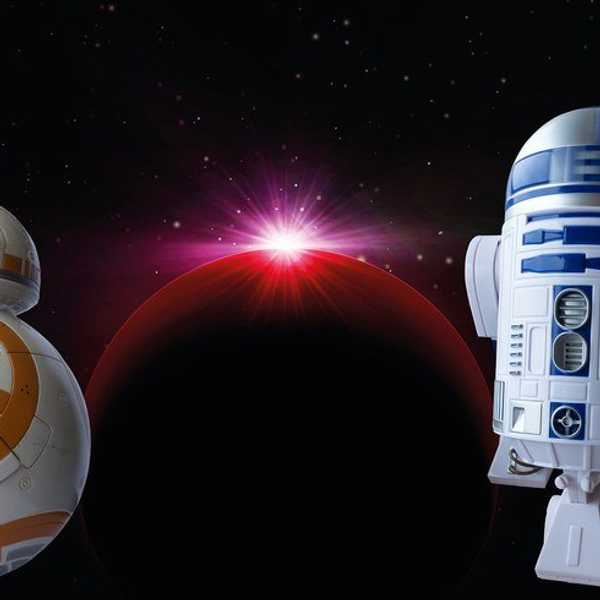
The film starts on Jakku, a desert-filled planet bearing some similarities to Tatooine. Before his village is ravaged by Kylo Ren and the New Order, Poe Dameron (Oscar Isaac) is given the map (essentially on a flash drive) to the whereabouts of the absent Luke Skywalker (Mark Hamill). He is requested to give the map to the leaders of the Resistance; he hides the “flash drive” in BB-8, the “R2-D2 ball” seen in the trailers.
This objective, though often passed forth between characters, is, for the most part, the objective of the film. It gave me such delight, too. A common rule to storytelling is that the character wants something, as Kurt Vonnegut says, “even if it’s a glass of water”. To have such battle ensue because of a map inside a cute little droid, I found a very bare bones, Indie Spirit to the former half of the film, one that is so small yet happening on such a large scale. It was a simple plot point but its implications were enormous. There was no galaxy about to be vaporized; it was just getting a map moved.
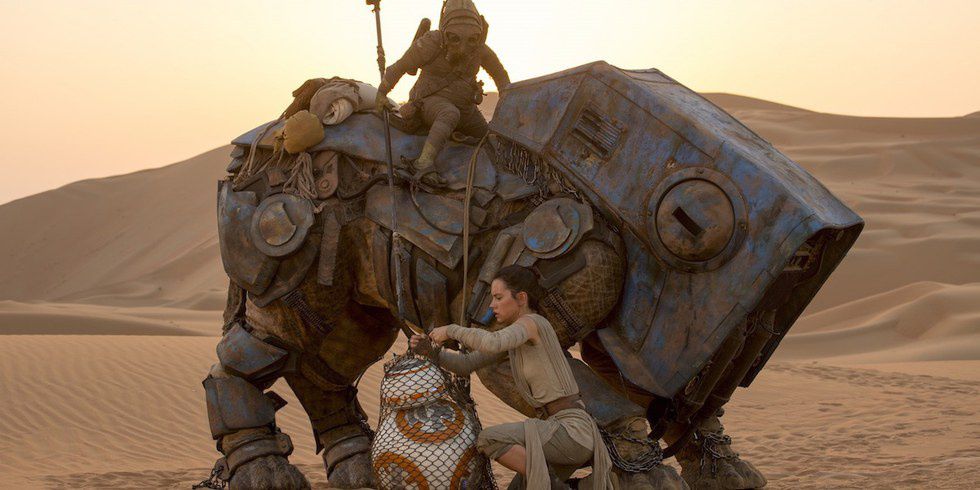
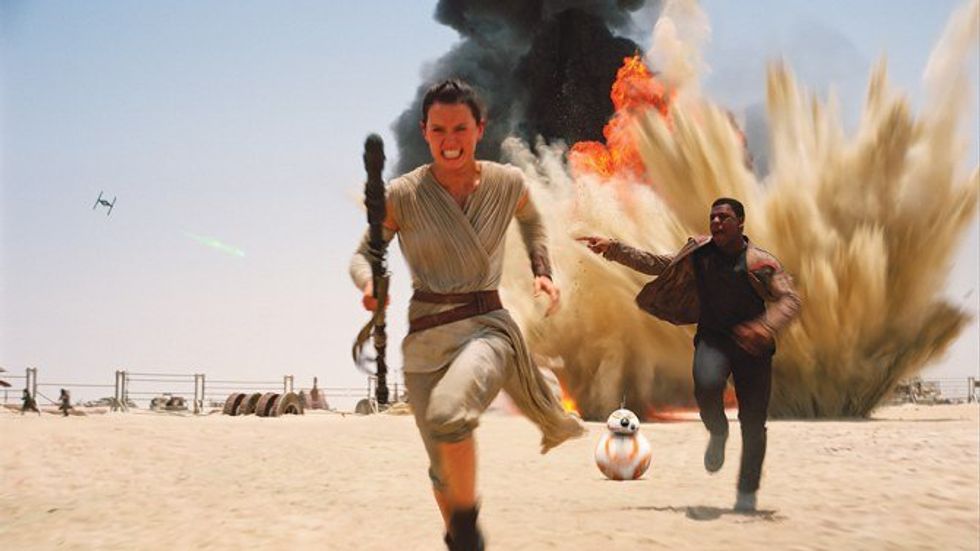
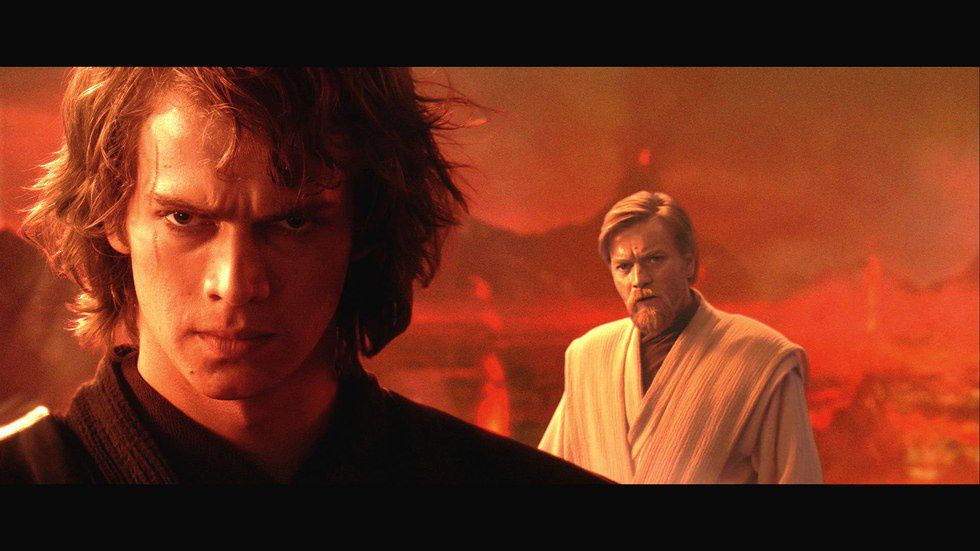
Along with Poe Dameron and BB-8, two other new characters emerge: Finn (John Boyega), a rebellious storm trooper looking for a way home, and Rey (Daisy Ridley), a poor Jakku native who eagerly joins the Resistance. These characters are one of the best parts of the film, a new face to the old franchise. They have their own motivations while still keeping with the plans of the aging Resistance. And boy, do they hit it off. In the first act, Boyega and Ridley have a better platonic chemistry than Hayden Christensen and Natalie Portman had in the entire prequels as, you know, the parents of Luke and Leia!
There are familiar faces, though, especially Han Solo (Harrison Ford), who, to some, can be considered a main characters based on how much screen time he has. He plays as a nice compliment to Rey and Finn, an older character we already know who has his common differences and similarities as the younger ones.
Another new face helps the film, too, and that new face is Director J.J. Abrams. His steady and stylistic yet humanistic direction keeps the film fresh at all times, even when the script lacks, and the action sequences left me grinning several times. He won’t be directing Episodes VII and IV, the honor for Episode VII (at least) will go to Rian Johnson, but this performance can serve as a useful model as what is to come.
Another plus to the film is Kylo Ren. Though at first he seems like a Darth Vader wannabe, you can tell toward the end of the film that something’s up with him. He’s not Darth Vader, no. He’s...he’s...vulnerable. Behind the mask is a vulnerable, scared man but with so much power. He’s a fascinating character in the film, one that brings a three-dimensionality to the villain that has never been too common in Blockbuster Cinema.
The Force Awakens, however, is not without its flaws. One protruding is the script, sometimes clunkier than the again Millenium Falcon, especially in the Second Act. Something constantly goes wrong; even the Falcon’s maintenance problems are seen as as rushed of a problem as some of the film’s more important moments. The viewer often can’t take a breath. Though it seems like a good thing, to have such a fast-paced film that is predicated on transitioning and exposition has its flaws, often dumping that exposition in small, saturated bits. One was even cringeworthy as well. When Han Solo, Rey, and Finn go to Captain Phasma (Gwendoline Christine) in the second act to receive help, she says “first there was the Sith. Then there was the Empire. Now there’s the New Order.” Why is she telling us this? This is something we already know! Something that she already knows! And come on. In the history of your Galaxy, there had to be some evil power before the Sith. That’s like Tom Hanks in Saving Private Ryan going “first there was World War II. Then there was the Korean War. Now there’s the Vietnam War.” Sorry, Tom, but you forgot a whole bunch of wars before that, too. Clearly if Phasma said the fictional dark powers before the Sith the audience member would be confused, but this line of dialogue, you can tell, is from a script, not from a galaxy far far away.
The film is also clunky and saturated in its humor. Often times, especially in the beginning of the Second Act, there would be a string of jokes in a short time span, often done far between. These jokes, too, are way too much. Yes, they are funny. The humor is more witty, more observational. It’s definitely better than the silliness that was Jar Jar Binks in The Phantom Menace. I couldn’t laugh at the jokes, though, without being reminded of Marvel’s trademark humor.What made the original trilogy so mystical was its originality, its otherworldliness. This film, at times, seemed no different from The Avengers. Though the humor isn’t too great, it is used more effectively than Marvel ever uses it, which is basically all the time. In a climactic scene in The Age of Ultron, Quicksilver is shot. Merely seconds after, he makes a joke to his sister Scarlet Witch before dying. The Force Awakens at least knows what comic relief is: a relief from the serious plot, not a concurrent power.
Though The Force Awakens does bear some similarities to Marvel films, the biggest film it actually resembles is A New Hope. There are some huge mirroring forces in it. Rey’s character, growing up on a planet almost exactly like Luke’s fits Skywalker’s main character archetype. Han Solo is the wiser mentor, the Obi-Wan Kenobi of the film. And the film kind of starts the same as well with a message in a droid needing to be given to the good guys. The biggest similarity, though, is the Third Act. There are two big storylines leading up to and including the climax and they almost identical to A New Hope.
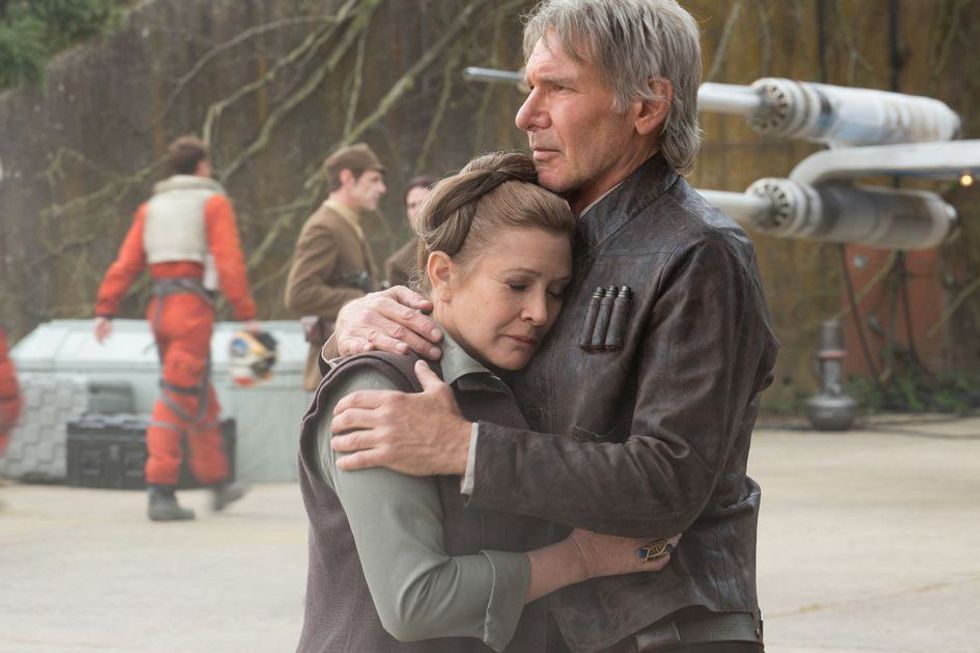
It’s not awfully similar, though. I doubt anyone walked out of that theater and said “that was A New Hope.” And, in a way, the similarities are a good tool because the ending leaves you with a sense for seeking, one that can leave the viewer with the feeling that uncharted territory will be trekked in the newer episodes.
One big part of The Force Awakens that seems lost, though, is it’s theme, or lack thereof. The film excels from its priority on story and characters, developing them gradually, but there seems to be something missing from it. One of the greatest features of the original film is the Force, something that can’t be seen but more believed, drawing allusions to God and the Holy Spirit. Though the force is seen in this film, it’s mostly a given. Han Solo confirms to Rey and Finn early on that “there is the force” and then they use it. Though there were small themes throughout, I saw no overarching theme to really teach us anything new. It may be a factor to the later films, but, if it is, I wished it was introduced here.
My biggest complaint, one that might even be quelled by Episode VIII, is the justification for continuing the saga. Every time anew film comes out, Star Wars becomes a little less sacred. Back in the 80s and 90s, Star Wars’ biggest advantage over Star Trek was its sacredness. Star Trek was littered with TV shows and movies (still is) while Star Wars was just a trilogy with a beginning, middle, and end and that was it. Then the prequels came and the legacy was lightly tarnished; the only way to get it back was to ignore its existence, which many did. Now the story will continue and don’t forget the spinoffs coming up including but certainly limited to Rogue One. I could feel a value in the theater, one from the viewers showing that this does not happen often. Unfortunately, I feel like, in ten years, people will start to grow tired of Star Wars. Their excitement will turn into mild interest.
So I ask why the continuation of this series is justified. What will be added that’s new, never seen before? The Force Awakens did not offer too much beyond its characters and there was no unique theme--no theme at all actually--that will have the audience leaving the theater having changed. This first film excels, in a way, to its getting back to basics, to cracking open the dusty lightsaber and have one more crack at it. It’s refreshing but it will only be for so long.
These complaints I make are brief, most I can look over. The Force Awakens is a good step forward for the franchise, one that meets its expectations and, at times, exceeds them.