
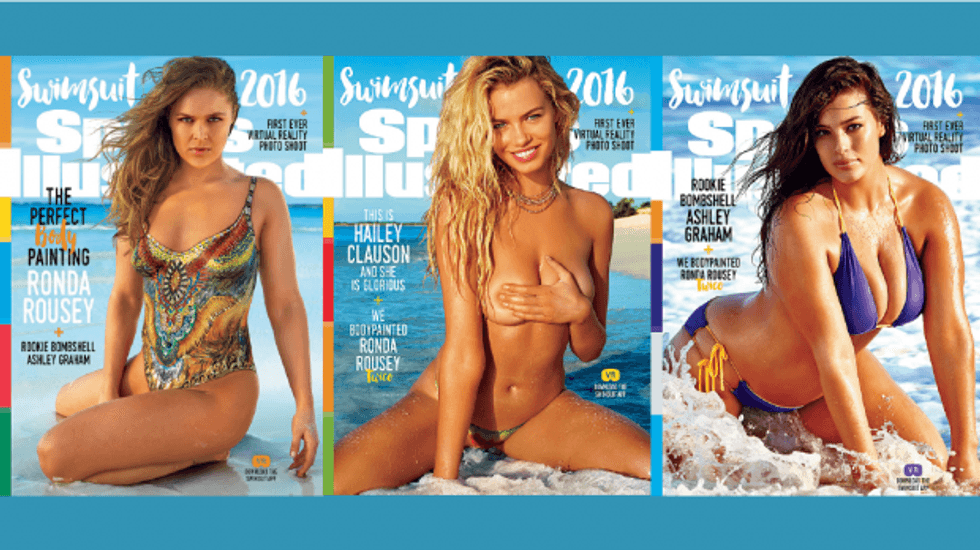
Over this past week, history was made with the "Sports Illustrated" Swimsuit Issue placing Ashley Graham on one of the three published covers. Ashley Graham is a beautiful and confident young woman who happens to be a little larger than the common runway model. Nonetheless, Graham is still categorized as a “plus-size” model to the public. Overall, there are two popularized opinions on this issue, and I’m here to explain them.
The first opinion applauds the "Sports Illustrated" publishers for finally displaying a plus-size model on the front cover, something that hasn’t been done in the 50 years that the magazine has been issuing this edition. Many body-image activists claim that this is at last breaking the boundaries of what should truly be defined as beauty. Now, every woman who has ever thought that she did not have a beautiful body due to her size can gain the strength to take on the world in a more confident manner. With these three varying covers, one of Hailey Clauson, Ashley Graham, and Ultimate Fighting Championship winner Ronda Rousey, beauty is presented in all forms; something that isn’t purely defined by how skinny one is. Nevertheless, the majority of popular human-interest magazines flying off of shelves today are the ones that display extremely thin women, an action that pigeon-holes beauty into one specific, and in many cases dangerous, size. This side of the spectrum commends "Sports Illustrated" for these progressive strides in promoting the inspiring ideology to young girls (and older women too) to love themselves and their bodies for what they truly are because that’s where the natural beauty lies.

The second opinion falls on the opposite side of the spectrum; one that criticizes the entire "Sports Illustrated" Swimsuit Edition. Firstly, the swimsuit edition is extremely derogatory toward women because, for the most part, men will be buying and browsing through these issues from a sexist standpoint. In a sense, the edition is more like a beautiful display of women to appeal to the male gaze. Secondly, supporters of this opinion claim that the overall hype of placing and labeling a woman as “plus-size” on a cover is beyond demeaning. It deepens the divide between being skinny and being “plus”-skinny. Essentially, Graham isn’t portrayed as just a beautiful model, she’s presented as a striking model that’s also plus-size. Advocators of this position ask the reasoning behind labeling a woman plus-size as if it is an alien trait. In fact, the average woman in America is a size 14. So what is truly the norm? If we continue to place titles of beauty under those who are thin, then are we claiming that the average-sized woman in America is unattractive? This side of the issue believes that the term should be taken away from the entire vocabulary of fashion.

Whichever opinion you choose, this magazine cover will definitely provoke talk. Beauty has long been associated with the appearance of women, and the perception of beauty has altered throughout history. Yet, until the long-awaited day comes when women are no longer defined by their beauty and the pressure of living up to society’s norms is no more, we will unfortunately continue to be bombarded with the cultural messages of what the “real” standard of beauty is; something that in many cases is unattainable and flawed.

















