
During the final decade of the apartheid era, the South African government researched disturbing chemical and biological weapons under the codename “Project Coast.” The architect of this program, Dr. Wouter Basson, conducted some of the most bizarre experiments under the apartheid name. Basson was ultimately found guilty of misconduct in 2013, and the aftershocks of his program are still felt today.
For those not familiar with the history of South Africa, the country was ruled under a system known as apartheid for over 50 years. The primary objective of apartheid was to insure white minority rule in the country, while treating native Africans as second-class citizens, and denying them the most basic human rights. Even for those familiar with the apartheid system, many of it’s most grotesque secrets remain untold. One little known operation was Project Coast: the apartheid regime’s covert chemical and biological weapons project.
Have Your Voice Heard: Become an Odyssey Creator
Project Coast was supported by the highest ranking government members, with Prime Minister P.W. Botha giving the program his blessing. The primary objective of the program was to brutally silence even the smallest whisper of internal opposition to white minority rule. To do this, government affiliates synthesized a myriad of crowd control agents in bulk, such as tear gas. In 1985 alone, more than 20 tons of tear gas were produced by one quasi-government agency alone. Alongside these traditional sedatives, toxic agents such as botulism, VX, sarin and cyanide were also synthesized. Other horrifying, but lesser known, features included a sterilization program designed for black South Africans and the milking of mambas for their lethal venom.
The History of 'Project Coast'
The primary architect of Project Coast, Dr. Wouter Basson, rose to precedence in early 1981. Basson was ordered to investigate the chemical and biological weapons programs of the West by the regime. With his extensive knowledge of chemistry and expertise in human anatomy, Basson was the ideal candidate for commanding a program with such heinous intentions. In order to operate under maximum secrecy, Basson established a number of private front companies. The establishment of these companies acted as a way for the government to distance itself from increasing international sanctions and work under ideal clandestine conditions. According to the United Nations report on Project Coast, Basson was allegedly involved in another secret apartheid program code-named “Barnacle.” Under Barnacle, Basson planned to assassinate enemies of the apartheid state, targeting high-profile dissidents such as Nelson Mandela. Basson planned to deliver Mandela a substance which would give him cancer thus incapacitating from him rebellion.
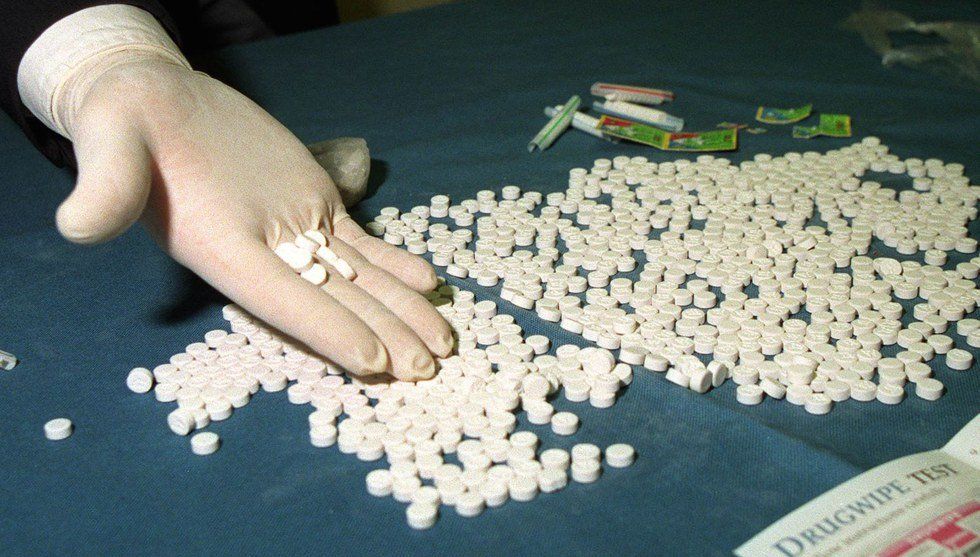
Perhaps Project Coast’s most bizarre and long lasting feature was the industrial grade synthesis of psychoactive drugs like methaqualone (known as Mandrax in South Africa) and MDMA (the main psychoactive compound in Ecstasy). Methaqualone may sound familiar, it was Jordan Belfort’s drug of choice in The Wolf of Wall Street, known as the Quaalude. Due to a government ban, America’s Quaalude craze was silenced in the early 1970s. On the contrary, Quaaludes have remained a popular recreational drug in South Africa.
According to the United Nations, one ton of methaqualone and one ton of MDMA were synthesized by Basson’s front company. Mandrax’s properties are similar to those of a traditional muscle relaxant and sedative, although it would not act as an efficient crowd control agent like tear gas. The regime produced 3.5 million capsules of Mandrax, roughly enough to dose everyone who lives in Cape Town, South Africa. Since the drug was produced under private ownership, there is no way to know if the capsules were leaked into the black market supply. However, some experts on Project Coast, such as Marlene Burger, argue that only the government could have disseminated a quantity this large. If one subscribes to this theory, it is completely valid to hold the apartheid regime accountable for South Africa’s current Mandrax addiction.
Sedatives, Secrecy and Seafood
Despite Project Coast ending in 1989, South Africa is still living through its unintended aftershocks. In his documentary The Story of the South African Quaalude, scientific journalist Hamilton Morris connects the illegal Mandrax trade to the poaching of an endangered shellfish called the abalone, which is a rare delicacy in countries like China. The poached abalone is then sold to Chinese buyers, who eagerly provide the carcinogenic precursors to continue the cycle of Mandrax production. The cycle of international poaching and the drug trade go hand in hand, just like the money exchanged from the Mandrax addict to the Mandrax dealer.
Ultimately, Project Coast is one of the darkest and most forgotten moments in the history of apartheid. The programs intended, as well as unintended results, have plunged South Africa into a spiraling public health crisis with no end insight. Instead of the Basson and the apartheid government, Chinese suppliers and South African poachers have become the new face of Mandrax production and distribution.