

“Now somewhere in America there is a child holding a copy of ‘Catcher in the Rye’ and there is a child holding a gun. But only one of these things have been banned by their state government and, it’s not the one that can rip through flesh, it’s the one that says “‘F’ You” on more pages than one”- “Somewhere in America”
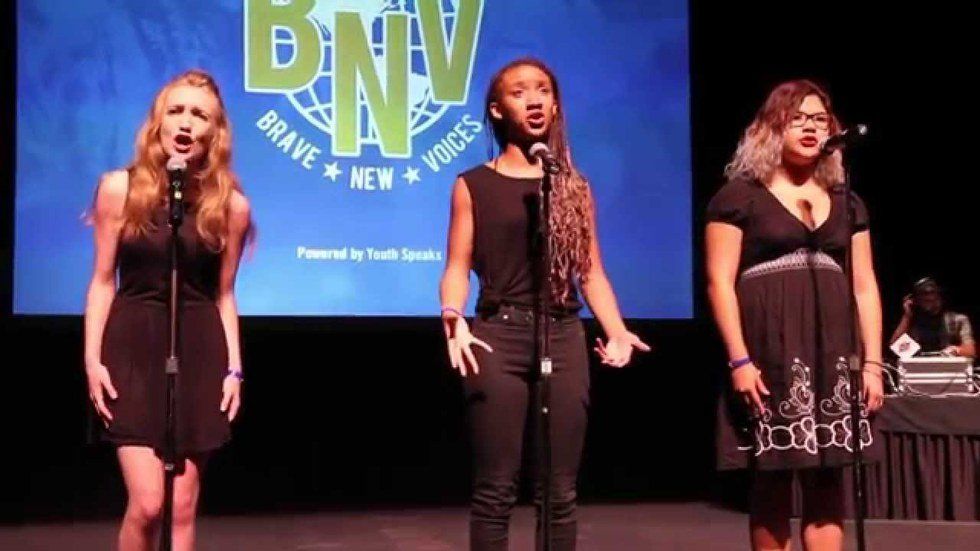
"Powerful,” “bold,” and “beautiful,” are a few words that have been used to describe this video. Three young women: Belissa Escobedo, Rhiannon McGavin, and Zariya Allen (members of the organization, Get Lit) performed, “Somewhere in America,” on national television. The poem won third place "Brave New Voices" back in 2014. It's recently gone viral.
Contradicting the American government seems to be the sole reason everyone has been reposting this video on every form of social media. Facebook feeds off conformity and, for some reason, reposting a popular video or changing your profile picture shows your innermost support. We need to look at these words a little more closely, and, if you then support these notions, please continue to share the video. The three girls argue that we learn more from the outside world than we do in school, because the American education system censors students’ voices.
This poem succeeded in highlighting realities that may not be discussed in certain curriculums. For that, I applaud their bravery. To appear on national television discussing controversial issues such as gun control, poverty, and homophobia not only demonstrate confidence, but courage. As Queen Latifah said, “[the] three young women [are] determined to change the world, one word at a time.” They may have had a strong objective, although there’s slight criticism regarding their execution.
The latter portion of this poem seems to touch upon more current issues. Luckily, many of us have not experienced these atrocious events. However, these girls seem to acknowledge the underlying problems at hand. They address inner beauty, widespread poverty, and sexual assault--despite their way of going about it. The girls argue that there’s much more to strive for than perfect attendance and academic excellence. That may be true, but that does not mean education isn’t important, especially at a young age.
At what level is censorship considered okay? Censorship seems justified when protecting children from violence, sex, or racism. On the other hand, in a public forum, everyone cringes at the idea they are not allowed to speak their mind. Certain television networks ban words such as “damn” or “hell.” Specific words that are considered taboo cannot be said on national television. Most of this is understandable, because many argue that media exposes us to unimaginable stories. This too holds true in a classroom setting. Teachers are advised not to discuss controversial issues, but this is not because they are trying to censor our voices. Rather, most complaints come from parents--not within the educational system.
The girls have a strong beginning and a powerful close. The middle of the poem, however, makes me question their education. I’m not sure what schools these girls attended, but teachers do allow you to express your opinion to an extent. It's even encouraged in many cases. In the past year, my course load included discussions about “Catcher in the Rye” and Japanese internment camps (which was not discussed for the girls). Maybe that’s simply due to my liberal arts-orientated curriculum. Many instructors have banned J.D. Salinger’s novel due to its vulgarity, violence, and depiction of sex--but in most cases, they don’t include the book due to parents’ disapproval.
Since when do schools “shout out your body fat percentage in class?” Fitness classes exist to determine whether you’re in the healthy range for your age. This test is an expanded version of your typical physical doctor’s visit, not to diminish a student’s self-confidence--especially when instructors keep this information confidential.
The lines, “The preppy kids go thrift shopping ‘cause they think it sounds real fun/But we don’t cause that’s all we got money for,” are quite a generalization. A nice car or an expensive piece of jewelry does not necessarily indicate one’s wealth.
We have to sympathize with these girls, because, viewers can conclude they have experienced at least some of the noted injustices. This is not to say we shouldn’t talk about them. These girls argue that censorship should not exist in the classroom. If this holds true, then students should not ask their Harvard Law professors to exempt Rape Law from their curriculum. One professor wrote an essay entitled, “I’m a Liberal Professor, and My Liberal Students Terrify Me.” This one speaks for itself.
In an attempt to argue that we learn more from living in the real world than within the walls of a classroom, they seem to degrade our educational system. They claim that this same system prevents freedom of speech, demonstrates hypocrisy, and that the teacher is always right. The rules inside a school are to ensure the best education for everyone--not to criticize a student’s views. These teenagers condemn the educational system because instructors have specific guidelines and ways of teaching.
This system tends to exempt controversial issues from their curriculum in order to avoid religious and political conflicts. If we say that we should refrain from censorship in secondary education, then these same liberals should not advocate for censorship in universities.
















