
Figure skating is a beautiful sport, a breathtaking balance of artistry, athleticism, and danger. The balance between artistry and athleticism, however, is tipped unevenly in favor of daring acts of athleticism. In the figure skating world, the athleticism of quad jumps distracts the judges, blinding them to the skills of artistic skaters. As there are two edges on a figure skating blade, these two aspects must be balanced to be at all effective. The artistry of this sport is being dismissed in favor of more athletic aspects, such as quads, and to ensure that every aspect is balanced in judging figure skaters, there must be a fairer judging protocol that prohibits the favoring of one aspect over another.
The importance of athleticism is highly debated in the area of competitive figure skating, whether it should be considered more or less important than the artistic aspect when skaters are choreographing their program. These issues cause conflict and unrest among the skaters competing and can lead to unnecessary rivalries. Skaters who rely more on athleticism are “accused of being robotic and rehearsed” (Schwarz 2008) while those who prefer the artistry are sometime seen as a “distraction.” (Schwarz 2008) These aspects are not balanced as they should be in the judgement process, especially since the dawn of quadruple jumps. Because of the intense fixation on these jumps, “the quad has become so routine in elite men's skating that the athletes are finding new ways to make such jumps seem revolutionary.” (Hersh 2016) Skaters are unofficially required to do jumps of higher difficulty if they ever hope to compete at the highest level, ignoring the skater’s artistic abilities almost entirely.
In order to understand the immense difficulty of a quadruple jump, it is crucial to understand the different kinds of jumps in the sport of figure skating. The use of different edges is critical whenever a skater attempts a jump. There are two edges on a figure skating blade, pictured below, an inside edge.
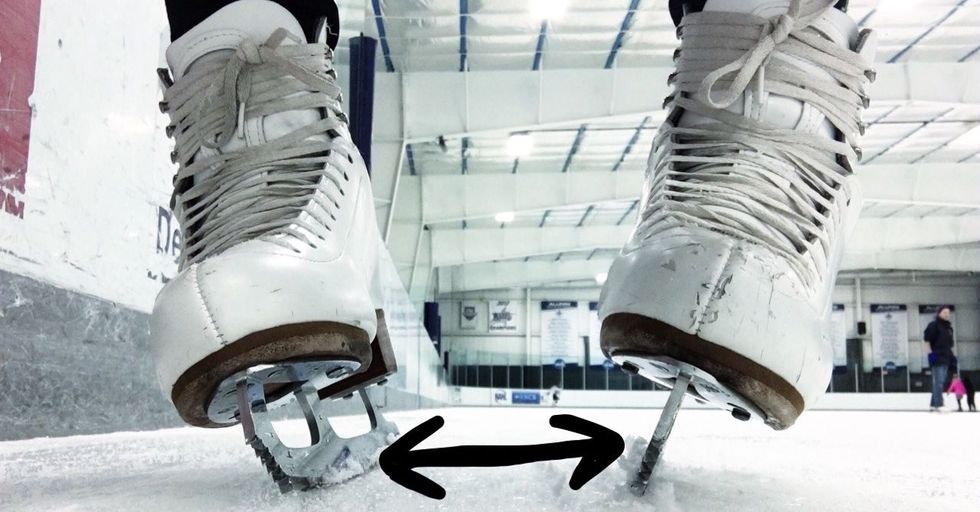
Pictured below, an outside edge.
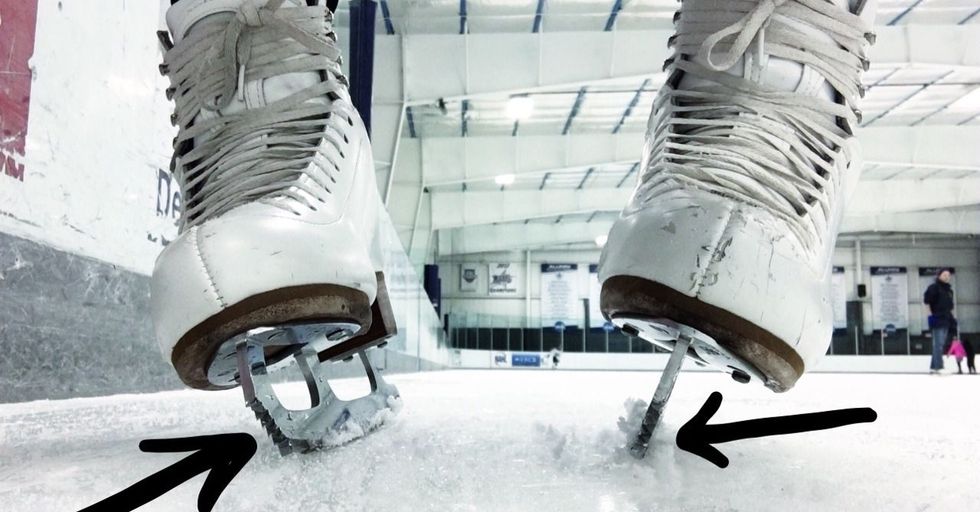
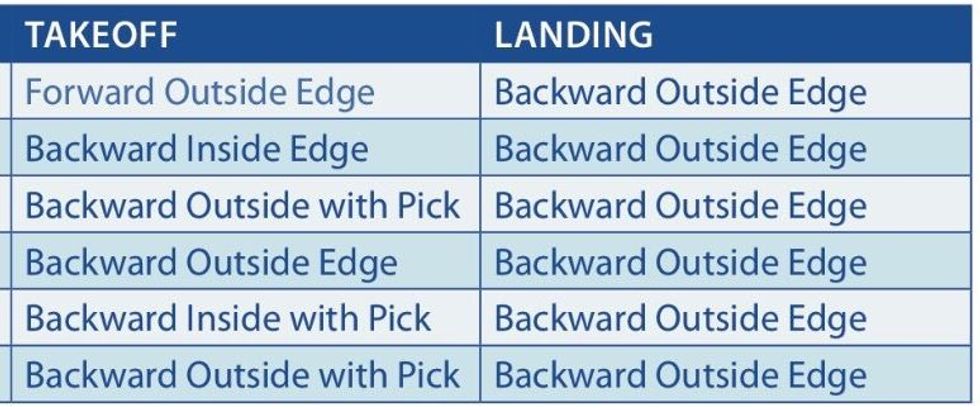
The use of inside and outside edges is very critical in competitive figure skating, and can be the difference between an average jump or an amazing jump. There are six different types of jumps in figure skating: axel, salchow, toe loop, loop, flip, and lutz. Each jump has varying rotations depending on the skater. Below is a chart from the United States Figure Skating Association that describes that take off and landing of each kind of jump in this order: Axel, Salchow, Toe Loop, Loop, Flip, and Lutz.
Jumps can be performed as a single, double, triple, or quad, and as their name suggests, the skater would rotate once, twice, three, or four times within the air. The more rotations the skater performs in a jump, the more dangerous and difficult it becomes.
It is also very important to understand the way scoring works in figure skating, and why quads are such a necessary element in men’s figure skating. The judgement process is as follows:
Skaters receive two sets of marks for each program: the technical element score (TES) is based on the difficulty and execution of the technical elements, such as the jumps and spins, and the program component score (PCS) is based on artistry, interpretation and presentation. The TES and PCS are combined for a skater’s total score.
The Total Element Score (TES) is a sum of all the element scores. A TES is determined by two sets of people for each program: the nine-person judging panel and a three-person technical panel.
The technical panel identifies each element (such as discerning a flip from a Lutz, or a quadruple jump from a triple jump). They are also charged with verifying if jumps are fully rotated or landed short.
For elements such as spins and footwork, the technical panel assigns levels numbered one through four, where four is the highest. A skater can enter the spin in a difficult way, or change edge or position during the spin in order to make it more difficult.
The judging panel evaluates the elements based on how well they were executed, assigning a grade of execution (GOE) of -3 to +3 to the element’s predetermined base value. Only seven of the nine scores are used: a computer randomly and secretly selects which scores to use. After seven GOEs for an element are selected, the highest and lowest values are dropped. The remaining five scores are averaged and rounded to two decimal places. So, the GOE either adds to deducts from the base value: If a skater performs a triple Axel (base value of 8.2) and the judges award it a +3 GOE, the skater earns 11.2 points for the element.
The Program Components Score (PCS) is based on the judges’ determination of the overall program, and not the individual elements. The judges mark five program components (skating skills, transitions, performance, composition and interpretation) on a scale from 0.25 to 10 (1 = very poor, 5 = average, 10 = outstanding) (Lutz 2017 para. 6).
It is important to note that if a skater does a jump during the second half of their program, the base value of that jump goes up because the skater’s fatigue is higher than when they began. Many skaters use this to their advantage to get as many points as possible in competition, but with multiple jumps containing three or four rotations sometimes skaters will lack character when they perform.
Figure skating is deeply rooted in artistry, and has been since the 19th century, it is what sets the sport apart from sports that focus only on athleticism. American skater “Jackson Haines. . . revolutionized figure skating in the 1860s, skating to music, bringing balletic movement to ice, and creating new ones” (Ice skating 2017), he is even sometimes referred to as the father of modern figure skating. Artistry is what drew people into the sport of figure skating, and made it so unique and interesting. Without its artistic elements, figure skating would not be as widely known as it is today. These major athletic endeavors are relatively new in the sport of figure skating, the first successful quad jump as defined by the ISU was “Kurt Browning's quadruple toe-loop at the 1988 World Championships” (The history of quadruple jumps 2016) Quads are a very modern skating invention, and has amassed many fanatics as skaters continue to attempt these jumps with an increasing level of difficulty. Artistry has been a part of keeping figure skating interesting and relevant, and the new appeal of the quad should not outshine this very important aspect of the sport.
To fairly judge any subjective sport, the person judging must rid themselves of biases in order to do so effectively. Figure skating “judging is subjective and often controversial” (Ice skating 2017) in many different ways, and has been the cause of debate among skaters and coaches. Many updates and changes have been made to the judging system over the years, after several controversies at the Olympic level; “After an international judging scandal at the 2002 Salt Lake City Olympics, International Skating Union (ISU) officials introduced an entirely new system for judging figure skating performances.” (Van Veen 2012) The concern of the old system was the judges had too big of an input on the judgement and could give higher scores to skaters from their own countries to get them on the podium. This is one of many examples of biases in the judgement of figure skating, and these biases, although it “would be hard to completely eliminate bias based on the nature of the discipline” (Van Veen 2012) through a major system change, the chance of bias interfering with fair judging can be significantly reduced. The presence of bias on the part of the judges cause an unfair advantage among certain skaters, and an even more unfair disadvantage to skaters who are not receiving this privileged treatment.
While there are many skaters and coaches who value artistry, there are also those who believe that athleticism should be the main focus of competitive figure skating. Evan Lysacek, an American figure skater “fashions himself a hard-core athlete” (Schwarz 2008) and believes the more artistic skaters, such as Johnny Weir, is “a distraction.” (Schwarz 2008) Skaters like Lysacek believe figure skating has evolved into an extreme sport, and should be considered as such in competitive environments. The modern invention of the quad has introduced the figure skating world to a more extreme alternative than it has encountered in its past, and many believe this extremism should be the standard figure skaters follow in its competitive future. The modern quad infatuation cannot outshine how figure skating has been established as a sport that balances athleticism and artistry. This bias that favors the quad allows skaters to figure out how to stack their points in order to have a significant advantage against those who focus less on quads and more on artistry. Mirai Nagasu “completed her stirring free skate” (Longman 2010) in the United States Figure Skating Championships and still lost to Rachael Flatt “who is mathematically astute in piling up points” (Longman 2010) in her programs. This bias offers an advantage to some, and a disadvantage to most in terms of fair judging and should be eliminated.
There are also those who believe that a competitive male skater cannot compete at the highest level without performing a quad, as it has become unofficially required to win any kind of competition. Former figure skater Johnny Weir call the men’s competitive environment as “a jump-fest” (Clarke 2014) and coach Audrey Weisiger even went as far to say a skater “[couldn’t] be [an] Olympic Champion without a quad – in the long and the short [program]” (Clarke 2014). There are many skaters and coaches alike who believe the quad is a permanent addition to figure skating and should not be restricted, but rather celebrated and assimilated into programs of all skaters, but especially male skaters. Weir described the perfect skater as “the man who can land more than one quad in the free programme – combined with all the triple jumps and artistry and star-power. . . to win the championship.” (Clarke 2014) This argument suggests that every skater who is worthy of competition is able to execute not only one quad, but multiple quads in the same program. This is not the case, as quad jumps are extremely taxing on the body and extremely difficult to complete successfully. Many skaters are extremely artistically talented, but the inability of performing a quads holds them back from competing at the highest level. Patrick Chan fears for the health of young skaters for this reason, worrying that because there is “a bit of disconnect between the toll their bodies are physically going through and the connection to their brain where it’s sending the pain.” (Sarkar 2017) Younger skaters are less concerned with the negative bodily aspects than older skaters, which can lead to serious health problems in the future.
The figure skating world’s obsession with multiple quadruple jumps could prove dangerous to the health of those figure skaters who are attempting to perform them. When skaters train, they “will practice jumps dozens of times a day, and always land on the same foot” therefore “they’re prone to getting microfractures that can cause major issues later on.” (Tabb 2017) Pictures below is a diagram of how a figure skater would complete a quad, without error.
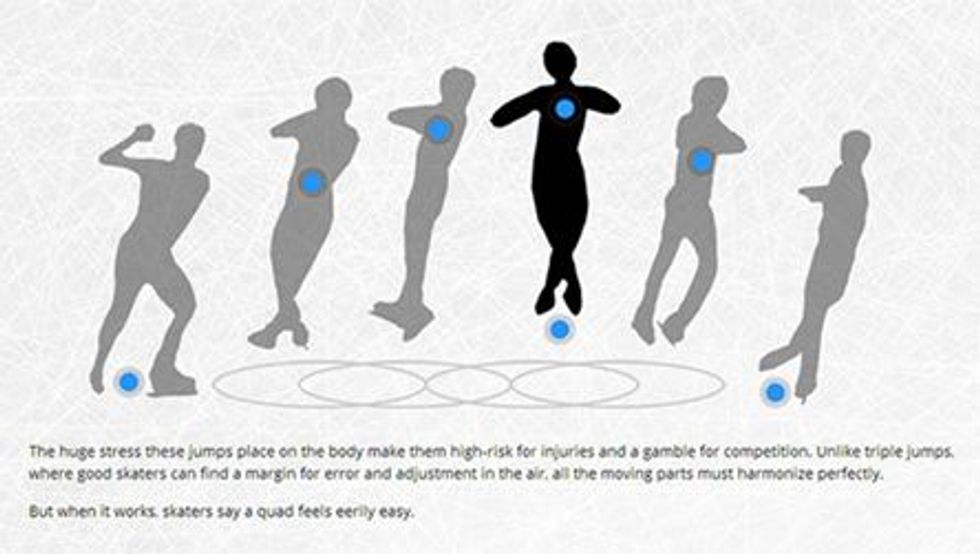
These injuries can cut a skater’s competitive career short, and possibly injure them permanently. Experts compare landing a quad on the ice to “jumping off a chair and landing on one [flat] foot” (Tabb 2017) which is extremely intense and painful. During practice, skaters can practice these kinds of jumps up to “100 times a day.” (Tabb 2017) What makes quads so different from any other jump is that the quad demands perfection in the leadup, execution, and landing. Quads are considered high risk because “unlike triple jumps where good skaters can find a margin of error and adjustment in the air, all the moving parts must harmonize perfectly” (The quad 2017) in a quad to avoid a devastating injury. To require skaters to complete these jumps multiple times during a competition means even more quads done in practice, which will lead to serious injuries for the skaters later in life. It is both unrealistic and dangerous to the health of figure skaters to expect every skater to be able to do multiple jumps with four revolutions during their programs.
To solve the problem of the quadruple jumps in figure skating is to lower the base value of quad jumps in order to make them less necessary to succeed in competitive figure skating. By lowering the base value, skaters who are unable to perform these overly rigorous jumps will have a fighting chance in the competitive field. This will allow skaters of all levels of ability to improve their artistry and character on the ice, rather than robotically push themselves to execute jumps with quadruple rotations in order to compete. Some describe the “essence of the artistic part of figure skating” (Luchianov 2013) as those skaters who “express as much as possible the nature of a theme and its original sense” (Luchianov 2013). By removing the stress of constant quadruple jumps, skaters will have a better opportunity to develop their artistic talent, while also tending to their health and avoiding the quad’s damaging affects on their bones and muscles. This change will result in a healthier, as well as a more memorable and artistic figure skating experience.
In order to implement the solution to the problem of quadruple jumps, the International Skating Union would have to create a radical change in the judgement system, altering the numerical base value of quad jumps in the skater’s technical score. Some skaters may oppose this change, as many have become dependent on quads to win competitions with ease. The unrest of those used to the higher power of the quad may pose a threat to this rather massive change in the judgement process. Future research of this topic could be some kind of compensation for those who favor quads, without creating the same bias that favors these jumps that exists currently. It is important to strive for the utmost fairness for all skaters when considering a change in the judgement system.
Figure skating is a stunning, but difficult sport, both in performance and judgement. It is extremely important to consider every aspect of the judgement process to ensure fairness for all skaters. With bias in the judging, there will be skaters who deserved a much higher score or even a spot on the podium that are not given what the deserve in favor of others. This cannot be allowed to happen, as it is unfair to the sport of figure skating, as well as to individual skaters who are brushed aside in favor of unnecessary shows of athleticism, such as quadruple jumps. Figure skating’s rich history cannot be forgotten in order to focus on the modern invention of extreme athleticism. By enforcing fairness in figure skating, it will be a much more successful and memorable sport as a result.