For those who don't know who Sia Furler is, she is a singer-songwriter who took the world by storm (accidentally) with her powerhouse vocals in David Guetta's "Titanium." The song was received so positively by Guetta's listeners that Sia's career took off. Two years after Guetta's hit, the artist dropped "Chandelier," which is one of the few music videos on YouTube to have more than one billion views.
The Australian singer's contralto and unbelievable upper register has left people across the world in awe of her musical capabilities; her voice cracks emotively, her pronunciation is unique, and she delivers unimaginable musical runs effortlessly. Christina Aguilera, one of the most prolific vocalists of the current musical generation, has even gone so far as to describe Sia as a "rare, strange, amazing, exotic bird." No truer words have been spoken. Whether or not you like Sia's music, her voice and her talent are both incontrovertible.
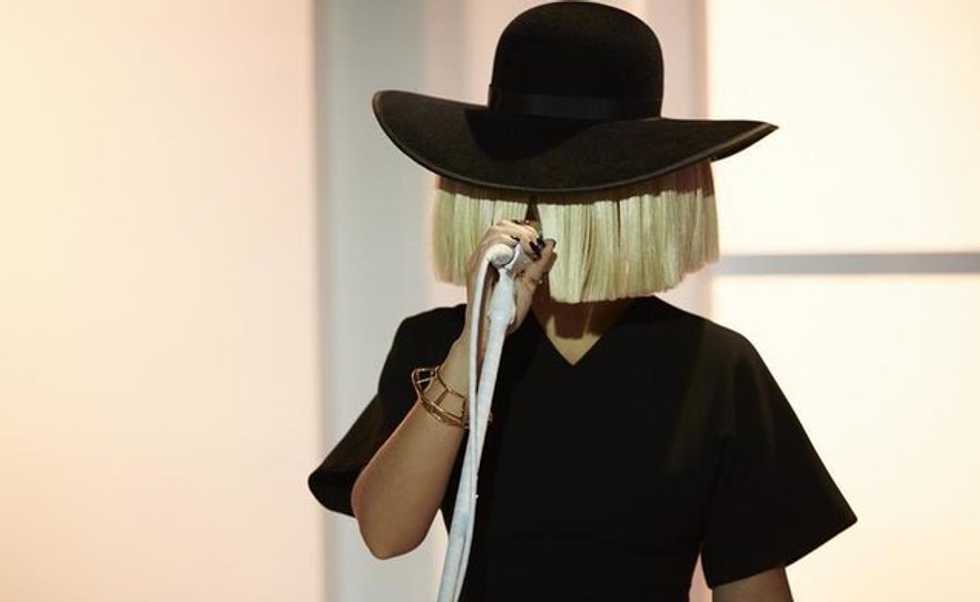
Another thing that is essential to point out about this amazing artist is the fact that she never shows her face. Yes, it's true that with a simple Google search, one can see pictures of the singer-songwriter (with her face!) prior to her construction of a musical empire. But, you would be hard-pressed to find a recent picture of Sia Furler. She doesn't even show her face when she performs!
Needless to say, I've recently been on a Sia kick. And when I shared her music and performances with my parents, they would ask me: "But why doesn't she show her face?" We all know why she doesn't show her face, though.
This is not an article about Sia Furler. This is an article about how her actions represent the problems of a society ravaged by amorality and a lack of human respect. The way she hides her face is not some sort of gimmick, and it is not the beginning of some sort of trend in the music industry. It is the symptom of a culture that harasses celebrities and refuses to acknowledge that they too are human beings with thoughts, aspirations, and a right to be left alone.
In an interview with James Corden, Sia says that she covers her face "to maintain a modicum of privacy." The reality of fame is that your face becomes a prize, your presence becomes a currency, and your thoughts take a backseat to your appearance and the way you are portrayed by the media. People are quick to say that, "That's just something you have to accept when you're famous! You give up your private life when you become a celebrity." It's as if to say that these people –– like you and me –– are asking to be harassed by paparazzi, to be attacked by slanderous media outlets, and to be completely disrespected and violated. Rather than blaming the victims for their lack of privacy, we as a society should blame the very people who are stalking celebrities and stripping them of any chance they might have of privacy.
We should expect more of the people who give us news about our favorite celebrities. If we take a close look at another masterly singer-songwriter's life, the implications of tabloid culture become dangerously clear. Amy Winehouse, seven-time Grammy award winner, died at the hands of the destabilizing nature of fame for which we all are responsible. It was impossible for the torch singer to go even to some place like McDonald's without being mauled by paparazzi.
As a young artist, fame can be debilitating. And thus, people like Winehouse end up turning to the needle and the bottle to numb the self-hatred that these experiences harbor. Amy Winehouse died at the ripe age of 27 because her blood-alcohol-content was 4.5 times the drunk driving limit. She'll never be able to record one of her timeless hits again because the way we sit idly by as cameramen and women disable celebrities on a daily basis.
We love them, yet this is how we repay them?
Think about it. If you saw a rare, strange, amazing, exotic bird –– brightly colored –– perched on a tree branch, and it warbled an amazing song that changed your perspective of the world, would you kill it? Or would you leave it be, watching it from afar and appreciating everything it makes you feel? As a society, we have a choice, and we have been making the wrong one.