
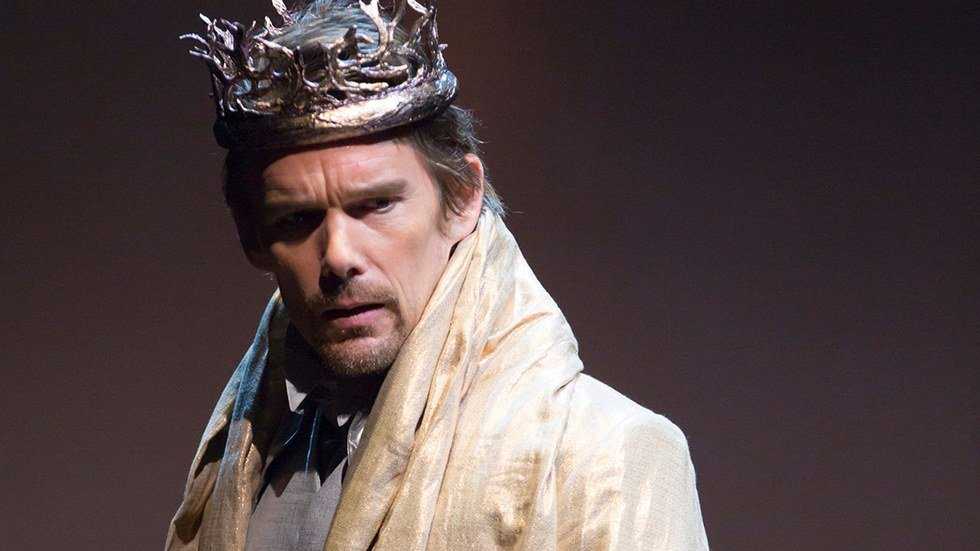
The one problem with making fun of dead people is, they can’t respond. You can yell at them, smack them and laugh at them but you never get a rise out of them, only the alive people passing by the cemetery. Then all that happens is the police get called and you get told to please dismount the coffin and exit the graveyard. I don’t want a response from alive people, I wanted the dead person to respond. But it’s been an entire 12 hours since that happened last, so: William Shakespeare’s Macbeth.
Being British and an English Major I’m predisposed to Shakespeare. Since I was a younger boy I was taught that Shakespeare is an untouchable genius—like Einstein with leprosy. His work is renowned among all the scholars with more essays on him than the girliest man in the Mexican prison. This makes this critique very difficult for me to write. I can’t complain about the language—where everyone is a celebrated poet weaving beautiful prose spontaneously instead of being poor drunk farmers, sharing five pub piano yellow teeth among their family. I can’t complain about the language being unrealistic without being mocked by all of the schoolyard children,
“Well you just aren’t smart enough to understand such beautiful language, you uncultured swine.”
Well, schoolyard children, that is quite a complicated chant you have going on there. But complex is not good. Conformal field theory is complex but I wouldn’t curl up next to the fire and experience it. Complex has its time and place and it’s not when I have four other books to read and fifty essays to write.
I can’t complain about Shakespeare using predictable fall-backs to forward the plot without someone shouting, “theme,” at me like their pacemaker is voice activated. And I can’t complain about Shakespeare’s no-this-is-really-how-the-aristocracy-act-you-guys brand of storytelling without someone trying to kill me with the driest lecture since the aquagenic urticaria’s desert historical retreat.
But it’s been awhile since the yelling-at-me based economy has had a good saturating. So here we go. You probably know the story line already but if you don’t then I’ll run over it for you:
In an aggressive prediction from the McDonald’s Director of Real Estate, the McDonald’s regional sales manager is assigned the task of corporate buy out of local stocks in the Scottish market. Once a majority of the stocks are owned, the regional sales manager makes his move and establishes a Headquarters in the Scottish Highland area near Glasgow but with a failing economic structure, the store fails and is forced into liquidation.
I’m just joking, it’s Shakespeare, so a dude kills another dude and then everyone dies. The dude in question is Scottish Noble, Macbeth, who is an amazing warrior. Well I say that but we have really very little to go off of for that fact as the story starts as do all of Shakespeare’s plays:
“Something really interesting has just happened, no really, trust me, you guys.”
Apparently Macbeth and his best warrior buddy Banquo have just finished beating back Irish invaders in a bout of no-doubt amazing warrioring with plenty of action and suspense and tension that would have been really cool if we were there but we totally missed out, it was rad.
That’s nice, Macbeth, can I see an example on how awesome their warrioring was?
“Ummm, you could, but they were just so awesome the battle is over now. You just have to trust me on how awesome their warrioring was.”
With no evidence, I like to imagine Macbeth and Banquo fighting off the Irish dust bunnies in Grandma Duncan’s sitting room. With how amazing Macbeth and Banquo are at dusting the living room, Grandma Duncan decides to promote Macbeth to head Grandson when next Grandma Duncan sees him.
On the way back from the amazing dusting, Macbeth and Banquo run into a group of time travelers who “predict” the thing that Grandma Duncan had just said in the last scene, which is like predicting the winning lottery numbers after watching them being drawn. The group of time travelers also break the “spoilers” rule of Time Lording, putting the entire universe in grave danger and telling Macbeth what he has to do in order to make the plot move forward. Well, Shakespeare says witches, but he never actually explained how and where they got their information from, so them being the Lost Time Lords of Gallifrey made the most sense to me… that or roaming plot devices.
Macbeth really does fall back on prophecy a lot—for the entire plot of the play, actually. Macbeth is destined to do all the things he does and therefore does the things because… because he’s destined to. Macbeth murders the King because he’s destined to do so, then he murders Banquo and his sons because he’s destined to do so, then murders Macduff because he’s destined to do so and then gets killed because he’s destined to die. Macbeth never does anything on his own volition. It’s all because the mystical plot device tells him to do it, which is essential equivalent to sticker slapping your character with personality.
What are the rules of prophecies? Are we operating under the Doctor Who prophecy, where things can happen maybe some of the time if you feel like it? Are we operating under the Romance of the Three Kingdom prophecy, where the prophecy has to happen and there’s no way around it? Or are we operating under a mix of the two? Does everyone know about the prophecy? Surely word got around somehow that Macbeth was destined to become king and kill the King and therefore when the King dies… while visiting Macbeth… at Macbeth’s house… and Macbeth becomes King, it wouldn’t take a genius to connect the dots. But no, the only reason people find out about Macbeth being the murderer of the king is because Lady Macbeth hallucinates. Well,� that makes sense doesn’t it? Apparently, all of the lords and ladies are thicker than the vault door where Marvel keeps all of the world’s money.
Hallucinations play a major part in the story, but since we never know if they are real or just a figment of Macbeth and companies’ degrading mental status, I can never get really invested in their importance. Just because a shouty homeless man tells me that he saw Jesus in that dark alley, tucked away from civilization, doesn’t make me want to believe him. Surely you can hallucinate anything if you try hard enough, so Macbeth and company’s hallucinations just don’t do anything for me.
Or is he destined to have these hallucinations as well? From my understanding, Macbeth is working under the predestination brand of prophecy where everything was written out beforehand. If this is true, then the story isn’t interesting and there is no tension because it was all meant to happen that way… ugh, I give up. I guess the schoolyard children can start making fun of me now. I can’t even get over the hurdle of what destiny has to do with the plot. I can tell you what it doesn’t do for the plot: add tension. If we already know something is going to happen, it doesn’t surprise us when it happens. I’m not going to be surprised when my pet rabbit dies of starvation because I didn’t feed it; the results are already well established.
Then again, some of Macbeth’s prophecy’s work off of a very legal understanding of prophecy. Being born of a woman comes to mind. Caesarean section still counts as a birth from a woman because birth is understood as, “The emergence of a baby or other young from the body of its mother; the start of life as a physically separate being,” and a woman is the thing that yells at you to clean up your room. What happens if you’d like to argue the decisions of your prophecy and what the prophecy counts as fair game or not? Is there a court for these proceedings or are you just left to suck on a salty sausage?
I digress. I could go on but I won’t... mostly because I can’t, but also because I’m destined by destiny to end one word from now: destiny.