Shakespeare has a really funny way of developing his female characters. There are a few tropes that Shakespearean females fall under: the virgin, the mother, and the whore. What is particularly interesting about the characterization of Shakespearean females is that they rarely speak for themselves, but rather, are developed by how the men in the play perceive them. While this may create a biased interpretation of the character within the world of the play, the reader (or actor) has the unique experience of finding the ways in which that female speaks for herself.
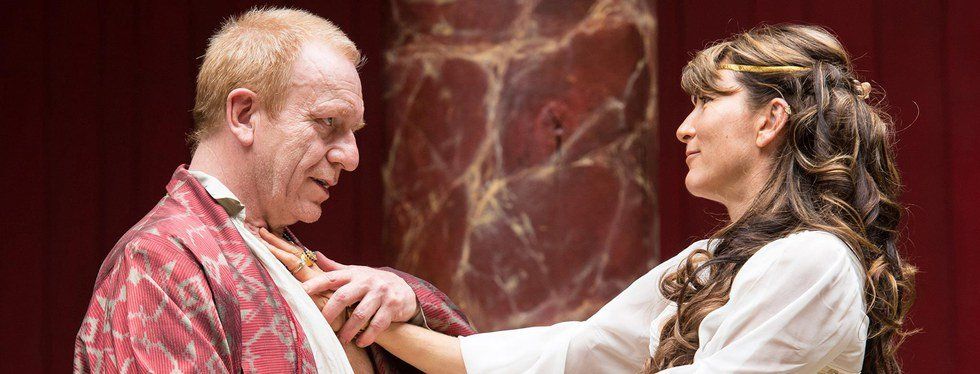
One of the most brash female characters in all of Shakespeare’s works is Cleopatra. In "Antony and Cleopatra," she is almost always viewed through the lens of the male characters of the play, who view her as a whore, apart from Antony, who views her as his greatest love. As one would expect, the men of the play are who develop the character of Cleopatra, viewing her as a sexual deviant and an over-dramatic actress. But, this has given Cleopatra a unique space to speak for herself, for the same feminine stereotypes that the men throw upon her is where Cleopatra’s feminine power flourishes, controlling the entirety of "Antony and Cleopatra".
The most prevalent form of sexism found in "Antony and Cleopatra" is essentially slut-shaming: the male characters of the play, who do not understand Cleopatra, make her akin to a whore, and make comments insulting her sexuality and sexual activities with Antony. In Act 2, scene 2, Enobarbus provides Agrippa with an anecdote about the first time Antony saw Cleopatra, in a scene that is almost dream-like. Enobarbus even describes her as being more beautiful than any painting of Venus. Agrippa, however, ends up flipping the beautiful scene described when he exclaims, “Royal wench! She made great Caesar lay his sword to bed. He plowed her, and she cropped.” Agrippa provides the reader with a perfect example of the slut-shaming that occurs in Antony and Cleopatra; he ridicules Cleopatra for being a sexual character and taking more than one sexual partner - much like our not-so-modern concept of slut-shaming.
Yet, the shaming of Cleopatra’s sexuality works in two ways. While at points throughout the play, this characterization undermines the overall likability of her character, Cleopatra is also able to find a significant amount of power through her sexuality. Looking through a more feminist lens, Cleopatra is able to use her feminine sexuality to gain and maintain an influence over the men of the play; regardless of whether the men of the play love her, or hate her, they are still thinking about her, and she has control over them. Her sexuality becomes one of the most compelling elements of her character. Even other characters admit to her power, even if it is in the form of mild slut-shaming, such as Enobarbus’ speech towards the end of Act 2, scene 2. “Age cannot wither her, nor custom stale Her infinite variety. Other women cloy The appetites they feed, but she makes hungry Where she most satisfies. For the vilest things Become themselves in her, that the holy priests Bless her when she is riggish.”