When you walk through the street of Soi Six in Pattaya, Thailand, you are immediately faced with the reality of the prostitution industry. Women and ladyboys stand outside bars in groups with painted faces and bright outfits, their voices calling constantly to potential customers. The entire street is lined with these bars and brothels, and it doesn't end there. Keep walking, and you will find yourself in the same scene, street after street.
No one can deny what they see on the streets of Pattaya: injustice, slavery and abuse. But another harsh reality is that such a hell exists here in Hawai'i and across the United States. Although it is not as readily seen, sex labor is a monstrous epidemic spreading through the States, and Hawai'i happens to be one of its major gateways into the U.S.
So why do so many Hawaiian and other U.S. residents know so little about the reality of human trafficking in their own cities and states and seemingly do so little about it?
Granted, sex trafficking isn't as blatant here as it is in places like Pattaya. With the exception of some counties in Nevada, the U.S. does not openly advocate sex trafficking or have streets dedicated to this industry. But nevertheless, it exists and is arguably one of the most unregulated crime industries in the States.
Fortunately public awareness is on the rise concerning human trafficking - I'm sure most of the people reading this article have by now become aware of sex trafficking in the States and a few realize how monstrous it is. If you don't know the monstrosity of it, here are a few facts from a survey done in 2014 by IMUAlliance regarding sex trafficking in Hawai'i :
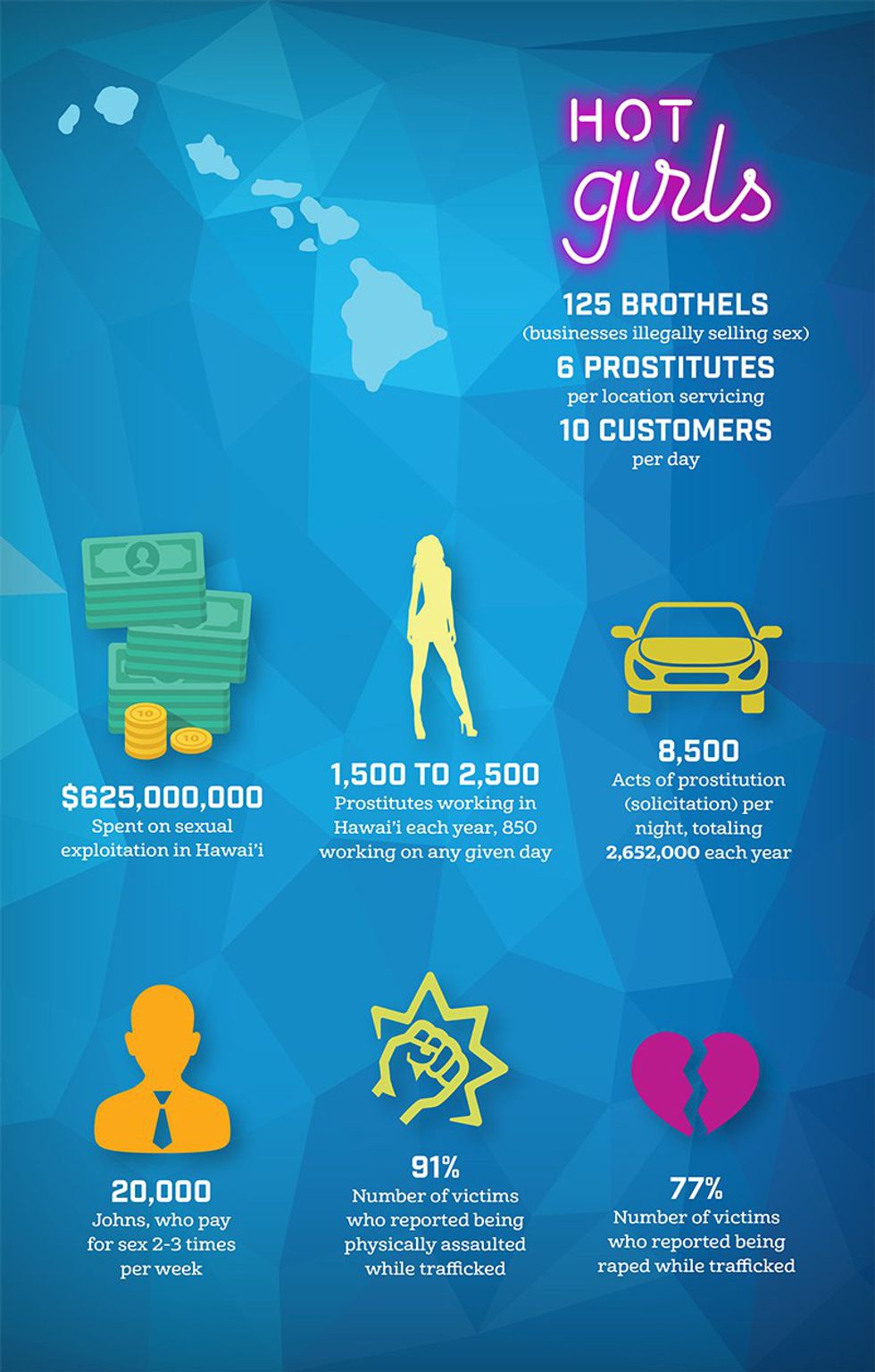
Human trafficking is a reality. But what keeps so many mouths closed and so many hands inactive probably has to do with the fact that ending human trafficking is impossible. It's true -- it is impossible. We live in a broken world and there will always be people using and abusing other people. Numbers and facts seem scary, and the idea that Hawai'i alone has over 1,500 trafficked victims is overwhelming.
But you can't look at the numbers and the impossibility alone. Even if someone manages to free one person from sex labor, the impossible has already been done. That person has experienced the impossibility of living a different life. Believe me, I felt the impossibility when I was working with victims in Thailand. But I also came to realize the possibilities when you decide to do something about it anyway.
After walking through Soi Six and talking to some of the bar and brothel workers in Thailand one night, a woman ran out into the street to give me a hug. She had pointed to her heart earlier that evening and said, “I have a bad heart. Men come, we go upstairs, they leave and my heart...bad." I told her that her heart wasn't bad; it was her situation, and I wanted to give her an opportunity to get out of it because she mattered. When she spotted me in the streets again, she felt compelled to leave her client and share her resolve to stop by the outreach center. And she did. It was a first step, one which leads her into a community of people who cared for her instead of used her.
So many of the women I met in Thailand, who had their lives changed by people who sought them out, went back to help other victims find their freedom. It's a chain reaction, fighting the impossible one life at a time.
OK, so now that you know that a little help can make a big difference, what exactly can you do to make that difference?
Trafficking is a bit different in the U.S. and victims are not as easily recognizable and approachable as in Pattaya. But here's some practical ways you can get involved specifically in Hawai'i and other parts of the U.S.
Get plugged in with a local organization.
There are many nonprofit organizations and outreach centers across the U.S. that seek to help and rehabilitate trafficked victims. You can find these organizations by looking them up online. In Hawai'i specifically, there is a great organization called Ho'ola Na Pua (A New Life For Our Children). You can follow the link to learn more and get connected. It's life changing for you and the victims when you take steps to help.
Learn how to identify a victim.
There are ways you can be more aware of your surroundings and identify those who are being victimized on the streets or in their work environment. Follow this link to learn these practical steps.
Raise awareness.
One way I am doing my part is by speaking up about sex trafficking. You can write about it, talk about it or share what you've learned on social media.
We can't let numbers scare us because people aren't numbers. Each number is a life, and freeing just one will lead to others.