
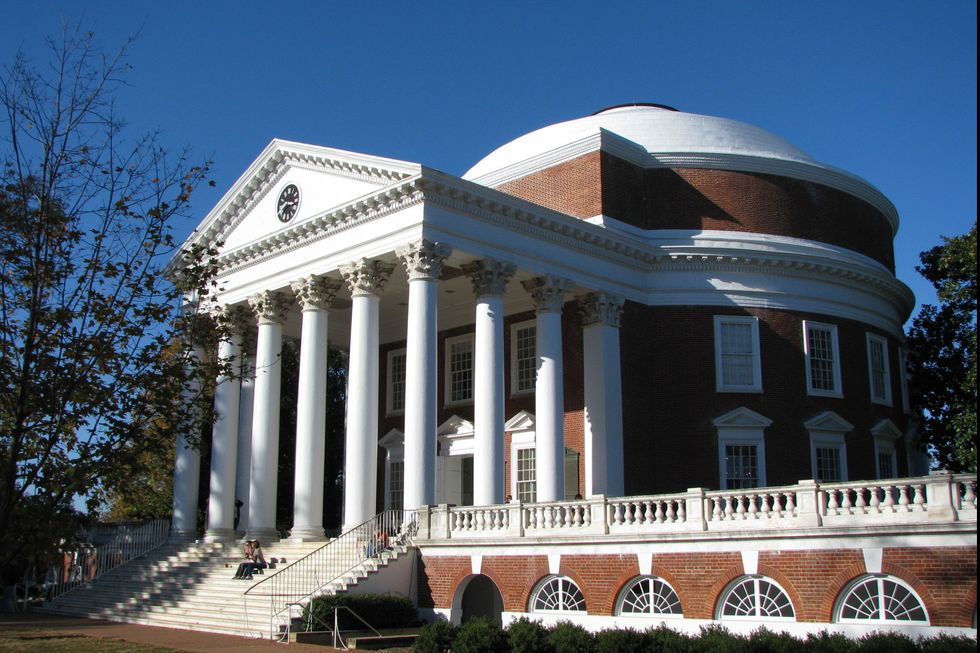
On the evening of November 8th, 1824, the Marquis de Lafayette arrived in Charlottesville, Virginia, to visit Thomas Jefferson and James Madison on his grand tour of the United States. The Marquis, having arrived in America several months before, had returned to the nation for which once he had fought to revisit old friends from the Revolution, and he had not overlooked the two former presidents. It was the day of the University’s inaugural banquet, and the guests were situated around a table in Jefferson’s half-finished Rotunda. Rising to his feet at the end of the long dinner, Lafayette toasted Jefferson as “Father of the University of Virginia” – a title that so moved Jefferson that he had it inscribed on his tombstone.
Today, a bust of Lafayette sits in the Rotunda’s North Oval room, a gift of the French government. But what of the Rotunda itself? How did Jefferson conceive the design of the University’s most iconic building, and how did it become the University’s emblematic symbol?
Jefferson, though a product of the Enlightenment, in many ways embodied the ideal of the Renaissance Man – a statesman and author who in his spare time studied the classics and amassed an enormous library, both of contemporary and ancient texts. One of the books in Jefferson’s collection was a 1721 edition of Antonio Palladio’s – The Four Books of Architecture – the text believed by many scholars to contain the inspiration for the Rotunda. Palladio’s drawings of the Pantheon inspired Jefferson towards the design of a central dome-like building at the heart of the University’s “Academic Village” – to be built not merely on classical guidelines but also on classical proportions.
Jefferson originally conceived the Rotunda not merely as an impressive landmark displaying his fondness for classical architecture, but as a laboratory for scientifically minded University students. As UVA was the first American University to offer the study of astronomy, Jefferson planned to turn the Rotunda into the nation’s first planetarium, with an interior painted with scenes of the night sky. For a time he even considered inventing a crane to allow students to observe the scenes at a closer view, complete with mechanisms allowing them to move the paintings of constellations.
Though this plan was eventually abandoned (perhaps because of its painful strain on Jefferson’s shrinking budget) it does much to show Jefferson’s ambition and creativity in his design of the original University buildings. In the end, the Rotunda was still put to some astronomical use; the Transit of Venus in 1882 was observed from the Rotunda via a combined project involving the McCormick Observatory.
Over time, the Rotunda grew with the addition of various side buildings. The “New Hall”, or Annex, was built on the Rotunda’s North Side in 1853 to accommodate UVA’s growing classes, and other side buildings with added over the years. All was nearly lost during the 1895 Rotunda Fire, which caused irreparable damage and left the interior entirely gutted. Yet many of the Rotunda’s treasures were saved by quick-thinking first responders.
The famous marble statue of Jefferson, which until then had been kept indoors, was thankfully transported to safety, as were most of the Annex’s scientific instruments and the Rotunda’s extensive library. Following a recommendation by the Board of Visitors, the nationally recognized architect Stanford White was commissioned to rebuild the Rotunda, while the wooden roof was replaced with tile by New York’s Guastivino Company. The number of floors was reduced from three to two, but the Dome Room’s interior was considerably expanded; the Annex, though rebuild, was now located at the South End of the Lawn.
Not all were happy with White’s variations on Jefferson’s original vision, and in 1976 – America’s Bicentennial – the University set aside $2.4 million for the Rotunda’s complete renovation. A complete rebuilding left the Rotunda with a replaced roof, three floors, and a simplified skylight, in accordance with the original design. Not long afterwards, the Rotunda was the scene of a reception for Queen Elizabeth II, hosted by Virginia’s Governor Mills E. Godwin.
Further restorations were undertaken in 1998 and 2012 to preserve the faltering roof and Greek columns for future generations. During the course of the renovations, a highly preserved nineteenth century laboratory was discovered beneath the building, complete with a complex system of ventilation tunnels.
UVA’s Rotunda has inspired the designs of numerous University buildings across the world – ranging from Duke and Johns Hopkins to the Grand Auditorium of Tsinghua University in Beijing. Today, its legacy lives on through events ranging from Rotunda Sing to the Lighting of the Lawn, a living reminder of UVA’s rich legacy in architecture, history, and the ideas of Thomas Jefferson.















