
I realized after the release of last week’s article, “The Return to Now” that I gave absolutely no opinion on what we may be able to do. This article is a follow up response...
Basically, as I see it, we have approximately two paths to choose from in this upcoming election.
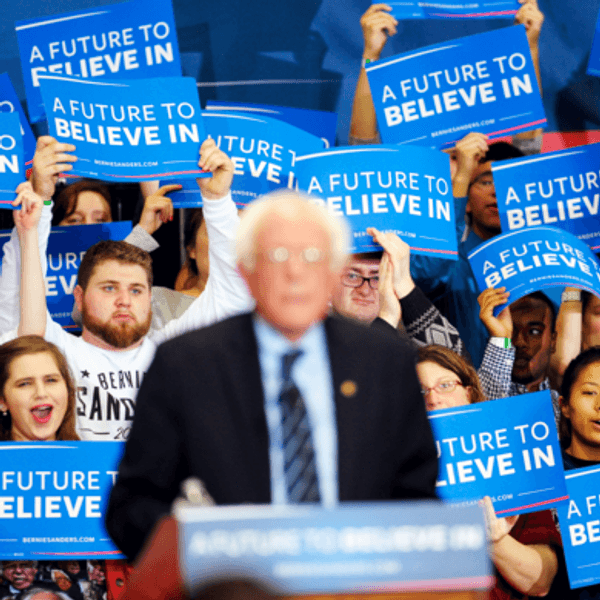
The first option for Bernie-supporters, on-the-fencers, undecided independents and the generally-pretty-bummed-out public, is to quit bickering over how terrible she is, and just vote for Hillary Clinton. Just get it over with. Do your duty to democracy. Just swallow the nasty medicine, along with everything we believe in and truly desire, all that we’ve worked for, and vote for the lesser of two evils, and get through four or eight years of who knows what, and then maybe try again in 4 or 8 years to get some other person who we really want in office.
I say this as the first option because it’s the same exact thing that has happened with Obama’s two terms: as well as Bush’s two terms, as well as Clinton’s two terms, as well as Bush (the older one, H.W)’s term, as well as Reagan’s two terms, as well as Carter’s term, etc. etc.: i.e. it seems to me that we are promised a lot of basic improvements from our candidates during every single election cycle and, so far, have been given almost none of them.
I say we haven’t been given any of them because, as I explored in last week’s article, all social/political/ideological improvements are generated by everyday human beings, not by lone-wolf geniuses or social hierarchies. Change comes through hard work, and communication on a large scale, from many people. Historically and contemporarily, change does not come from, say, a CEO who feels bad for his workers: it is something that happens gradually and partially, and continues until the CEO is put on a leash through non-violent protests, or put into an early grave by violent protests. Either way: change happens, and it happens through the will and activities of the people; of you and I.
OK, so here’s another thing to think about: what is it that we expect, as American citizens, from our government? And have we even asked and/or been asked this question?
Because to me, ideas seem to be regarded nowadays as more of a trickle-down-from-the-top sort of affair: where the people on bottom have to (or get to, in many people’s eyes) choose how to live their lives based on the value systems of one of two dogmatic, seemingly diametrically opposed ideologies. In reality, however, the two parties are engaging in a symbiotic relationship wherein they use working class rhetoric and divisive politics in order to chicane votes from the actual working class. Both sides pander thickly and evenly. And don’t kid yourself: there is no difference between a democrat and a republican, other than that the democrat is just a bit more behind-the-scenes and careful about deceiving you.
What is it we want out of democracy? What is it we want out of government?
Well, to start, maybe we can look at what we currently get from it: basically we give a bunch of people who we learned about from commercials and magazines (and newspapers and radio, people we don’t really know) our money and say, “Hey, here ya go: make our lives a little better, you seem like a pretty solid person from what I’ve seen. And also, hey, here are some guidelines.” But, you see, this politician has a secret, as do many others: 87% of politicians’ funding comes from groups who DO NOT have your best interest at heart. They are funded by people who want to revert back to slavery and no minimum wage and no public schools and no corporate restrictions: the people who are supposed to take care of your money, your interests, your livelihood, are funded by people who want to send you back to the stone age.
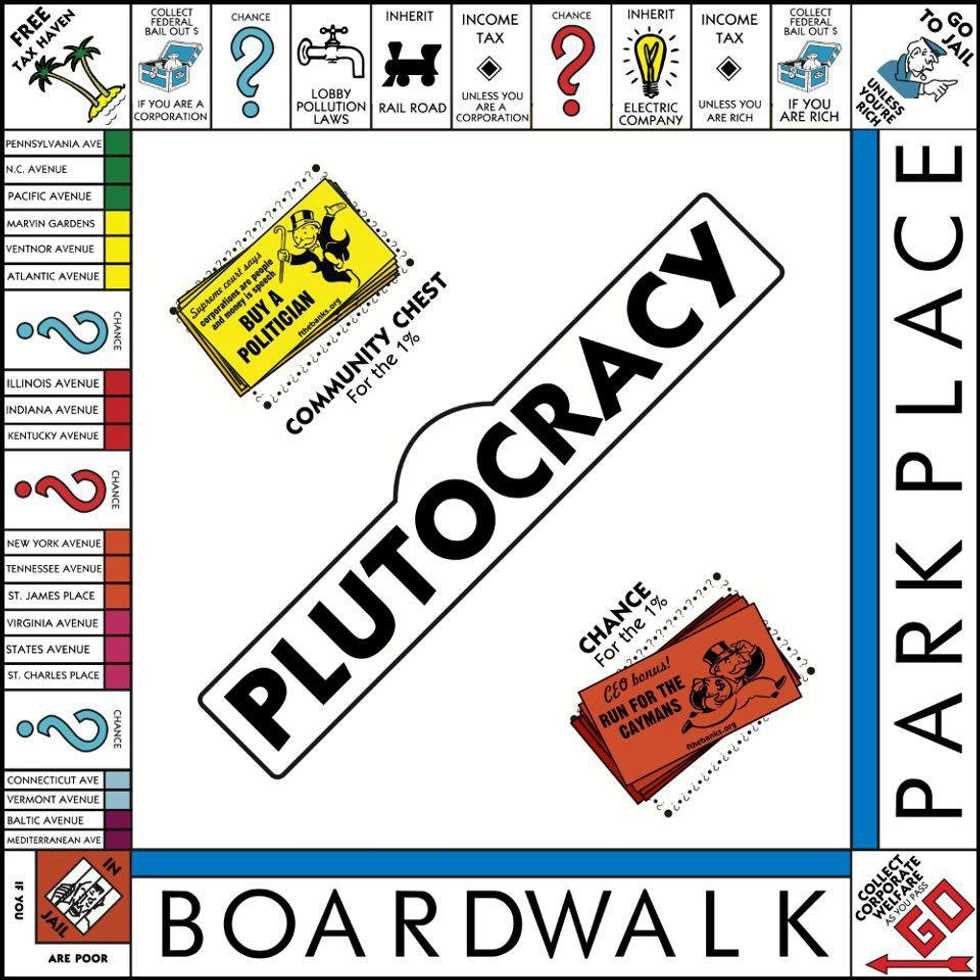
OK, so that’s one part of it: the next part is that these politicians (as many of you know (and I’m sure it’s annoying to you to hear again, but other people haven’t heard it: so bear with me)) are then obligated, not in a friendly way or a, “hey, I’ll help this person who funded my campaign because, shucks, I’m such a nice guy,” way, but are actually legally bound to represent whoever has given them the most money. And remember, this is not a bad thing: this is an extension of capitalism, and should not be feared. Just as well, Citizen’s United, PACs and SuperPACs, soft money, gerrymandering: all of these are natural offshoots of capitalism, and work to advance capitalism’s end goal.
[It should be noted here that capitalism has but one goal: theconcentration of wealth. When combined with democracy, everything becomes like this big weird non-sensical game where the goal for politicians is to keep wealth separate from the masses who voted them into office, and to keep that wealth in the hands of a very few powerful people who politicians then receive handsome rewards from. It is almost as if the economy has become our new religion: pray to and protect the nation’s wealth, feed it by buying lots of material goods, and punish anyone who dares violate the property of anyone else (a cardinal sin in capitalism is the destruction of property (this is evident in our laws from the very beginning as well as, more importantly, the fact that during the post-Civil war reconstruction era, the 14th amendment (seeking equality among the races) was hijacked and, “Very soon after the Fourteenth Amendment became law, the Supreme Court began to demolish it as a protection for blacks, and to develop it as a protection for corporations,” (Zinn)) This system’s basic raison d’etre is to keep things exactly as they are internally, while allowing for massive progress externally and materially.]
So anyway, you got your politicians receiving money from people who want to do you harm financially, and then they go off and they write more laws that allow corporations to do a whole bunch of other messed up stuff which the politicians said they wouldn’t allow to happen. Then, after a while, when these politicians are found to be the same old story, we are introduced to politicians with promises for “a better tomorrow,” and who will really bring home the change this time and who, maybe at the beginning of things, were genuinely concerned with helping change america. But then the same things happen: the politician with the most genuine seeming and attractive message is picked by lobbyists, who pour millions of dollars into that politician’s campaign, which allows that candidate to win by a landslide but who now has obligations to the same corporations who got them into office, and, Lo, the cycle starts all over again.
So this is what we are getting out of government right now: a few very minor, sideline changes, in exchange for giving power to people who will write laws to bring more power still unto themselves. I am not trying to advocate one way or another, right or left, because I think that the “right” and “left” are the same thing. I think the real point I’m grasping for here is: what do we get out of all this? And, why haven’t we changed things?
Well, the answer to the first one has been simplified down to what I see as its essentials: but then why haven’t things changed? Or, why have they only changed incrementally?
I guess part of this, at least the way I see it, is that we are all so busy: I know that I have to work 40-50+ hour weeks in order to contribute even marginally towards my college and living expenses. Many of my friends work more, and many parents have worked this way their entire lives: and who can say, honestly, that they have enough energy and drive at the end of the day to go meet up with hundreds of others to yell and protest, just to go home at midnight, get up for work the next day, and come back again the next night to start everything all over.
It makes sense why change cannot happen quickly: and it makes sense why strikes work so well. Strikes work because the second that workers realize, en masse, that they are being taken advantage of, and the second they stop working, it has a direct effect on capitalist production and progression, and must be met with either force or compromise. This is confirmed by hundreds of historical cases of worker strikes: that capitalism is absolutely NOTHING, without its loyal bands of workers.
Basically this entire article was written to get to the following: a follow-up on last week’s article, titled “the Return to Now.” Re-reading what I had wrote, I found I gave no suggestions as to how we can possibly escape the situation we find ourselves in. Well, here it is. Our first option, as mentioned, is to vote for Hillary Clinton, and keep on the road we are headed down. OK. Fair enough. That’s a safe, comfortable choice. Or, we could make the grown up decision, make the tough, conscious choice to shed all government and begin directly representing ourselves: stop paying taxes. Stop working at corporate and state owned facilities. Begin focusing on what is in front of us that needs fixing: and to fix it ourselves (think about it, we already do!). Begin realizing that workers without people breathing down their neck, workers who work for both themselves and their community, are far happier and end up producing far more than our previously over-worked over-stressed american workforce. Begin holding weekly community meetings in every town, city, district and street: have people talk to one another openly, and honestly about all that is going on in their minds. Create interconnected, community-based governments throughout the U.S and abroad: begin growing our own native food locally again. Begin using trade and socially conscious egalitarianism to provide support for communities in need. And to finally, finally, instead of living for ideals and quotas and capital and materials and whatever’s on the horizon, to finally start living for ourselves again, living for one another, living with one another, right here, right now.