

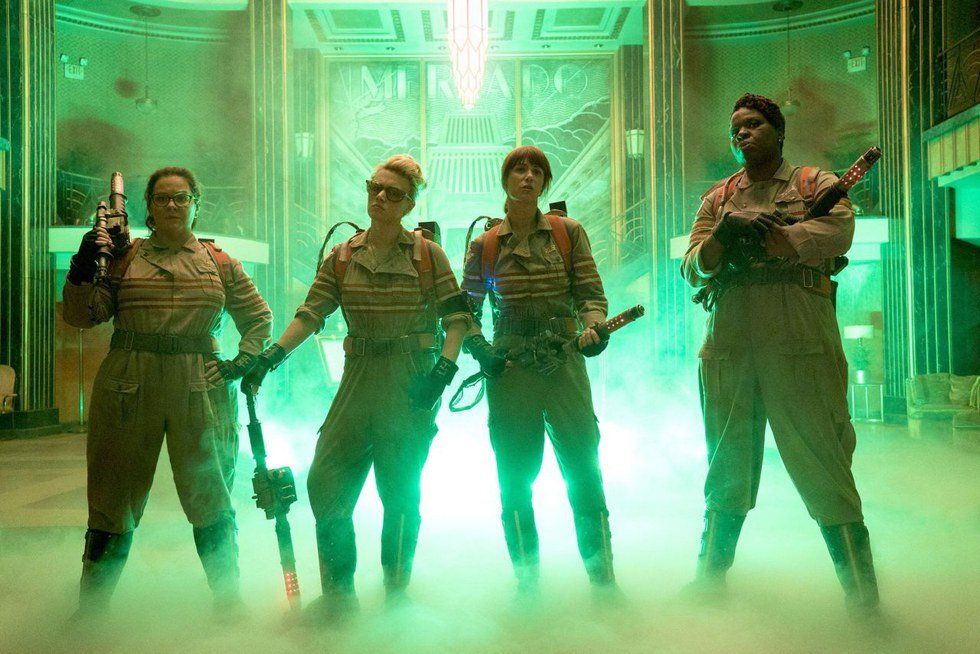
In a recent video uploaded to geek culture-centered website Cinemassacre, video game critic James Rolfe, or the Angry Video Game Nerd as he is professionally known, did the unthinkable—in a brave and defiant stand against what surely could have been a deadly assault on his childhood, he announced his refusal to watch the new "Ghostbusters" film, presenting his argument for all the Internet to criticize. I plan to do exactly that in this article, breaking down his arguments over the course of the video’s 6-minute run-time and highlighting the points where Rolfe descends into absolute nonsense; critiquing “critique” would be my goal here I suppose.
To begin, Rolfe contends that one reason for his boycott is that we now have to refer to the original film, a “timeless classic,” as the 1984 "Ghostbusters,” and this is for some reason a significant condemnation for him. While I will agree that the title isn’t exactly creative, I also realize that judging a book by its cover is a great way to miss out on some great books. Movies’ titles have no impact on the quality of the actual film, and there are plenty of great films that have terrible titles, like "The Empire Strikes Back" or "Edge of Tomorrow." Rolfe must only watch films with incredible marketing teams, I suppose. Truly his taste in film is that of a sommelier to wine. He even says in almost the next breath, “maybe it’s good. It’s a possibility,” while subsequently re-stating his desire to avoid seeing it lest he be drawn into temptation and away from divinity, or the 1984 "Ghostbusters” as I will be referring to it from now on, mostly out of an internal desire to piss Rolfe off.
The crux of Rolfe’s automatic distaste toward the new film is, I believe, rooted in something often felt in fan bases—a sense of possession felt towards the object of the group’s devotion. In this case, the devotion is toward films that are now thirty years old. Rolfe states his wishes for what the 2016 film “should have been,” and according to him it was preordained that a continuation of the franchise should star the entire original cast reprising their roles to pass the torch to the next generation. There are a few problems with this, chief among them being that he believes we need to see a torch be passed. Later in the video the argument is presented that "Ghostbusters" 2016 should do what "The Force Awakens" did and have an old character reprise a previous role to deliver a line similar to Harrison Ford’s “Chewie, we’re home.”
Not only was “Chewie, we’re home” probably the worst piece of writing in "The Force Awakens," but it just amounts to the idea that a new installment of a franchise has to target the original fans in order to “correctly” hand the property off to its new stewards. The Nerd also expresses fear that the new film will be mistaken as being the original, which is nonsense; a child growing up in 2016 lives in a culture saturated by nerd-oriented art - to attempt to assuage the doubts Rolfe expresses late in the video, no one is going to assume that the 2016 film is the original, this is not something that is a genuine concern to literally anybody but you as far as I can tell.
The idea of there even being a torch that needs passed is the biggest issue with his whole argument as far as I am concerned, as it expresses a clear sentiment of perceived ownership over a property that needs to be transferred to another group of people that are just there to appreciate the same thing, though perhaps with a different value system and cultural context befitting the current generations of younger audiences. If I may offer some advice to Rolfe, if he is indeed so concerned over the ability of younger generations to “get” the 1984 "Ghostbusters," then seeing the 2016 film makes a lot of sense; by seeing the film he can gain a lot of perspective on culture today and more effectively argue his point that a period of transition was required, perhaps by using elements of the plot that don’t work as well as they could have otherwise as examples to enforce his point. What doesn’t make sense is convincing yourself that by not seeing a movie, by refusing to take part in the accompanying discussion and analysis, you are somehow winning an imaginary outrage contest.















