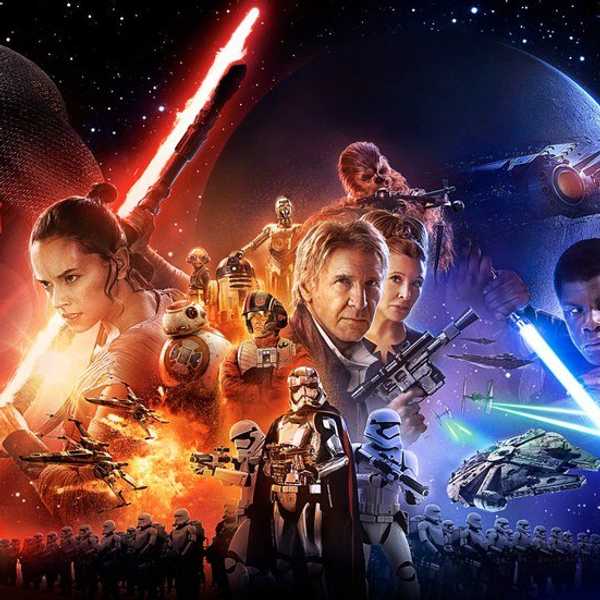

In less than an hour I'm going to go see "Star Wars: The Force Awakens", the seventh installment of the iconic series. Don't worry, no spoilers for those who haven't seen it: I specifically instructed my brother, who saw it on its opening night, not to tell me a single word about it, so I don't know anything more than what's been in the trailers.
When it was announced that a seventh "Star Wars" was being made, I knew it was going to be a big deal, but I wasn't quite ready for the frenzy that's been created around it. Over a year ago everyone it seemed was already freaking out about the cross guard lightsaber. My friends have been making "Star Wars" references on Facebook for months now.
Even Google has recently redesigned everything to include lightsabers and "Star Wars" everything, and gives users the option to "pick a side" and make all their accounts themed to either the dark side or the light side. I can still remember when Episode III came out. I was in elementary school and I had been watching these movies basically since I was old enough to know what a movie was.
Everyone had been anticipating that movie for years because it was finally going to explain how Anakin became Darth Vader, especially for all the people who saw the original trilogy first. Speaking of that, I went to a traveling museum exhibit in Indianapolis a couple of years ago. In it they explained how since the original trilogy was made first but it's set after the prequels, the moviemaking technology was more advanced for the prequels even though the "Star Wars" universe's technology is supposed to be more advanced in the original trilogy. To circumvent that when making the prequels, they based all the ships and vehicles in episodes I, II, and III on 1950's hood ornaments so they would have a retro feel. That's why the ships in the prequels are all made out of sleek shiny chrome and the ones in the original trilogy are all banged up and damaged because they've been in battle.
It's kind of amazing how a story could become so ubiquitous for basically two entire generations. A couple hundred years from now, I wonder if our great-great-great-great-great-grandchildren will view "Star Wars" the same way we look at things like Dante's poetry and William Shakespeare plays. Will future high school students write interpretation papers on the importance of light imagery in "Return of the Jedi" or give presentations on the cultural values demonstrated in "The Clone Wars?" It's funny how much the stories we love say about who we are. I wonder what this one is about to say.