Against all odds, the “Star Wars” name and franchise has lost none of its potency or its impact. What could have easily been a fad with limited ideas instead has survived to the present day with plenty of good ideas—which brings us to this year’s “Rogue One: A Star Wars Story.” Directed by Gareth Edwards and set chronologically between 2005’s “Revenge of the Sith” and 1977’s “Star Wars,” “Rogue One” is proof of the series’ longevity and offers a glimpse into what the series can bring to the table in the future.
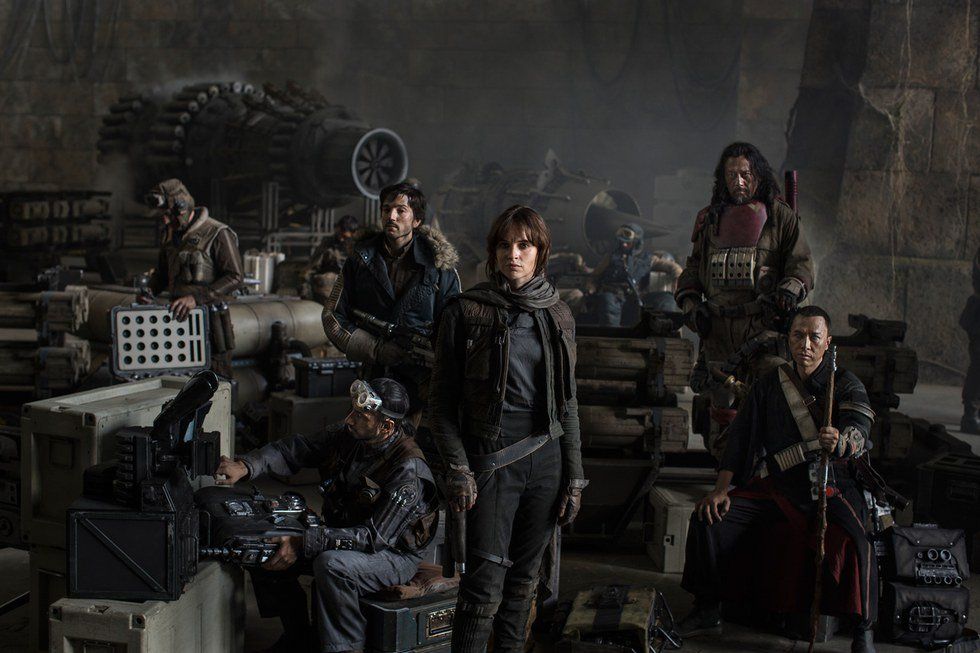
The story of “Rogue One” follows Jyn Erso (Felicity Jones), a young woman who wants nothing to do with the ongoing war between the Galactic Empire and the Rebel Alliance. A cascade of unfortunate circumstances ropes her into a Rebel effort to stop the completion of the Empire’s latest weapon, the Death Star. Alongside Captain Cassian Andor (Diego Luna) and his ragtag band of Rebels, Jyn partakes in a perilous mission to foil the Empire and the Death Star’s designer, Director Orson Krennic (Ben Mendelsohn).
The title crawl of the original “Star Wars” stated that the Rebels and the Galactic Empire were at war with one another, but the magnitude and ramifications of said war aren’t really explored in that film. This isn’t a knock on “Star Wars,” it’s just that it doesn’t focus so much on the war as it does on the exploits of Luke Skywalker and his friends. In this film, the focus is quite the opposite.
Gone are the lightsabers, the prophecies, the old-fashioned heroes-versus-villains setup; in its place are the battlefield, grit, and the true horrors and effects of war. Everything from the militaristic combat sequences, evocative of films like “Apocalypse Now” and “Saving Private Ryan,” to the tragedies of the main characters remind the viewer that the original “Star Wars” and its two sequels took place during a war: a time of conflict that inevitably carries with it death, suffering, senselessness, and loss.
“Rogue One” chooses to explore its central conflict as a clash of ideologies, shying away from the classic good-versus-evil mentality. The Empire, though still portrayed as a dictatorial and intolerant entity, does have some credibility in its efforts to quell insurgent, terrorist-like forces not affiliated with the Rebel Alliance. The Alliance is not just the underdog hero faction we are to root for; they are a political and military organization that, due to the overwhelming odds against them, are forced to gamble with and compromise their morals for the sake of beating the Empire.
These two factions and the conflict between them puts our heroes in a precarious position on the emotional and situational level, leading to revelations about their individual and very different philosophies and beliefs. Though these characters technically don’t have too much background information, they are still developed thanks to the ideological clashes present in their exchanges and interactions. Said interactions reveal motivations and goals to the audience without relying on narrative details. When the heroes finally do see eye-to-eye and unite against their foes, it is gratifying and logical in terms of character progression and narrative themes.
Though there is certainly humor and punchiness to go around thanks to the likes of Donnie Yen’s Chirrut Imwe or Alan Tudyk’s K-2SO, the performances of the cast are expectedly more realistic and toned-down in their roles compared to the casts of other “Star Wars” films. Mendelsohn’s Krennic, for instance, isn’t a mustache-twirling bad guy, but instead is a calculated and intelligent individual who has enough competency to be regarded a legitimate threat and has a serious chip on his shoulder. Jones and Luna portray heroes that are probably more realistic than the likes of Han Solo or Luke Skywalker, evoking a comfortable balance of flaws and strengths that makes their characters more down-to-earth.
The film isn’t perfect, unfortunately; the pacing at the beginning and the end of the film feels slightly rushed and unbalanced. The many events that transpire and characters that are introduced within the first fifteen minutes ultimately amounts to a somewhat tedious mental recapping of all the little details. It isn’t impossible to follow, but transitions in this beginning portion are jarring at times and not given a whole lot of context. Additionally, it seems like the end of the third act could have used a bit more of an epilogue or reflection; as is, it seems that there is something missing from the ending though it isn’t a complete disappointment.
All in all, “Rogue One” is not your typical “Star Wars” film, and that’s definitely a good thing. The film succeeds where the prequels failed, expanding and enriching the lore while also standing on its own two feet with a robust, original story and grounded, kinetic cinematography. Even if you’re only a casual “Star Wars” fan, “Rogue One” is a fine action film and will certainly do much to remind you of the franchise’s versatility and creativity.