There have been scores of writers who’ve entered into my life and influenced my creative spirit, men and women who have in one way or another given of themselves so freely, pouring metaphors and dreams into my brooding skull and setting me on my path towards the end goal of becoming the man I was meant to become. There was Daniel Keyes, who gave me Flowers for Algernon, tied with another book I’ll discuss later as my absolute favorite novel. Harper Lee wrote a singularly important Southern novel in To Kill a Mockingbird, and for that she helped me in cementing my own backwoods identity even amid all the racial tensions. Even Harlan Ellison, known as a cranky old man long before he reached his eighties, proved his deep rooted love for humanity and ethics, in stories like “Paladin of the Lost Hour,” “The Deathbird,” and “I Have No Mouth, and I Must Scream.” So many authors who raise their voices to sing; so many stories who preach to me of the hidden secrets of the universe…And yet here I am stuck on this third rock from the sun, with no way to take my leave of home to find new landscape to make my own.
And so I am left to wonder, to even ask myself: Will there ever be one voice to take me away from here?
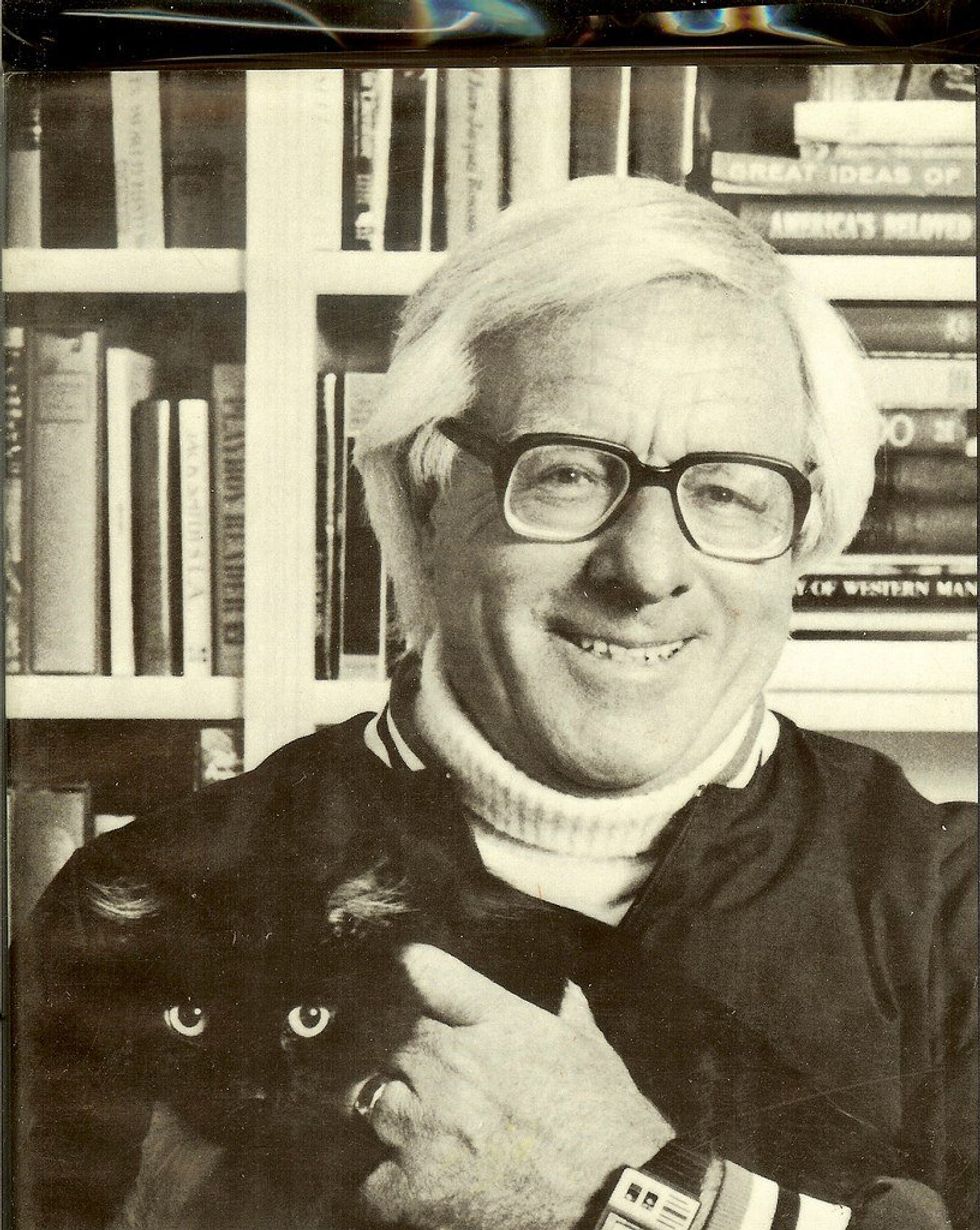
There was, in fact, one such voice—Ray Bradbury, born August 22, 1920, and died June 5, 2012. The man who wrote such gems as The Martian Chronicles, Dandelion Wine, and my other favorite novel, Fahrenheit 451. Sprint-runner of the short story, traveler who journeys to far off metaphors in space and the shaper of Martian-Egyptian myth, here is a man who not only shaped contemporary science fantasy as pure literature, but he also transcended the forms of genre to give us words of poetry within every paragraph. Ray Bradbury, the author of From the Dust Returned and Something Wicked this Way Comes, came as the triumphant prophet, preaching words of hope against the sorrows of man; he was to return to space, where the stardust from which we were made opens its arms in welcome. Ray Bradbury was, to put it mildly, a spiritual and literary father figure to me, helping to shape and mold me into the writer I am to become.
Imagine my sorrow, then, the deep and excruciating pain that no man, woman or child should have to face, when I received word of Ray’s passing that June morning in 2012.
Ray Bradbury was only 91-years-old—he was still a kid in my book!—and yet his failing health had finally caught up with him, and the ones who make such decisions decided to help him cross that bridge. Here was a man who opened one novel thusly: “It was a pleasure to burn.” Now stop and think about such a sentence—so simple, not a single deafening or opaque word, and yet the sheer poetry that comes only out of the hands and lips of a master poet, a man who sent us onto the surface of Mars but who never drove a car. A quintessentially brilliant paradox of fire and ice, Ray Bradbury breathed a cavalcade of fire and ice sculptures, creating new visions out of thin air and repainting the American literary landscape.
Ray Bradbury was a man outside of my own family who felt like he’d never left my side my whole life. In many ways this dreamer had saved me from the depths of loneliness; as an only child in a family largely comprised of adults, as a bookish weird kid who dreamt of far off wonders, I often felt as though I could never been of the same cloth of another human soul. Ray Bradbury changed that for me, for he showed me that he had been my twin.
Imagine, then, my sorrow when my mother told me of Raymond Douglas Bradbury had died the morning of June 5, 2012. I had been planning to meet the man and hank him for being who he was, and my mother had made preparations for such a meeting to occur—but the months were too long, it would seem, and no matter how immortal a genius may be his body is still rather limited. And so the man who showed me Mars had finally received his due rest, and I could not offer him thanks for showing me what it is to be human. I cried so heavily for my lost chance at offering gratitude, but even more heart wrenching was the guilt I carried for how selfish I felt at bearing this burden. My mother herself felt just as harshly as I, and my father could only watch as the dark tapestry of grief unfurled itself.
Among the hundreds of stories written by the man who was to become my idol, there exists one early tale, entitled “The Lake” (the story, in case you are unfamiliar, can be found in the collection The October Country). Bradbury tells how he cried for the first time over anything he’d written with this piece, for it was with this one that he finally learned to sing with his own natural voice. Recalling a childhood memory where a girl who he’d played with on the beach sand had gone out and drowned in the water, a young writer had hoped to use his story to bring her back to play. Realizing that in literature he could resurrect the dead, Bradbury gave unto the world a vehicle in which to so beautifully and miraculously grieve into a better tomorrow. This is a strong testament to the human condition, and to the hope of the human heart to continue living.
Rereading the story I try and call back my idol and breathe new life into his nostrils.
August 22, 2016 would have marked Ray Bradbury’s 96th birthday, but if you had known the man while he was alive you could maybe find a certain youthful chuckle tucked deep inside his smile, and a glow wrapped around his eye. The one who read Edgar Rice Burroughs’ novels depicting John Carter of Mars and created his own Red Planet Mythos had recreated the dream of exploring space. It was because of Bradbury that I so strongly support the efforts of NASA to learn about the cosmos. And as I long for the dream to come to fruition, I look up at Barsoom (John Carter’s word for Mars), and proclaim, “Take me home!” In the world of letters and imagination, I can still find comfort in knowing that in some small way I can show gratitude to my second father, a man who gave birth to my every creative dream.
Ray Bradbury, I hereby pull you out of the lake; your memory shall live long and be prosperous, so long as I have anything to say about it. There shall be no fear in death, for your words have given proof to the hope cobbled together and flung out among the stars. The time for tears has come to an end; now is the time for action.
Ladies and gentlemen, there is power in the blood that courses through the ink stained pages, and none is more vibrant than the words of Ray Bradbury, the native son of Green Town and the curator of the finest in dandelion wine. I may not have gotten to thank the man while he was alive, but I can make for darn sure that his name will live on forever—for that’s what the best stories do, is to inspire us to live on forever.
And so I again raise a glass to the memory of one of our greatest writers, recipient of a Pulitzer Prize special citation and a Presidential Medal of Freedom, a man who dared to remain a child on into late adulthood and came out victorious in the end when he left for the great, otherworldly playground in the afterlife. I believe that Bradbury is the Patron Saint of the Imagination, and I will not be quarreled with. His was a light that was a pleasure to burn, and his light shown all the way to the city where we met to make our dreams come alive. How else does one make a legacy on this dusty blue-green planet?
Make your bed in your house up on a Martian hill somewhere, Mr. Bradbury. I shall soon make like John Carter and stretch out my hands to join you.