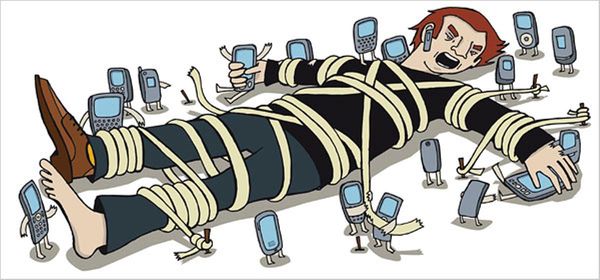

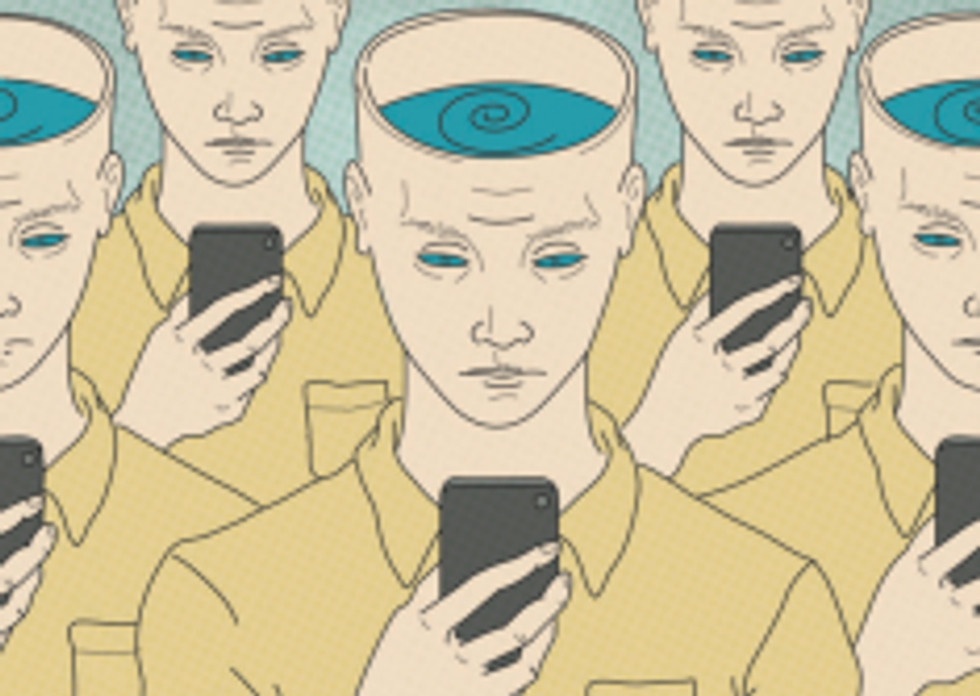
In my last piece, I observed how one falls into the great, never-ending spiral of the internet. Now, I have the research to explain how it is affecting us and the human race.
When I first started writing the previous piece, I thought back to watching a recent video released by the YouTube channel AsapSCIENCE titled, "How Is Your Phone Changing You?" For those who haven't heard of AsapSCIENCE, run by Mitchell Moffit and Gregory Brown, check their channel out. Their videos include scientific research ranging from study habits to "What if the world became vegetarian?" and so on.
One of the observations that astonished me was that when looking down at your phone, your spine angle is the same as having an eight-year-old child sitting down on your neck. On top of that, people spend an average of 4.7 hours a day on their smartphone. If you add that to time spent on your computer, it could increase your chances of getting myopia, or nearsightedness. While in the 1970s one-quarter of the U.S. population had nearsightedness, now, it's nearly half!
To explain the reason why we can't get off of our phones, the game app "Candy Crush" is given as an example. While achieving little goals throughout different levels, your brain rewards you by giving you little bursts of dopamine, a neurotransmitter that regulates the reward and pleasure parts in the brain, all the while producing new content as you progress through the game. This creates a "compulsion loop" which is also found when addicted to nicotine or cocaine. This is why social media apps are designed to provide new content and notifications, which makes it hard to ignore them.
This leads to research saying that 93 percent of young people say they use their smartphone as a tool to relieve boredom, compared to going out with friends or reading a physical book. This type of repetitional behavior has lead to "nomophobia," a fear of not having some form of technology on someone's person. Is this starting to sound familiar?
And to make the findings even worse, being on our phones has changed our brain patterns as well. In the brain, there are two types of patterns: alpha rhythms, which concentrates on "wakeful relaxation," and gamma waves, focused on conscious attentiveness. According to experiments, if a phone starts ringing, these waves increase in power and make your brain function differently. And don't forget about bringing your phone to bed and losing sleep due to the screen's blue light.
After watching this video, I wondered if there were any similar articles related to this subject matter, and to my surprise, AsapSCIENCE left links to numerous articles for further reading, that also related to their research for their video.
In a TIME Magazine article, it is noted that in a 2015 study, it is found that some people feel like their phones are a part of them, like an extension of their arm. In a New York Magazine article, psychologist Bill Thornton led an experiment where statistics students either kept their phones on their desks while they were tested or had them stowed away. Thornton and his colleagues found that the group of students without their phones present did better than the group who had their phones in view.
With all of the research that has been put into understanding society's struggle with letting go of the phone, from different psychologists, researchers and creators alike, the facts clearly show.
Now for noticing the tell-tale signs of addiction, I diverged from Asap's list and found an article from The Telegraph, which gives a summarized list of questions on what you need to look out for:
1. Do you feel like you lose track on time when on the Internet or smartphone?
2. Do you become irritated when you are interrupted?
3. Do you feel guilty afterward?
4. Do you isolate yourself from people, including your friends and family?
5. Do you feel calm when on the internet/smartphone and/or panicked when offline?
6. Have you developed dry eyes, aches, gained weight, or had sleep disturbances?
Looking at this list myself, I have fit all of the criteria on the list! As a highly emotional person myself, I have experienced feelings of irritation and particularly extreme guilt, where sometimes, I would be crying and criticizing myself for not having any self-control, because that is what it comes to. This clearly shows that this phenomenon is not to be taken lightly; it's all psychological. It should be treated like any other addiction out there, even as an illness.
When I started becoming more aware of my addiction, I felt as though I have been unraveling this whole time like my mental growth was turning backward. While I was doing my homework diligently in middle school, I was procrastinating near the end of high school. I feel as though my mind has been numbed to not appreciate my achievements and the little things in life. When I graduated high school, walking out onto the field in my black gown and cap, I didn't feel in my heart that I finished my primary education, and only now, as I'm writing this, three weeks into summer vacation after my first year of college, I finally recognize and accept that achievement with pride.
I'm missing out on what the world has to offer - the big, beautiful world outside my window. I still have lots of years left to live, I have already wasted four of them, and I don't want to spend my days plugged into the virtual world. And I think all of us are starting to recognize that now. What better time to recognize this early on in the game.
Next week, I'll come back with suggestions on how to spend less time on the Internet, social media and on your phone. Now is the time to figure out how to regulate our use so that we don't miss out on what really matters.
Our passions.
Our friends.
Our family.
Causes worth fighting for.
And the world surrounding us.