

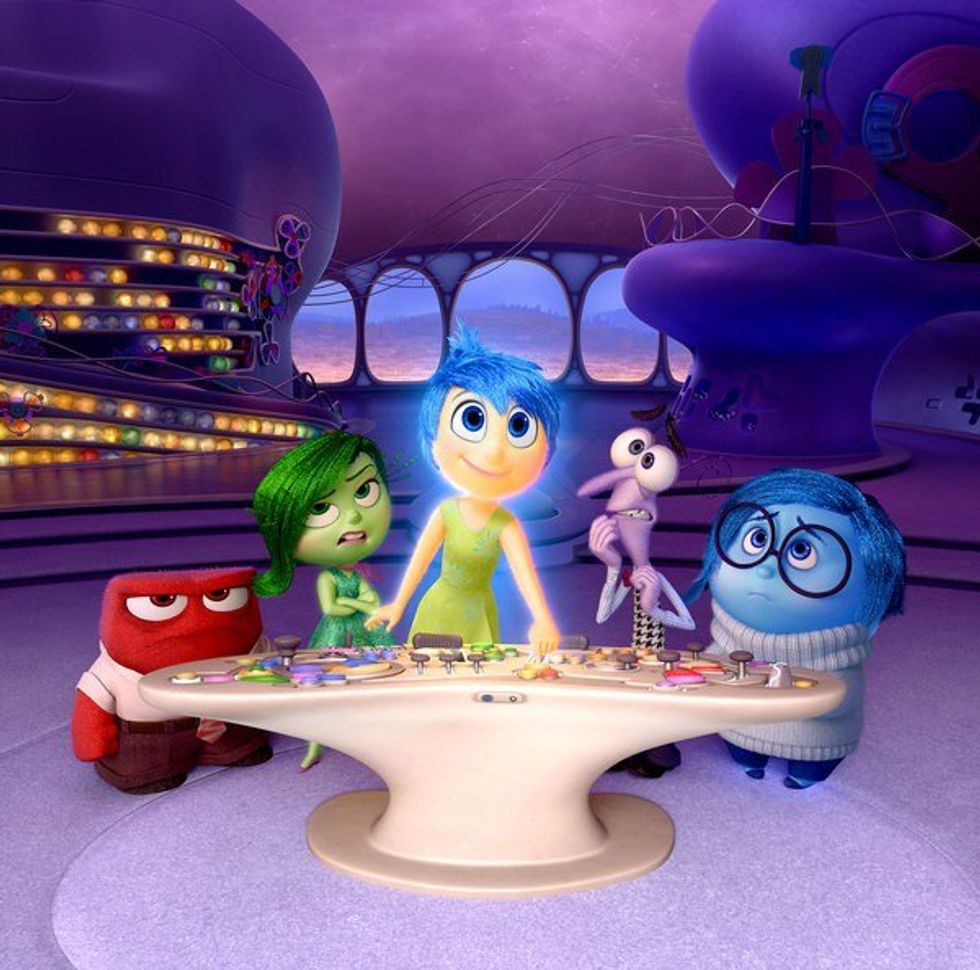
"Inside Out," Pixar’s newest animated creation, is an entertaining and endearing story of a young girl’s childhood and struggle to adapt to her family’s move from Minnesota to California. This movie is about how five emotions — Joy, Sadness, Fear, Disgust and Anger — control the mind of 11-year-old Riley.
Joy, an upbeat and positive character, whose goal is to keep Riley happy, primarily controls her personality. However, as seen as the movie progresses, Sadness is the emotion that ultimately affects Riley’s fate. While Pixar portrays sadness as a downbeat and lazy individual it has actually been proven that the emotion of sadness can empower someone to make changes to their life for the better.
Not only does Pixar do a fantastic job of embodying each emotion, they also successfully portray how memories form us into the people that we are. Each person’s personality is made up of a few core memories that forever impact us. When Sadness taints Riley’s core memories with a blue hue, her thoughts and feelings are changed as well. Joy, afraid of what Sadness might do, discounts her feelings and attempts to keep her at bay without much success.
Disaster strikes when Riley’s core memories are threatened and begin disappearing, thus slowly destroying Riley’s disposition. Joy and Sadness are also accidentally thrust into the depths of Riley’s mind leaving the other three emotions in charge of Riley. Joy and Sadness must race back to headquarters to restore her memories and prevent her from inevitably making a rash decision.
While "Inside Out" is a children’s movie, there is actually a great deal of psychology that went into the making of this film. As explained by the New York Times, “Studies find that our identities are defined by specific emotions, which shape how we perceive the world, how we express ourselves and the responses we evoke in others.” Basically, emotions guide our decisions and our moral thinking.
The way this film portrays and explains the connection between emotion and memory is fairly consistent with what we know scientifically. Every day when Riley goes to sleep we see the conversion of critical memories from short-term to long-term memory. Sleep does in fact help with consolidating memory. We also see how memories that are no longer relevant are forgotten in order to make room for new ones.
By the end of the movie the audience learns a few important lessons. We learn that while we might wish to push certain emotions away, its important to let yourself acknowledge all of them. You can either be overwhelmed by an emotion or accept the way you feel and move on. Each emotion is critical to someone’s development and shapes the decisions one makes.
Pixar even reveals that it is possible to feel contradictory emotions at once such as sadness and happiness. However, the most important lesson, in my opinion, is the fact that emotions are universal. No matter what you might be feeling, someone else is experiencing something similar. This knowledge validates what we’re feeling and reminds us they we are never alone.