In a diverse space, practicing Muslims bring their practice with them, no matter where they are from. This practice includes, foremost, the five daily prayers. They are one of the most important parts of the Islamic faith. Prayers are multiple times daily, and an inextricable part of the routine of many. In largely non-Muslim spaces, like the American public sphere, Muslims find themselves exerting significant energy into navigating them in a way that does not compromise their faith. In this article, I will talk about how Muslims at my college deal with the unique struggle of praying in a place where, except inside their dorms, they are always in public.
For a little introduction, Humans of New York’s April 2014 photo captures many facets of what prayer is to Muslims, especially in the public sphere.
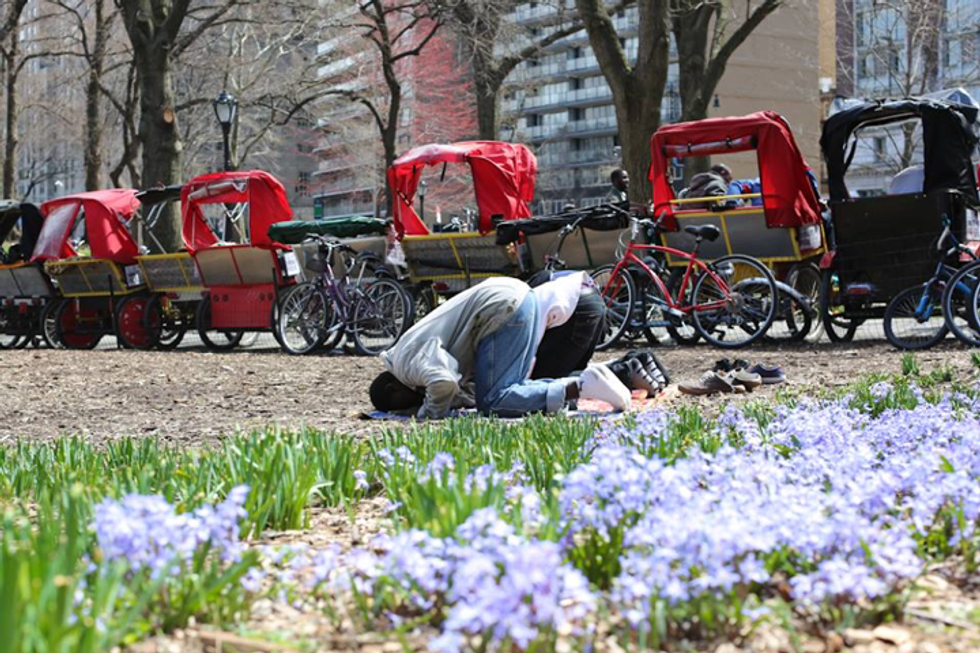
It shows two Muslims praying in Central Park. At the moment the photo is taken, they are deep in the sujood position, one of the many steps that must be followed in their respective order to pray. The Salah, as the prayer itself, and the system of five daily prayers, is called, can be prayed anywhere at all. According to a saying of the prophet Muhammad ﷺ Allah has made the whole world a mosque for Muslims, so one can pray anywhere that is convenient, and fairly clean. The prophet ﷺ even prayed in sheep pens if a mosque was not nearby. The timings for prayers change a little all year, as each prayer time is associated with the position of the sun. Moreover, each prayer has limited time. For example, the early morning prayer, Fajr, must be prayed after the first ray of dawn, before sunrise. Hence, the need to be able to pray anywhere at all when on the go, or at work etc. arises.
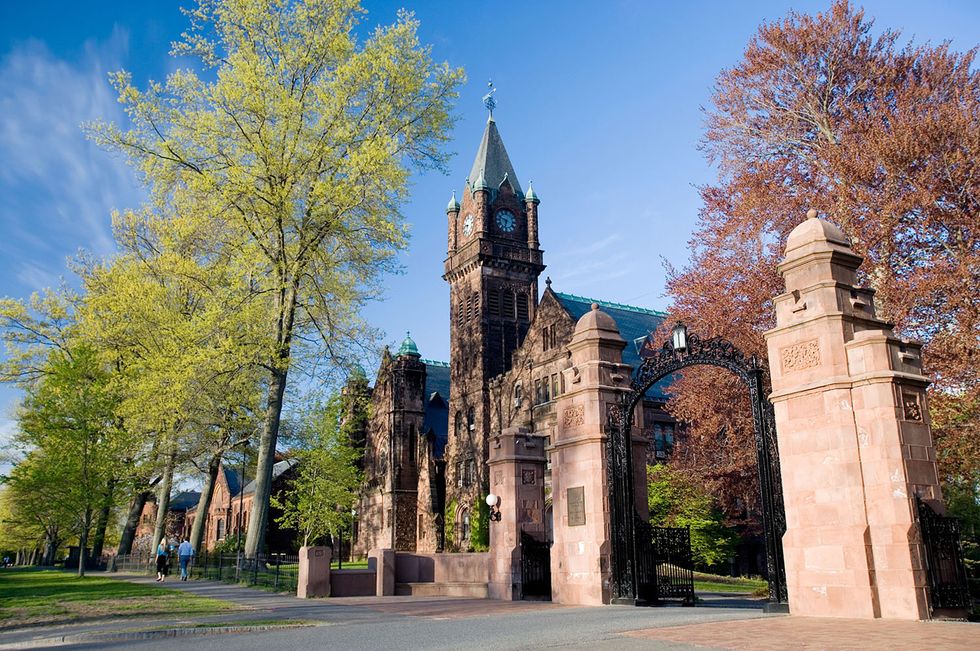
During my first days in college as an international student, I thought that praying would be a breeze, even though my dorm was pretty far from the academic buildings. The college that I attend, Mount Holyoke, takes pride in its diversity. It is equipped with a whole building dedicated to Religious & Spiritual Life, namely Eliot House, center of various spaces for different religions. In the basement, equipped with prayer mats, prayer-beads, head-scarves, and other cover-ups like skirts, is the Muslim prayer room. Moreover, there is a large Muslim community, people all from all over the world with different faiths; even the majority of American white students are respectful of diversity, and passionate about social justice. While improvement is needed, Mount Holyoke might be one of the safest public spaces for a Muslim in America.
The prayer room and the assurance that the community is respectful are the good parts about praying in Mount Holyoke. Eliot House’s prayer room was instrumental in keeping my prayer habit strong in college. Because I did not go back to me dorm before night time, I had three prayers to perform outside the comfort of my own room. Most of the year, I prayed all three at Eliot. The same was true for my friends. Especially in winter, when the days are short, and prayer times are condensed one after the other, we started staying in the prayer room all day. Soon enough, we had a little Eliot community that prays, studies, eats, complains and even takes naps together. We pray in congregation, which is a group prayer with a leader. In between the prayers, we make chai, and other teas using the supplies in the main room, and do homework, or shop online, and discuss the trivial and the profound. During the day, many other Muslims drop by for one or two prayers as well. As someone unaware of the community in the prayer room till after the year ended, Wafa Zahid Malik ’20, expressed that she would have greatly benefited from the experience had she known. She plans to be more active next year, to reap the emotional and religious benefits of praying in congregation.
While Eliot House is a significant resource for Muslims on campus, Muslims at Mount Holyoke believe that the college can definitely do more to facilitate prayer. Especially in the cold, walking frequently to Eliot from the library, or Blanch, where many students spend most of their day, is a time-consuming hassle. Many times, when my group of friends is having a good time in the prayer room, I don’t go there to avoid distraction from work. Although Muslims can pray anywhere at all, not everyone is comfortable with being seen performing an alien ritual. Additionally, Malyun Hassan ’20, pointed out that it is aggravating to spend a lot of energy to “play hide and seek or something to find an empty room or cubicle to pray”. Therefore, Muslims have been asking for designated prayer spaces in major buildings in the college, at least in the library. Such a space would remove the need to spend significant time and energy into looking for a place to pray. Moreover, like Malyun suggested, posters in these spaces explaining what prayer is, and marking the area, would also remove the awkwardness of looking strange. Tehreem Waqas Mela, ’20, felt that the Muslim advisor and chaplains at Eliot House were under the impression that we are asking for something much bigger. They thought that prayer spaces must be big, proper, and well-furnished. While that would certainly be nice, we are not asking for a large, lavish room. We want nothing more than simple posters in some quiet areas of the library, designating some small, existing spaces for prayer. A significant number of Muslims study in the library. They need to pray. This is a small, valid, and justified demand.
Other Muslim students also want a little more from the college to acknowledge their need to pray. Many classes and labs at Mount Holyoke are scheduled from 1 pm to 4pm, right around the time for the afternoon prayer. While Islam provides relaxations, like allowing one to miss and make up later if they are in class, for many Muslims, missing prayer is unthinkable. It is a habit since their pre-teen years, that helps them stay focused and refreshed throughout the day. Asiya Jawed ’19 says she would love it if there was a special prayer break in afternoon classes. The prayer does not take more than ten minutes in most cases. Moreover, aside from the existing Jummah Lunch, one of the other things students like Aicha Belabbes ’19 wish we had, is actual Jummah (Friday) prayer. It is a compulsory congregational prayer with a sermon every Friday, a tradition that all Muslim countries and communities abide by.
For Mount Holyoke College, having Muslim students on campus must extend beyond just admitting them. Mount Holyoke must genuinely accept the practice that makes us Muslim. We are members of the community too, and must be truly welcomed in this space. Prayer is part of our identities, and one of our most pressing daily needs is to be able to pray with ease, and dignity. One prayer space at a corner of campus, which most non-Muslims are painfully unaware of, is not enough. We exist in this space, all over it, and are as much part of it as anyone else.