
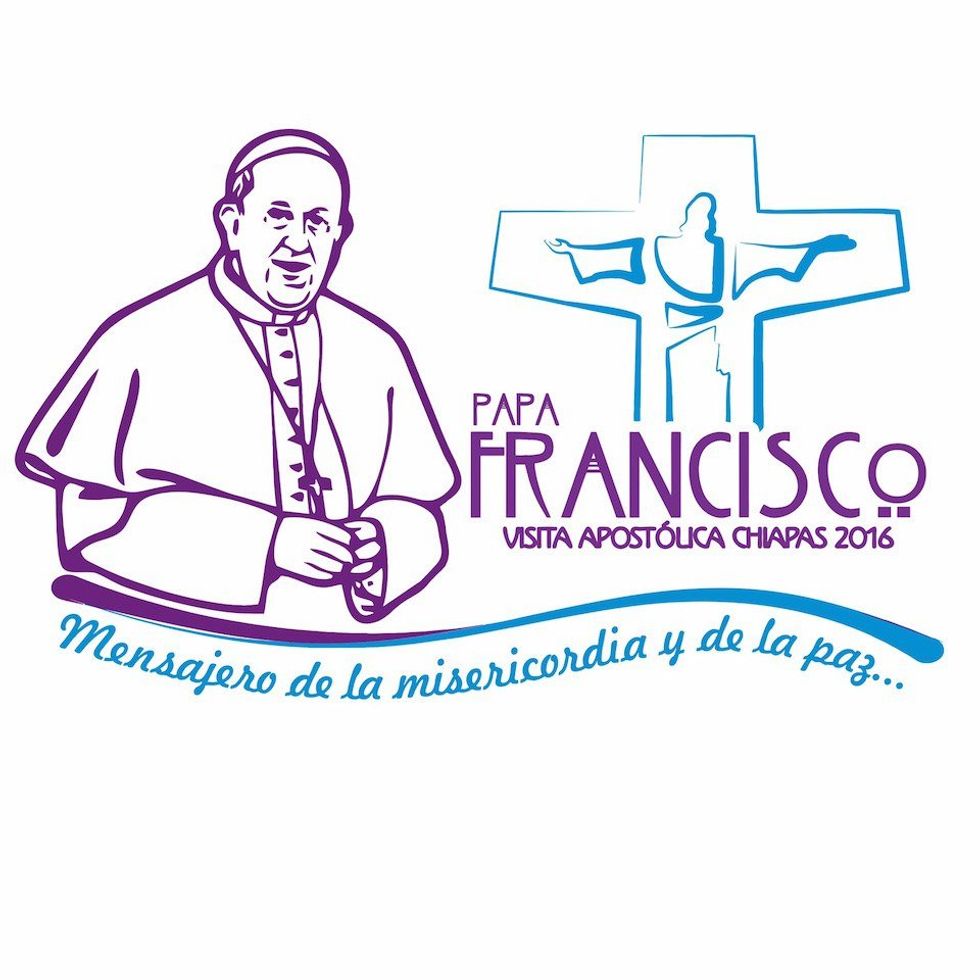
We all know Pope Francis.
He is surprising the world with his particularly outspoken take on Christianity. I mean, most people, secular and religious, heard about his "controversial," who am I to judge comment regarding homosexuality. If you turn on Fox News right now, they are probably saying he's too political and are getting after him for chastising the Donald.
But he is the first Latin American Pope, and in Latin America the radical message of Jesus has met politics over and over again. Here we can picture the independence marches of Miguel Hidalgo in Mexico under a banner of la virgen de Guadalupe, the creation of liberation theology (which was condemned by Pope Saint John Paul II), and the martyrdom of Saint Oscar Romero.
Yet, with regards to His Holiness, last week, he surprised us yet again as he headed down to the southern part of Mexico, the impoverished state of Chiapas, the site of the Zapatista uprising in the 1990s and the home to a mostly indigenous population of Mayan origin. Not only did he authorize the use of indigenous languages in the Mass while in Chiapas, but he also stood in solidarity with the people of the state and other marginalized groups around the world as he took a shockingly ecumenical turn in his homily and quoted the Popol Vuh.
Now, the Popol Vuh, also known as the Book of Advice (Libro del consejo), is a work of biblical significance for the Maya. Thanks to a Spanish-American Literature class I took last semester, I was able to read and study part of the Popol Vuh and, now, recognize the profundity of its usage in the Pope's homily.
Originally written in the Quiché language, the work records the myths and history of the people of southern Mexico. The book was written after the Conquest as the language took on the Latin alphabet, but it still followed the same traditions created by the hieroglyphic nature of the pre-Colombian language. It would be authoritatively translated into Spanish in the 19th Century and into English sometime after.
So, drawing on the socio-political implications of such a work and using the religious wisdom of an often forgotten heritage, the Pope ran full throttle at what he aptly calls our "throwaway" culture. According to a transcript provided by the National Catholic Register, he proclaimed, "[God's] word, his law...becomes a symbol of freedom, a symbol of happiness, wisdom and light. It is an experience, a reality, which is conveyed by a phrase prayed in Popol Vuh and born of the wisdom accumulated in these lands since time immemorial: 'The dawn rises on all of the tribes together. The face of the earth was immediately healed by the sun.' The sun rose for the people who...have walked in the midst of history's darkest moments."
In one fell swoop, His Holiness validated a whole civilization and their history and "all the tribes together" who have walked in darkness. The Pope continues, highlighting "the yearning to live in freedom" that is shared by all people who yearn for "a land,...a time when human corruption will be overcome by fraternity, when injustice will be conquered by solidarity and when violence will be silenced by peace." Allying all people together under the wisdom of a forgotten people, a marginalized group, the "other," Francis is able to call us all together to "examine our consciences and learn to say, 'Forgive me!"
He asks us to cling to this ancient wisdom as we figure out how we can stand as "all the tribes together," as one humanity. Frankly, I don't see this as too political.