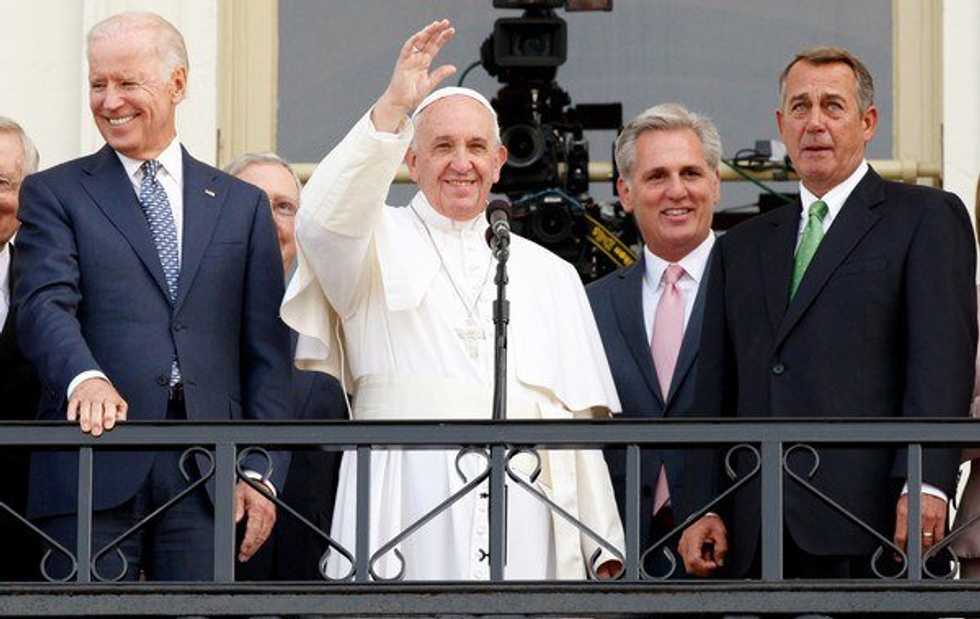
Pope Francis (Jorge Mario Bergoglio) spoke to the United States Congress on Thursday, Sept. 24, 2015 as the religious leader of the Roman Catholic Church and a minister. His speech resonated like a sermon throughout the chambers of the House of Representatives. He incorporated American political thought, social justice, socioeconomic inequality, immigration, and the sanctity of the family into his one hour discourse, while at the same time appealing to Republicans and Democrats.
The pontiff referenced Abraham Lincoln and Dr. Martin Luther King, Jr. as two emblematic figures which represented the American values of representative democracy and liberty. Moreover, he urged Congress to remember their obligations to the people they represent. I doubt many of the representatives heeded his advice, yet, I hope that some of his words permeated the minds of our public servants. A good portion of college students fears Congress’ inability to compromise and remain true to a principle of this country’s founding: statesmanship.
Pope Francis elaborated his dialogue by imploring a universal abolition of the death penalty. He based his argument on social justice and church doctrine. Stating that rehabilitation needs to take precedence over capital punishment, for all people serve a purpose in the eyes of the creator. The pontiff certainly declared his opinion to the 31 U.S. states with the death penalty, the U.S. military, and the federal government. Perhaps a moral dialogue will change U.S. public policy on capital punishment, however, not at the current moment.
Further, the Pope talked about socioeconomic inequality, which many college students believe is a primary issue in the 2016 presidential election. A lasting question in the minds of college students is the following: how will our generation deal with years of economic policies which marginalize the poor? Once more, Pope Francis cites Church teachings as his basis for advocating on behalf of the poor. Additionally, his upbringing in Buenos Aires, Argentina and witnessing firsthand how the poor live informed his critique of unfettered capitalism. The pontiff’s continuous mentioning of the peripheries, in regards to the poor, reminds us that a world beyond our territorial borders suffers as a consequence of our actions; especially within our borders, in our cities and towns, countless U.S. citizens are living merely to survive. This issue, unfortunately, falls within the political party lines in our country and will require political action, regardless of which faction seeks to advocate on this front. Let us hope those politicians who eagerly stood up and applauded the Pope during his speech take action.
Immigration, another issue Pope Francis vehemently champions, took center stage in Congress, which cannot agree on comprehensive reform. He attempted to appeal to the history of the U.S. and the debt we owe to all the immigrants that helped build this nation. While the majority of Democrats stood up and hailed him for his statements, the rest of the folks in attendance remained glued to their seats. Students at the City University of New York support comprehensive immigration reform, on the state and federal level. Furthermore, we at the City College of New York and CUNY believe that families should remain together.
Pope Francis’ last point, the sanctity of family, touches on another key component of Catholicism and any religion quite frankly. He affirmed the importance of the family unit, without specifying the ideal family for a reason and his political savvy triumphed in this instance. For which politician can argue with the statement that we must value families?
Although Pope Francis cannot change the Church’s stance on all issues which college students care about such as allowing women to become priests, reproductive rights, and same-sex marriage, he undertook the path of inclusion, welcoming everyone to discuss issues with the goal of agreeing on some issues. Pope Francis believes that addressing poverty, capital punishment, and immigration are issues the American people can agree upon. The question remains, will the moral argument prevail on these public policy issues?