
There are certain names that never die, and there are other names that fade into obscurity while only their works continue on. Names like Victor Hugo, Charlotte Bronte, and L. Frank Baum are names that are often overshadowed by the works they created. Other names like those of Mark Twain and William Shakespeare, hold just as much-if not more-weight than the writing they left to the world. There is a third name, often heard around this time of year, that holds a place along the wall of those that never fade.
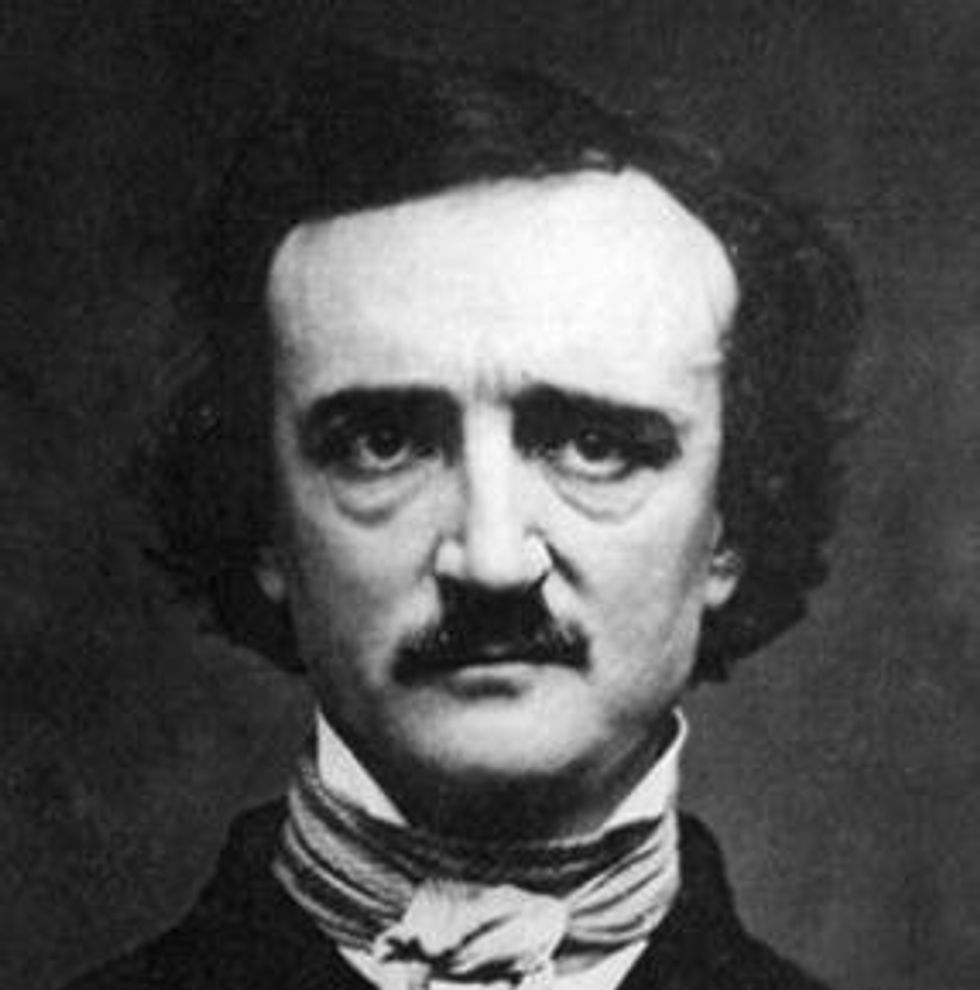
Edgar Allan Poe is a name familiar to most students. Some of his works have been appearing around Halloween since middle school. Teacher favorites generally include poems such as "the Raven", "the Bells", or "Annabel Lee." The most notable of these works would have to be "the Tell-Tale Heart." Other works often seen in a classroom include "the Pit and the Pendulum", "the Cask of Amontillado", and finally "the Fall of the House of Usher." Those with sensitive stomachs may wish to avoid "the Pit and the Pendulum" since little detail is spared in his depictions of horror.
Most can agree that his writing stemmed from a life that continued to deal Poe a rough hand from birth until (and even after) his death. Poe was seen as dreary, despondent, and often dressed in black. This appearance was often reflected in many of his works. In his piece entitled "The Bells", Poe talks about all the bells one may hear in a lifetime. The bells range from sledge, to marriage, to alarm, and then the dreadful tolling of the iron bells. Each section becomes longer than the last until more than a page reveals "the moaning and the groaning of the bells."
Even Poe's shortest work reveals a common thread to his writing. It is rare to find a writer with the ability to craft a one sentence poem. However, Poe managed to make one line of text contain a world of meaning in his poem "Deep In Earth." The poem reads:
"Deep in earth my love is lying And I must weep alone."
Poe often wrote about loss of a loved one in his work. "Annabel Lee" is a perfect example of that. In the piece, one line of text holds room for the audience to include their own interpretation. "My love" could mean any number of things, especially in this day and age. That is up to the reader to decide.
Poe's other works focus on any number of ideas, though some are more violent than others. "the Cask of Amontillado" is a tale of revenge where the character Fortunato wronged the teller one too many times and ultimately pays the price for his greed: "The thousand injuries of Fortunato I had borne as best I could; but when he ventured upon insult, I vowed revenge." If only Fortunato's name had allowed him to be what it sounds like. It was a most unfortunate tale for him.
"The Tell-Tale Heart" is another tale of misfortune. However, this time the narrator was driven by guilt instead of revenge. It shows that a murder committed in cold blood for an utterly pointless reason can drive a man to the brink of madness. The steady thudding of a heart long dead can easily tick away the time and one's sanity. With writing like this, it is easy to see how people could hold a poor opinion of him.
Questioning of his literary works aside, he has actually made various appearances in semi-recent pop-culture. The movie The Raven (which came out in 2012) features Poe attempting to catch a serial killer that was inspired by his writing. The movie itself does make more sense if one is familiar with the mentioned or referenced works. The band Creature Feature also released a song called "Buried Alive" (released in 2007) which contains a slew of references to his writing.
Edgar Allan Poe remains a relevant name, and not just around Halloween (though that certainly helps). His writing will continue to enthrall and inspire fear long after his name is forgotten to the tides of time.