
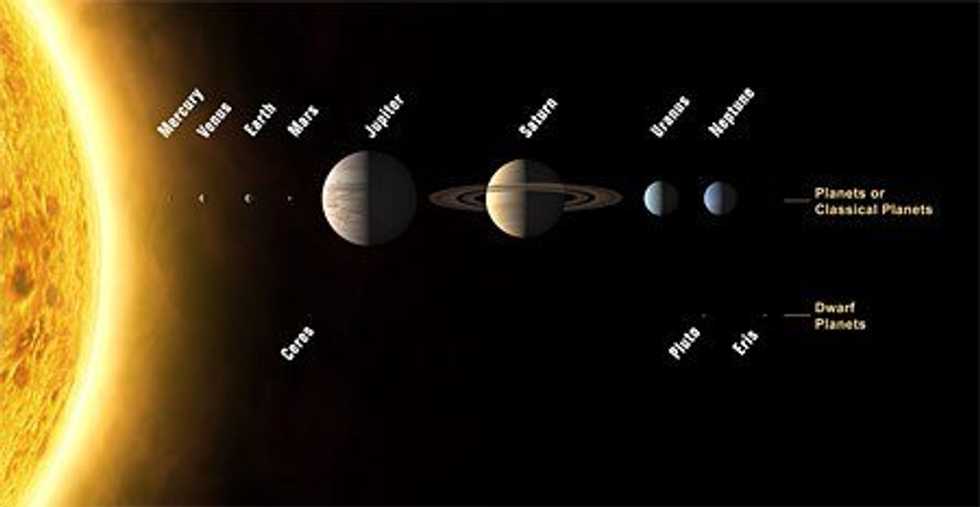
Planets are pretty cool, and the one we live on seems to be pretty unique. What's even cooler is that our known solar system, the collection of planets that belong to our sun, hasn't really gotten bigger over time. Uranus and Neptune (planets seven and eight) are the only ones to have been discovered since ancient times, and that was well over a hundred years ago (1781 and 1846 respectively).
Recently, astronomers have been watching the sky and have found substantial evidence for a ninth planet well past Neptune. Neptune sits approximately 30 AU (astronomical units) away from the sun, which is 30 times the distance from Earth to the sun. The supposed "Planet X" could sit between 600 to 1200 AU away.
This is all very exciting, but a ninth planet? It's hardly new information that Pluto is no longer considered a planet, but many people find it hard to let go of that special little rock. In a stunning turn of events, one of the astronomers at the front of "Planet X's" discovery, Mike Brown, made an earlier discovery of Eris in 2005 that led the IAU (International Astronomical Union) to formally define a planet; a decision that would result in Pluto's demotion.
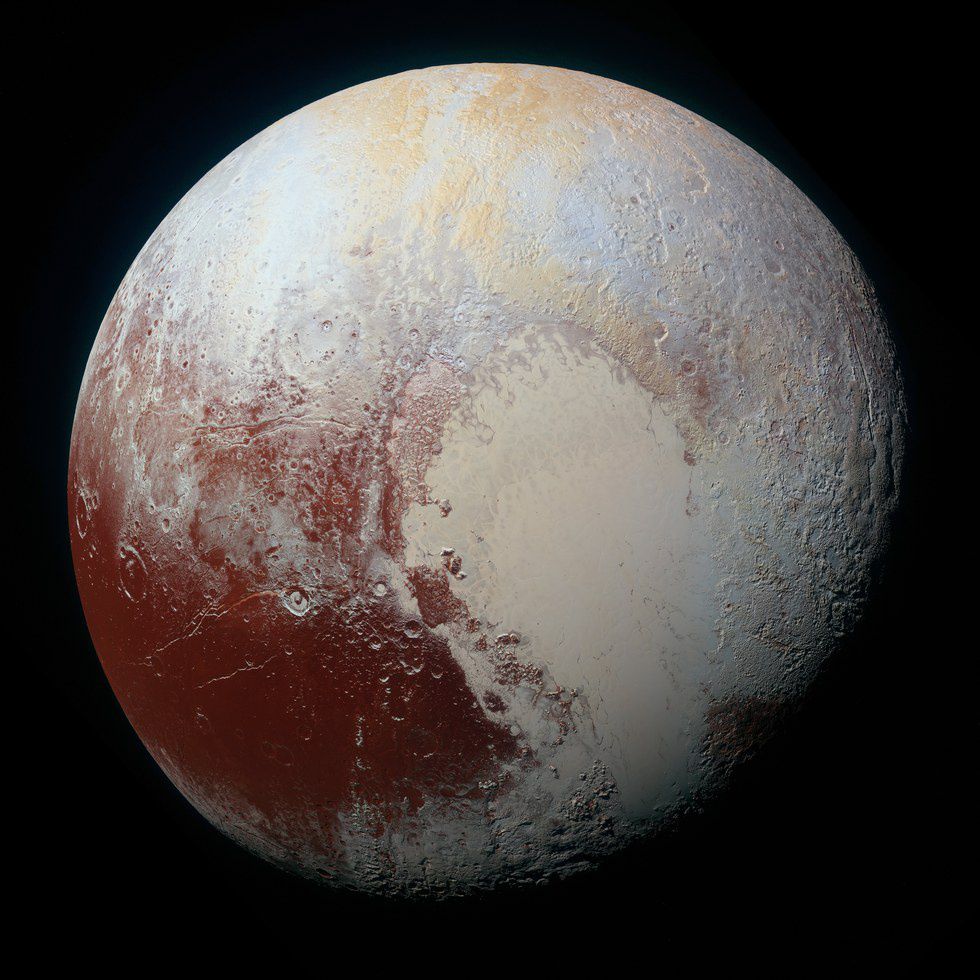
So what was it about Eris that took Pluto off its pedestal? And how does this new planetary definition exclude Pluto? First of all, what exactly is Eris? It is a planetoid object orbiting the sun past Neptune, and very nearly inside of the Kuiper Belt. The Kuiper belt is similar to an asteroid belt, but composed of ices rather than rocks, and exists just beyond Neptune's orbit. Eris's orbit takes it through this field of ice along with its moon Dysnomia.
How then did the discovery of Eris result in Pluto's fall? The term planet had not been formally defined before Eris, but was commonly held as an object orbiting the sun that also owned a moon. The issue Eris brought up was that if these were the only requirements for a planet, there are an abundance of relatively tiny objects that fulfill the classification.
A planet then is:
1. An object that orbits the sun
2. Has enough mass to form a nearly round shape, and
3. Has "cleared the neighborhood"
That last bit is what keeps Pluto from being a planet. The phrase "clearing the neighborhood" refers to the gravitational dominance of an object; essentially it needs to be the largest object in its orbit. Pluto does not reach this criteria, and as such is not counted among the planets.
However, Pluto's not gone, it's just been given a new title, Dwarf Planet. Things do look exciting for another addition to our solar system with this potential new planet. No name stands for it yet, but everyone has their own idea on what it should be.