
If you didn't care what happened
to me
And I didn't care for you
We would zig zag our way through the boredom and pain
Occasionally glancing up through the rain
Wondering which of the buggers to blame
And watching for pigs on the wing
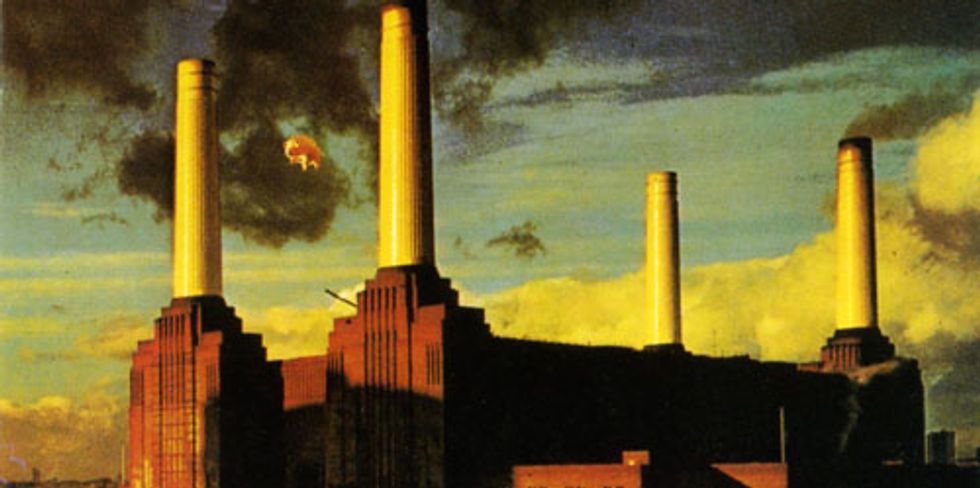
Pink
Floyd's
"Animals" is a
progressive rock concept album released in 1977. The album serves as
a critique of socio-political issues that England faced throughout
the late 1970s that persisted into the 1980s, and pursues this
harsh criticism through a metaphoric hierarchy of walking, talking
animals (akin to George Orwell's "Animal Farm")
consisting of sheep, dogs, and pigs. While this highly experimental
(and admittedly fantastical) album seems to have been very much so a
artifact of a lost rebellious, anti-Thatcherite mentality,
"Animals"
still holds a surprising amount of relevance in our modern society.
The
first step of the three-part hierarchy we should analyze is the
lowest: the sheep. The sheep are especially relevant because,
according to "Animals," the sheep are symbolic of us. They are the working-class civilians
who are at the mercy of their overlords. Many sheep are thoughtless
and merely accept their mistreatment, and those who dare to rebel are
far too small in numbers to succeed. The sheep are “harmlessly
passing their time in the grassland away”, and are “only dimly
aware of a certain unease in the air”, unknowing that those above
them merely want to use them.
The second step of
the hierarchy is the dogs. To the sheep, the most dangerous animal is
the almighty dog. They are fierce and militant, and exist only to
rule over the sheep. The dogs “have to be trusted by the people
they lie to” for the sole purpose that “when they turn their
backs on you you'll get the chance to put the knife in”. The dogs
are seemingly valiant, but beneath their flesh lies a pure lust for
power. The dogs represent (not surprisingly), politicians. However,
we know that our hierarchy consists of three parts, which leaves one
species above all.
The third and
final step of the hierarchy is one of which the sheep are unaware, the
pigs. The pigs are in control of all capitol and resources; therefore they have significant power over the previous two species. The
pigs are described as being old, fat, and physically powerless; however, they manipulate the dogs to keep the sheep under control.
The pigs attempt to present themselves as “big men” and “house
proud town mice” (this second verse being a direct reference to
Mary Whitehouse, a British pro-censorship advocate) but are called
out by the narrator as merely being “charades”. The pigs
represent CEOs of major corporations; they are seemingly uninvolved
with the political conflicts between the sheep and the dogs (the
civilians and the politicians), but in reality, they are the root of
the problem, being in control of both species due to their extensive
wealth and influence.
At
the conclusion of
"Animals,"
the sheep rise up against the dogs, defeating them; however, they
realize that it is impossible to defeat the pigs alone. The root of
their problem stems from a lack of cooperation with each other and a
lack of understanding of what the real issue is. The sheep believe
that the dogs are their only predator, and the dogs are completely
unaware that they are not in charge and have been “dragged down by
the stone”. Together, they stand a chance against the pigs and can
bring about equality and an end to corruption. Together, with
acceptance, understanding, and passion, we can bring about a new age
of equality, free from the oppressive hierarchy that binds us.
Instead of sheep, dogs and pigs, maybe someday we'll just be people.
You
know that I care what happens to you
And I know that you care for me too
So I don't feel alone
On the way to the stone
Now that I have found somewhere safe
To bury my bone
And any fool knows a dog needs a home
A shelter from pigs on the wing














