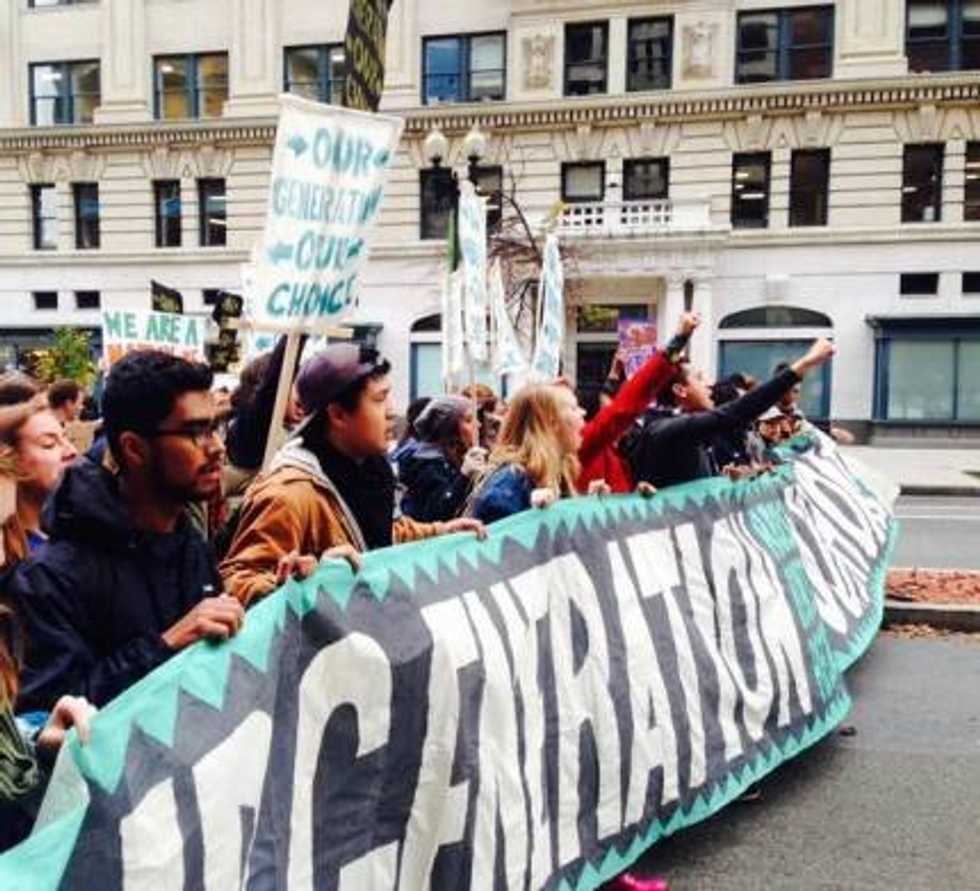
On Monday, Nov. 9, over 1,000 students gathered in the nation’s capital to protest our government’s inaction on climate change, racial issues, and immigration reform. A group from Williams College left early the morning before, excited and ready to engage in what was advertised as the “biggest march” for these intersectional issues. We arrived Sunday at noon, exhausted but ready to take action and make our voices heard.
That night, we slept in the local church with students from dozens of other colleges. A group stayed up late into the night, making new posters and banners. The next morning, they rose bright and early, and met up at the rally in Franklin Square Park, ready to march.
I didn’t join them.
My choice to not march was one that I agonized over. This was my first experience with a march of this sort, and I was scared of what my classmates would think of my choice to not march. Did that mean that I was a failed activist, for not standing in solidarity on the streets of Washington, too cowardly to engage in civil disobedience and risk arrest?
In the days before and after the march, the Internet was buzzing with articles, lauding the bravery and courage of the young activists that marched in solidarity and protested that weekend. But what did they not mention, however, was the hidden dialogue and conflict leading up to the march. The day before the march, the organizers (namely 350.org, Divestment Student Network, United We Dream, and Million Hoodies) put together a five-hour mandatory “nonviolent direct action” training session.
It wasn’t the five hours of non-stop training that bothered me. Or the seemingly empty and meaningless chants we were told to repeat. Rather, it was the complete disconnect between the organizers and the students attending the march and the completely lack of intersectionality (despite the fact that this was advertised as an intersectional march).
“The most important thing is that you have fun!”
I was shocked when I heard an organizer announce that to the training group. Yes, this is supposed to be a positive experience, standing in solitary, singing and chanting and marching. Yes, protesting and marching can be fun. But that is not what civil disobedience is about. People are suffering, genuinely suffering and dying. To make civil disobedience all about having “fun” is to make a mockery of the history of civil disobedience and turn marching in solidarity into an appropriation of previous movements, romanticizing the fight against oppression where more much than the slim possibility of arrest is at risk.
The same organizer later said, “After the march, we will rally back at the park to pat ourselves on the back.”
That is what this entire event felt like. Like a predominantly white group of college-aged activists patting themselves on the back for an activist job well done. Meanwhile, the small number of students of color felt so marginalized by the organizers and training that an exclusive caucus for people of color was organized on the spot to deal with the lack of intersectionality in the movement. The one organizer of color that spoke during training felt like a prop, only there to briefly tell his story about the intersection of immigration issues and pollution, with absolutely no follow up on the issues or his story afterwards. There was little to no education on the actual issues themselves, but a vague notion of the “rightness” of the movement and the malevolence of “every evil motherf*cker” on K Street. Workshops were held early in the morning, but because most people arrived only in time for the mandatory training, were inaccessible to most. Privilege and power were brought up and resolved by vague assumptions that everyone understood what white privilege entailed. Several students of color stood up, eager to start a discussion on how to use and acknowledge white privilege properly, only to be told by an organizer that there would be “no back-and-forth.”
It was painful and tortuous. When a friend and I attempted to share our feelings with a classmate from Williams, they shut down the conversation immediately. They were unable to understand where we were coming from, unable to see the distress we were experiencing from the training. This is not an isolated event. Every time people of color speak up against injustice, there is always someone ready to justify and shut down the discussion. Often, it’s racist trolls on Facebook. Sometimes, it’s well-meaning allies who don’t understand the implications of their words.
This lack of constructive dialogue and conversation was ultimately the final straw for me. People of color were marginalized, silenced, and dismissed in favor for chants and games. This is unacceptable. You can’t advertise an intersectional march and then expect zero conflict or dialogue to happen. Conversations about race and power and privilege are unconformable, but a necessity. These dialogues require you to analyze assumptions and beliefs you’ve always held as truth—discomfort is implied and expected.
This is not to condemn the march as a whole; it was a good effort, and if it motivated even one person to educate themselves about the issues and create greater awareness on their campus, it was worth it. But it was certainly far from successful in its goals, and the problematic rhetoric that happened behind the scenes was more damaging than positive. For movements like this to be successful, intersectionality is a must. The focus should not be on using bodies to blockade traffic, but empowering voices that are often push aside and marginalized in favor of more mainstream faces and stories. That is what I hoped and expected from the Our Generation, Our Choice march. I wrote this piece in hopes that others will use their voices and speak out about their experiences with activism. Only this way, can an intersectional and diverse activist community grow and flourish where it has been faltering, and make the voice of our generation truly powerful.