Some catch phrases come and go, others have been around so long that we do not even remember where they originated or sometimes even what their original meanings are. Many popular phrases have dark origins while others began at fair stalls. So I decided to share the origins of six popular phrases used in America.
1. Pleased As Punch
Commedia dell'arte, an Italian play in the 16th century featured a puppet named Punchinello and his wife Judy. The play became very popular in Britain until its decline in the 20th century due to its political incorrectness. Punch, just so happened to take pleasure in two things during the play: beating his wife and murder. Punch took great pleasure in his actions and often called out “That’s the way to do it!” Throughout its time in Britain the show did change, however, it did not stray too far as Punch’s abusive and murderous ways remained the same. The first recorded use of the popular phrase was in 1797, by William Gifford in his series "The Baviad," and "Maeviad," with the line “Oh! how my fingers itch to pull thy nose! As pleased as Punch, I'd hold it in my gripe.” The phrase caught more popularity as Charles Dickens used “pleased as Punch” and “as proud as Punch” interchangeably. In his novel "David Copperfield" (1850), he wrote “I am as proud as Punch to think that I once had the honor of being connected with your family.” He used the more popular version in his novel "Hard Times" (1854), writing, “When Sissy got into the school here . . . her father was as pleased as Punch.”
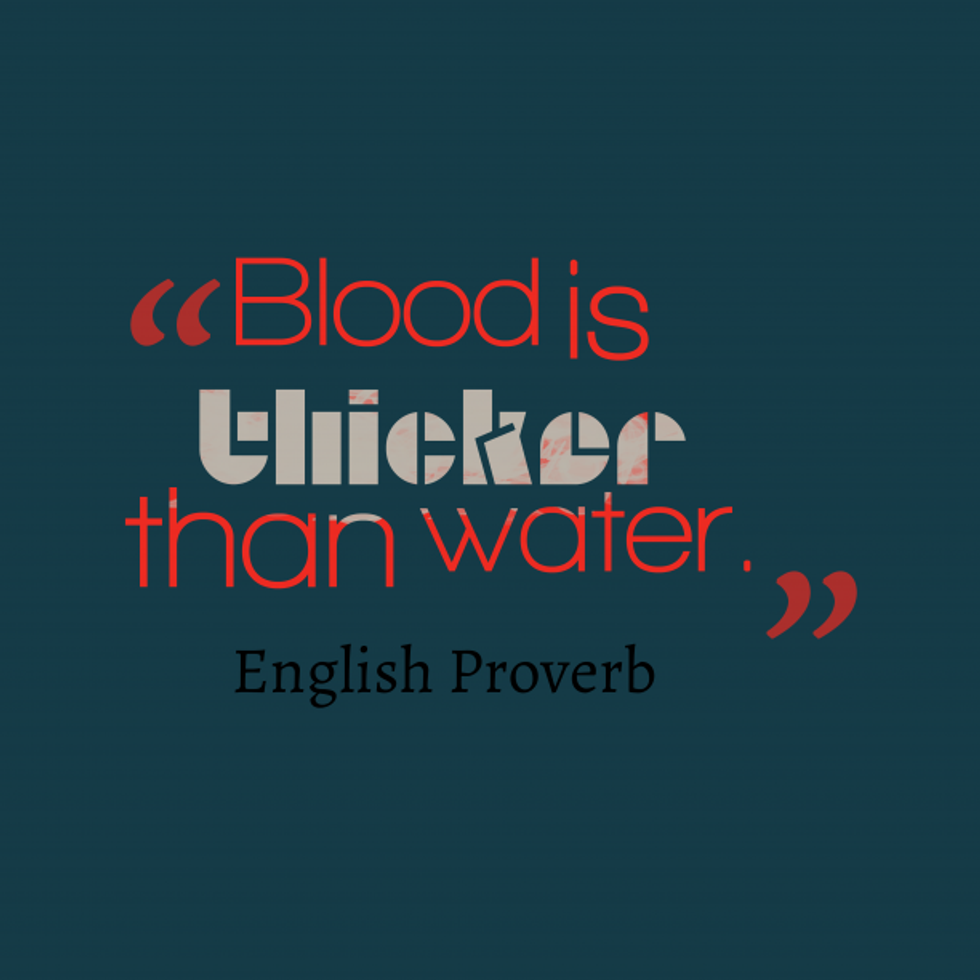
2. Blood Is Thicker Than Water
The original phrase is “The blood of the convenient is thicker than the water of the womb.” This came about when cults and other organizations began the ritual of blood brothers, insisting that the bond created by the blood ritual was stronger than the ties a man would have compared to the water of the womb with which he was born. Germany was the first to use the phrase in the modern since. Insisting that the bonds of the blood that you share with your family is much stronger than the bonds you make with friends. They stated that blood leaves stains, while water can easily evaporate and leave no trace of its existence.
3. Cat’s Out Of the Bag / Let the Cat out Of the Bag
This phrase came about due to fraud in market places. Merchants would sell piglets in the street markets, putting them in sacks for easy transport for the customer. Some, however, would put cats in the sacks instead of piglets. The unsuspecting costumer would not know that they had been cheated until they got home and literally let the cat out of the bag. The first published form of the phrase was in The London Magazine in 1970 in a book review after the author revealed a secret, the journalist stated, “We could have wished the author did not let the cat out of the bag.”
4. Cat Got Your Tongue
While there is no evidence to support this theory, it is believed that ancient kings would cut out the tongue of anyone who displeased or spoke out against them and feed it to the royal family’s pet cat(s). The recorded use of this phrase was 1881 in Ballou's Monthly Magazine, when a journalist mentions the phrase and follows it up with a “as the kids would say.” The next time it is mentioned is in 1911, by Henry Howard Harper in his novel "Bob Hardwick." It grew rapidly into popularity in 1950 and on through the 1960’s. Oddly enough, the French have a similar phrase, “je jette ma langue au chat,” which translates to “I throw my tongue away to the cat.”
5. Curiosity Killed the Cat
Started as “care killed the cat” (care meaning worry or sorrow) in 1598 by English playwright Ben Jonson. His play "Every Man in His Humour" included the historic line "Helter skelter, hang sorrow, care'll kill a Cat, up-tails all, and a Louse for the Hangman." William Shakespeare was among the group of actors (The Lord Chamberlain's Men) that preformed this particular play. When Shakespeare’s "Much Ado About Nothing" kept the phrase alive with the line, "What, courage man! what though care killed a cat, thou hast mettle enough in thee to kill care." In 1898 Brewer’s Dictionary sculpted it into the primary state of the modern phrase by stating: "Care killed the Cat. It is said that a cat has nine lives, but care would wear them all out." Care was changed to curiosity due to the naturally inquisitive nature of cats, with the help of three influential men. Saint Augustine (Confessions, 397 ACE), John Clark (Paroemiologia, 1639), and Lord Bryon (Don Juan, 1819) all spoke poorly of curiosity. Referring to hell as a place created by God for the inquisitive due to the sinfulness of this vice. The first recorded form of the current phrase was The Galveston Daily News in 1898, declaring “It is said that once ‘curiosity killed a Thomas cat.’”
6. Close But No Cigar
This phrase first came about in the mid-20th century. During the time, men would play fair games to win cigars. When the men fell short of winning the men running the stalls would say “Nice try, but no cigar!” In the 1935 film Annie Oakley, the first form of the current phrase was uttered in the line “Close, Colonel, but no cigar.” After 1949 the phrase’s popularity boomed. Its first appearance in a newspaper was The Lima News (Lima, Ohio) in 1949.
There you have it, the origins of six everyday phrases that are used without a second thought. Whether used with the same original connotation, or with a slightly more playful one, these phrases have survived the ages.

Tschüss!