Just imagine falling asleep at night watching the stars shift into constellations across a purple, midnight sky speckled with the Milky Way. There are no distractions: no technology, no service, just the person in the sleeping bag beside you on the rocks, huddling close to conserve body temperature when it drops to near 32 degrees Fahrenheit.
This was something I experienced when I backpacked with a group of strangers in the Sierra Nevada Mountains, Sequoia National Park, California. By the end of our week backpacking together, we bonded, creating relationships over the shared feelings and emotions of solitude, survival, exhaustion, excitement, hunger, pain, and blissful happiness.
First, let me back up and tell you how I became part of this life-changing experience. There is a national organization for all honors programs and colleges in American universities known as National Collegiate Honors Council (NCHC). NCHC has a program, started by LIU Post Honors College director Dr. Joan Digby, called Partners in the Parks, in which honors students come together on outdoorsy and adventurous environmental trips in many of our national parks.
I took up this opportunity since I am in the LIU Post Honors College. It was an opportunity of a lifetime, one I didn’t realize at the time, but I do now. I chose Sequoia National Park in California, but I didn't know what I was in for when I applied. It turned out the trip in Sequoia is considered the most physically strenuous trip with the most amount of backpacking — the backcountry of the rustic Sierra Nevada Mountains.
Preparing for the trip proved difficult, especially since the month before I was studying in England. I was expected to leave for California three days after returning from England, but I had fallen sick and wasn’t eating or getting out of bed. I had so many doubts about how I would survive backpacking for a week.
Regardless, I packed a suitcase with my pack, sleeping bag and pad, clothes, tent, survival supplies, and other necessary things. Before getting to the destination for the trip, I spent a few days in Santa Barbara, where I was determined to get back into shape for the trip. I spent my days running: six miles one day, eight miles the next, and six the day after. I'm used to running since I am on track and field and XC teams, but after being so sick, my lungs were lacking their usual capacity. It made me even more nervous, because I was at sea level in Santa Barbara and would be backpacking 12,000 feet above sea level in the Sierra Nevadas. There were so many signs telling me I shouldn't be going on this trip.
The morning I met up with the group, my parents' rental car was broken into. Everything of value that my parents brought had been stolen. The windows were shattered, and the car didn’t work. Thankfully a trip leader picked me up, but I had a feeling this was yet another bad sign.
I already was dreading going on this trip since day one when I signed up months ago. It was one of the few things my parents ever forced me to do. I didn't want to go because I was afraid of being out of my comfort zone. I was afraid of not having service for a week, of having to carry my own house and food on my shoulders, of having to dig holes in the mountains so I could go to the bathroom. But, this trip turned out to be the most life-changing experience for me. I was enlightened by so many things in life, and I learned to take nothing for granted and to appreciate everything I am given and everything I can achieve. I learned to respect others and to help them before myself.
For example, the first couple of nights I was very into helping myself. I wanted to make sure I got enough food and was comfortable. But, by the last morning, I was the one sitting in the center of the circle handing out the oatmeals every person wanted. I got whatever was left over, and that did not faze me, even if I didn't like the flavor.
When I had picked up the leftovers for myself, one girl from Florida asked me, “Chloe, are you sure you got the flavor you wanted?” I had shrugged in response and with a big smile said, “Don't worry about me — I am happy that I have food.”
Our diet in the backcountry was limited. We feasted on two oatmeal packs each every morning, granola bars and peanut butter crackers for lunch, and backpacking dry food you add water to for dinner. We didn't complain, because we were hungry and tired, and by the end of a long, arduous day, any nutrition was delicious.
I started the trip carrying a 40-pound pack, clean, frowning, and doubtful. I ended the trip losing three pounds in body weight, with greasy hair that hadn't been washed in seven days, smiling, hungry, and covered in dirt, sweat, and blood. It took me a full day of scrubbing to get all the dirt and blood out from under my fingernails and buried in the life lines in my palms and fingertips. But I didn't care.
I had accomplished something I had had at first yearned to escape — something, that by the end of the trip, I didn’t want to leave. I was ready to go back into the backcountry for a couple more days, sleep under the stars, eat wild berries, and swim in alpine lakes.
One of the most important things we learned before heading into the backcountry was dealing with human trash and waste. The evening before embarking into the backcountry, our trip leaders sat us down around a campfire and taught us nine different ways to go to the bathroom in the wilderness.
The general rule is that if you must go to the bathroom it has to be a minimum of 200 feet away from where you are camping and the nearest water source. If you are doing number two, you have to dig a hole that is at least six inches deep, and it must be covered with dirt, NOT rocks (also known as a "shit sandwich" — a big no-no). All toilet paper used must be stored in a plastic bag and carried down the mountain to be thrown out in trash cans. This was one of the most foreign things I have ever experienced.
We were fortunate to have a pit toilet at one of the lakes we backpacked to. It is the most amazing toilet you will ever see in your life because of its impeccable view over Monarch Lake and Sawtooth Pass. It has an actual toilet seat and three walls of crumbling wooden planks. Of course there was no privacy, and while you were on the toilet people would wave to you from the lake.
We learned to respect each other, and honestly, sharing our space with each other didn’t bother anyone. We changed in front of each other, talked about our bowel movements, had pee and poop partners, and everything you could imagine in-between.
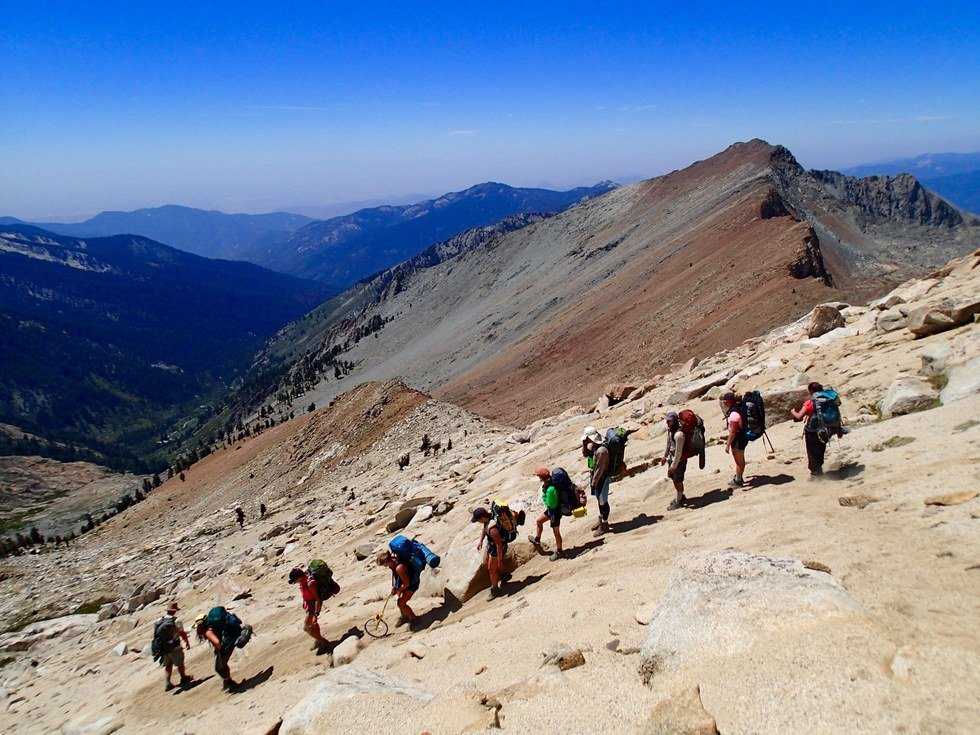
Most of the time backpacking was spent bushwhacking. There was an easy way up the mountain, but taking the easy way out was far from being on our agenda. We spent hours each day inching our way over the mountain towards a new destination. On the first day to Monarch Lake, in just one mile, we climbed over 1,000 feet in elevation. There were times when we trekked through thorny brambles, emerging with legs scratched and bloodied.
One girl from North Carolina slipped and gashed the side of her leg open. Despite all the pain, blood loss, and scarring, she picked herself up and kept marching onward at the front of the group. She was determined to make it to the top of Sawtooth Pass, and for that we commended her. She pushed through the pain and looked towards the rewarding feeling of accomplishing such a feat. Seeing her suffer through her pain to reach the summit made me realize just how nonexistent and silly my complaints and laziness were.
Every evening before sunset, two students would make dinner with the trip leaders. It became customary for all of us to volunteer our time and comfort to help out the team, whether it was cleaning dishes, preparing food, skipping a second serving for someone else, going down to the lake to fill our water purifiers, or filling everyone else's bottles with purified water and leaving the little left over for yourself. Every night after dinner we would then form a circle to discuss environmental issues, a reflection on the day, and anything else that came to mind.
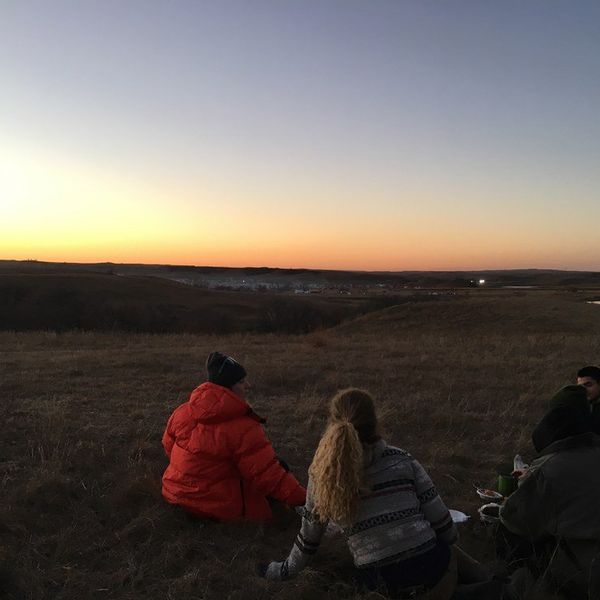
Our first evening we hiked up a mountainside to watch the sunset over Sequoia, where we held our first circle on the heated rocks. We hiked down in the pitch black, with nothing more than headlamps to guide us safely over the rocky precipice and away from bears or mountain lions. When we camped at Columbine and Monarch Lakes, we would bring our sleeping bags out onto the rocks and huddle together to discuss. It was customary to make hot cocoa while talking and watching the stars.
At first, we went ballistic from seeing one shooting star, but by the end of our trip, we had become so used to stargazing and seeing 10+ shooting stars an evening. Our last night had also coincided with the height of the meteor shower, and so as mentioned previously, that was the night we ditched our tents and slept under the stars in 32F. It was beyond magical and surreal.
Every morning, we would take down our tents and pack our backpacks. We never spent more than one night at a time at a location. Our hands would be numb and turning purple in the freezing 6 a.m. mountain air, but we did what we had to do to get a decent start up the mountain. When we would arrive at a destination, which was always a lake, we would seek out the flattest, most protected spot from the wind and set up our tents. We came across a few other backpackers during our journey, but most came out here for solitude. The one or two that would camp at the lake at the same time as us would pitch their tents on the opposite side of the lake.
One morning, when we were camping at Columbine Lake, over Sawtooth Pass, one of our trip leaders, Johnny, walked around to every tent and whispered, “Sunrise hike. It's going to be a beautiful day.” Those quiet, soothing words were enough to wake me up from my warm cocoon at 5 a.m. to embark on a hike and watch the sunrise over Mother Nature’s work.
It was absolutely breathtaking, watching the sun's rays spread light over seven valleys, then a forest fire that had been going for two weeks, then over a canyon called Lost Canyon with a picturesque silver river down the center, then over Columbine lake, and finally over the Sharp, tooth-like peaks of Sawtooth Pass.
I felt like I was reborn by being a witness of something so beautifully natural, yet so surreal. It gave me some hope for a future in which Mother Nature is not completely destroyed by man and his desire to achieve greatness through solely economic gain, no matter the repercussions on Mother Nature.
Throughout the trip, we climbed a little over 12,000 feet above sea level. If you were to measure how high up vertically in the sky we climbed, it would be one straight mile up. That is a ridiculous amount of elevation, and to think I had climbed all of that on my own while lugging 40 pounds on my back makes me feel accomplished and proud of myself.
I learned many things I wouldn’t have learned other than by being forced out of my comfort zone. I learned basic survival skills, but also about prescribed burning and environmental issues that threaten the existence of nature and our national parks. I also learned the beauty and enjoyment of complete solitude. There were times we were instructed to find a place we could call our own, where our only distraction would be the sound of the wind on the lake. We completed a service project to collect micro trash in campgrounds and around the lakes we camped at. Even doing something as simple as this was rewarding, individually but also for the environment.
Here's a not-so-fun fact: the average tourist spends seven minutes in a national park. In the Grand Canyon, the most visited, the average time is only eight minutes, to take a selfie and go. I grew up in a family that would visit a different national park every year. Whenever we visited, we never went to the touristy attractions — we would choose trails and hike the backcountry of the park, where you would be lucky to see two other people the whole day on the trail.
I still remember the last time I was at Arches in Utah, we hiked 15 miles one day in the desert, without seeing any other hikers. So if I had been used to doing this all my life, why was I so reluctant to go on this excursion? It's pretty simple. I would have the comfort of my family, a warm, delicious dinner at the end of the day, and an actual bed to sleep in. This backpacking trip was completely self-sustaining, in which I had to establish my own shelter, food, and bathroom. If I needed help, it was from strangers, and I had to instill all my trust in this group of people I had never met before. Let's just say, this trip put me on a whole different spectrum than just being out of my comfort zone.
This trip didn't turn me into an environmentalist, nor did it change my opinion about the future of Mother Nature. But it did teach me to appreciate the land, to appreciate people, and to appreciate and love the most natural and simple things in life. And for these reasons and others I can't possibly begin to explain in words, I don't regret embarking on this once in a lifetime experience. I would recommend everyone, even non-honors students, to seek out unique, outdoorsy experiences like this one. I can guarantee it is one you won’t regret!