
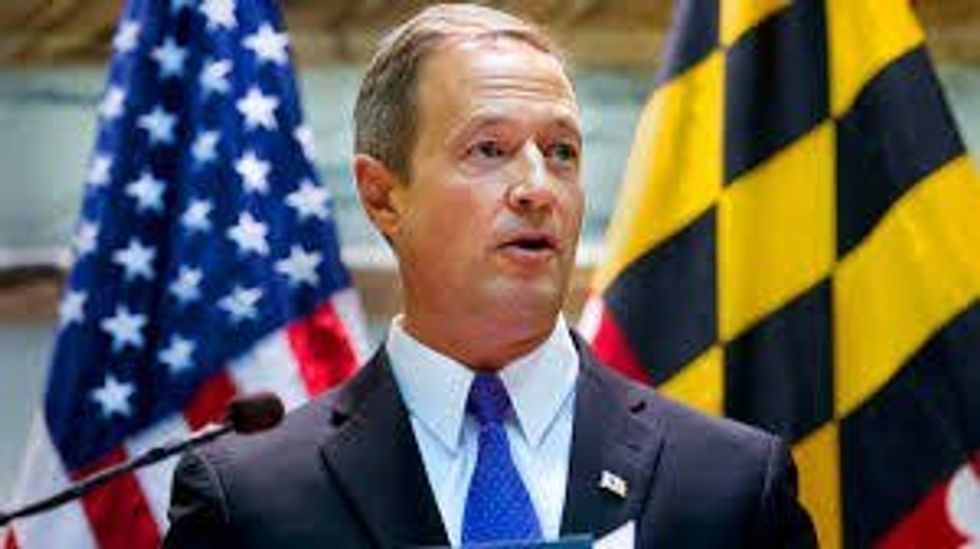
Last Wednesday, Maryland's former governor and current presidential hopeful Martin O'Malley released his plan to help undergraduate students of public academic institutions graduate debt-free. And while he's not the first presidential candidate to respond to the growing concern of millennials with rising college debt (which, by the way, is a whopping $1.2 billion and counting), O'Malley's plan does have its merits. But these merits may not outweigh the faults in it, nor more importantly, in plans proposed by other candidates.
O'Malley's ultimate goal is to send bright American college graduates into the big bad world with zero debt. He also aims to increase college completion rates, especially for low-and-middle-income students. But then, those are goals shared by many people, as well as other presidential candidates. Bernie Sanders proposed creating free tuition, funded largely in part by the federal government. According to his plan, the federal government will allot $47 billion to alleviate costs to states that eliminate undergraduate tuition at public colleges and universities. Two-thirds of the tuition costs would be covered by the federal government, paid through the "Robin Hood tax" on wall street (the raising of taxes on financial transactions of large investments), and the state would be responsible for raising the remaining third. Marco Rubio, this week, also offered a plan to alleviate student debt: put financing an education into the hands of investors. By his plan, students would forego loans and instead agree to pay a certain percentage of their income to investors for a set amount of time.
O’Malley’s plan can be found online, easily laid out and in colorful patriotic page borders. He outlines his main goals; to provide immediate relief to student borrowers through refinancing student loans, to freeze public tuition rates, to reduce tuition costs (by tying the tuition price tag to median state incomes), to incentivize states to maintain their own funding efforts and to increase college completion rates on a national scale. The latter he’d do through a variety of methods: by supporting part-time and mid-career students, or reducing time to graduation by changing the curriculum and encouraging online/blended learning. His plan includes the possibility of helping students before they get to college as well, both through increased college counseling and through early college credit programs. O’Malley’s plan most starkly deviates from Sanders and Rubio’s plan in that it wouldn’t just apply to decreasing tuition. It would go on to alleviate other costs relating to school, like room and board, through an increase in Pell Grants and an expansion of the work study program.
So here are the pros: the cost to alleviate student debt wouldn’t entirely be on students, entirely on states, or entirely on the federal government, whose real role is to incentivize states to invest in youth through matching grants. Students, however, would have the slack lifted dramatically. Then, according to his plan, state tuition would be 10 percent of the state’s median income for four-year universities, and 5 percent for two-year colleges. That means (assuming he wins the election), no more are the days of eight hours in the college dining hall to stretch your dining dollar. Theoretically, tying tuition costs to income will enable families to find tuition costs that are not covered by the government in their budget. Revamping and expanding work study will lift some student costs while simultaneously helping out the school, and high school students will likely feel more ready (financially and academically) for college with the help of expanded early college programs and college counseling.
But the cons: economists say it will be tricky to pull all of this off. Incentivizing states (matching grants or not) will be tricky. What’s further, is that changing a price of a good--any good--can have unintended consequences. Dropping the price of tuition to 5 or 10 percent of a state’s median income is no different, carrying multiple risks for unintended consequences. Some or these may be good, like more college graduates, but some may be bad, like higher debt levels as a BA becomes a necessary qualification to participate in what would become a highly skilled workforce. Or, the risk of diminishing returns to education, since graduates would have to compete with a greater number of qualified workers for the same amount of jobs.
O'Malley claims he and his wife are $339,200 in debt, nine loans worth, from putting his two daughters through college. While this is by no means a national average, it goes to show that something needs to be done about the skyrocketing cost of an American education.