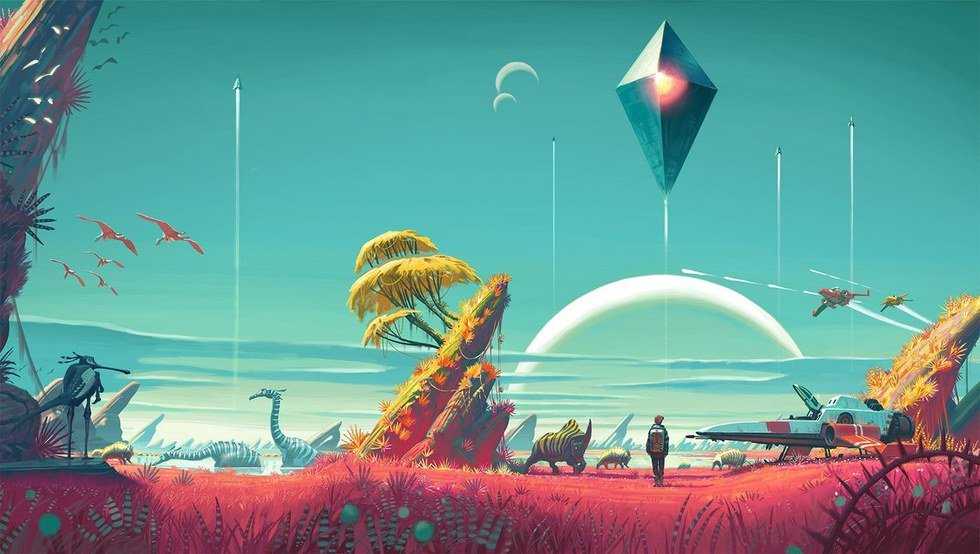
So. Here we are, in the post release of Hello Games' "No Man’s Sky." This was, without a doubt, one of the most widely hyped titles during its advertisement phase, comparable to the Blizzard hit "Overwatch." Gamers were promised an experience like never before.
Before we start, a short explanation of "No Man's Sky." This indie game is a procedurally-generated space exploration game where you, as the player, go to different planets and interact with the biospheres and local wildlife, get into battles, and generally do most of the things you would expect a planet-hopping adventurer to do. Your end goal is to get to the center of the galaxy.
Now, did it live up to that grandiose premise?
Before I continue, let it be known that this is not meant to be a game review of any kind – I'm not qualified for that. I’ve played the game thoroughly, but my opinion on the matter does not stem (entirely) from that. No, this is something made to elicit some form of discussion. Of course, there will be opinions – that's inevitable in something like this. Nevertheless, everything said here is based on not only anecdotes, but various game reviews, videos, and other types of reports on people's experience with the game.
Let's start with the game's selling point: its procedural generation. Put simply, procedural generation, well, generates something “random” based on preset logic. It's an advanced programming trick that gives a more organic feeling to a game world.
In "No Man's Sky," you are dropped into a procedurally-generated universe. No, not Solar System, a universe. In real life, a galaxy has hundreds of billions of stars at the least, with an innumerable number of planets. "Hello Games" stuck to this figure, creating a galaxy of somewhere in the neighborhood of 18 quintillion planets. That's titanic, and you're expected to visit those planets on your way to the center of the galaxy.
The results of this ambitious goal were met with mixed reviews, at best.
Once again, let me reiterate that procedural generation is an advanced technique; one that would require dedicated programmers. Our subject of the day fulfilled its promise of making the planets mostly different, but internally consistent with their own laws of physics.
Where they seemingly fell short, however, were making it really meaningful (you’ll be hearing me say that word a lot). In a universe this vast, where almost anything is possible, it’s easy to think that one could never get bored. You would always have something to do, no matter where you go. Variety is the spice of life, as they say.
Well, no, not really: meaningful variety is the spice of life would be more apt to describe the human race. We, as creatures, love to have choices, but only when those choices are meaningful. ‘Meaningful’ being that they not only help you in some short-term way but also in the long-run in a feasible and easily digestible manner. Basically, “is this going to affect me in a way I care about?” A lot of this is covered in The Paradox of Choice by Barry Schwitz.
It’s easy to see how the game can be a bit daunting with that many things to explore. But, not only did they present what could have been too much choice, they failed to really bring meaning to it. How? Well…
Let’s start with the multiplayer. It was stated that by the developers themselves that "No Man’s Sky" game isn’t exactly the multiplayer experience you’re used to. You won’t be in constant queue with other players, or finding other player-controlled ships flying around. No, it’ll be you, NPCs, and the vastness of the cosmos. However, there are some points where you might run into another person - the rarity of these encounters is supposed to keep the gravity of it all.
That’s a good idea. In theory.
Players aren’t as clear cut or simple as that, especially in this age. They want more instant gratification. This is a game about the long haul; not about the destination, but the journey there. And, again, that’s perfectly fine. But, when you deliver something that’s this large, with multiplayer being as sparse as it is, you have to do a few things: make more meaningful content or cut content altogether. That’s dichotomous, of course, but you get the idea.
"No Man’s Sky," well, it was both a hit and a miss. They took a chance, and they largely succeeded in making the content. It was an astounding technical achievement - that’s something these developers should be absolutely proud of.
Then again, where some players drew the line was that promise of an engrossing experience (in the form of a 60 USD price tag) wasn’t entirely fulfilled. They felt that the game was too simplistic, grindy, and/or linear, and the actual universe itself lacked enough meat and substance to qualify as a full-priced game.
Now, are they wrong? Perhaps. Perhaps not. On one hand, the technology involved plays a huge role in this pricing, as well as the fact that this studio is indie. On the other, hype letdown is an incredibly damaging thing for a company; especially considering the ambition this game had.
Or, perhaps we’re looking at it from the wrong angle. Gamers have been known to try and focus everything under a single lens, and scoff at the subjects that lack characteristics they’re used to. Let’s not judge it for what isn’t there, and judge it for what is: a profoundly huge world, with a few issues internally.
Of course, this is but one of many opinions by a guy behind a computer screen.
So, what did we learn? Well, for one, this game’s status as a “revolutionary title” is divisive, at best. Something this big will always be; we’re in uncharted territory and playing with new types of technology we only dreamed of. Was it a hit? Was it a miss? It’s definitely more complicated than that.
All I know is that I’ll be playing more.