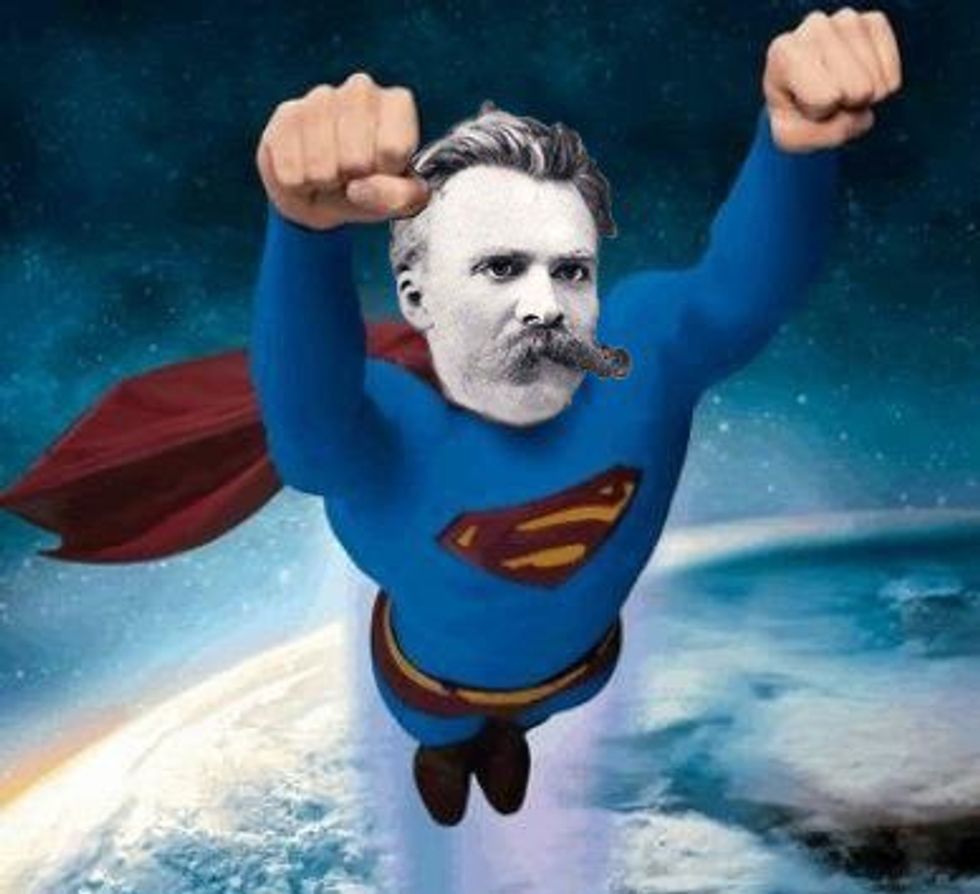
Friedrich Nietzsche was a German philosopher in the 19th century who is well known for being eccentric, and like a wild child of the modern philosophers. I took an ethics class this past semester that proved this understanding of him, but I also was able to come to a better understanding of one of his most interesting perspectives: his concept of willing.
Nietzsche did not believe in a free will, or a lack thereof, but instead a unique style of willpower that he referred to as one's willing. The willing is one's internal drive, to put it (very) simply. It is a combination of thoughts, feelings, desires, experiences, and much more, into a manner that makes up the way in which someone goes about making action happen in their lives. Nietzsche believed that different people have varying degrees of willing, in that one person may have a stronger willing than another. Those with a weaker willing are good at following others, and going about life on auto-pilot. They are affected by their environment, and hardly affect the environment, if at all. In some modern contexts people with weaker willings are called sheep, as opposed to a person with a stronger willing who could be the shepherd or wolf type.
I often have to clarify that someone who is very easy going or goes-with-the-flow doesn't necessarily mean they have a weaker willing, or someone who is good at taking orders may not have a weaker willing either. Being respectful of authority or someone else in charge does not make one have a weaker willing than those being respected either, for the willing is much more internal.
A person with a stronger willing is someone who has goals and achieves them with determination. This may have to do with one's work ethic, or their ambition, but regardless, the willing is impacting the individual who is acting. A stronger willing means that the individual keeps their mind on their goals and makes progress towards completing them, and the means to doing so is irrelevant (in my ethics class, Nietzsche explained that someone who has aligned their willing with an ethical grounding is, basically, the best kind of person). Someone with a very strong willing for the worse would be Frank Underwood from House of Cards, while someone with a very strong willing for the better would be Bruce Wayne from any Batman movie (except maybe Batman vs. Superman). Underwood's willing leads him to do anything that will move him towards his goals, even if unethical in nature, and Bruce Wayne's drive for justice and moral code of not killing anyone in doing so represents a willing that is much more ethical.
So! If one were to look at history, many of the great turns of events that led to the world we live in today were caused by those with strong willings. Julius Caesar moved from an extremely successful general to the emperor of Rome, which resulted in the fall of the Roman Republic, and the rise of the Roman Empire. Galileo's willing was strong enough to work through persecution, and helped bring forth the astronomy that we understand today, and the sciences that have flourished as a result. George RR Martin's willing was twisted enough to kill off enough Game of Thrones characters to make me so invested in the show that I would write this article much much later than I would have wanted to. The examples are everywhere.
There are potential exceptions to this, of course, like Gavrilo Princip, the man who shot Franz Ferdinand and sparked World War 1. Princip was following a group of radicals, and happened to be in the right alleyway when Ferdinand was escaping an initial assassination attempt. Princip has been described as frail and sickly, and may not be the poster-boy for a strong willing. All the while, he was also driven enough to carry out his mission, and traveled on foot to Belgrade from Sarajevo before the age of 20, so willing isn't too easily calculated.
Could history really be related to Nietzsche's willing? Do you believe that the willing has a legitimate philosophical standing, and should be further explored? It was certainly one of my favorite parts of the ethics course (maybe I'll touch base on Aristotle's sometime too!). Let me know what you think.