


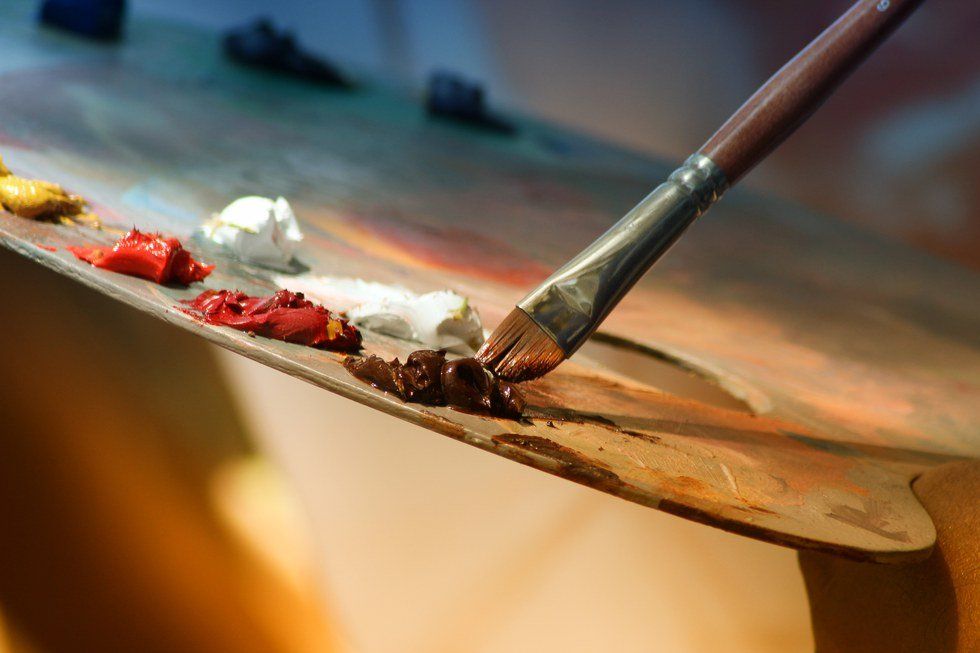
Let’s take a glance at American society. Myriad fast food restaurants are stationed across the nation; food must be a priority. Huge stadiums and enormous salaries for professional athletes indicate that sports are a pretty big deal. But the arts? They might be appreciated in small doses now and then, but they’re not viewed as something essential. As far as practicality, the arts are not very useful. As far as entertainment, most people would rather watch sports or funny YouTube videos. Thus, the arts are not a priority for the general population. However, the arts are incredibly powerful, and we need them in our lives.
Yes, we need the arts in our lives. Math and science are the stressed subjects in school, and I recognize their importance; however, I also believe it is dangerous to completely ignore the creative and artistic side of the mind. Math and science allow us to make discoveries and to explain the world in logical terms; however, in reality life cannot always be explained logically. Not everything is tangible, especially not the soul. The language of math or science will not suffice here; an intangible language is necessary for the soul to speak, and I believe the arts are a powerful form of that language.
Think back to prehistoric times, when humanity’s primary goal was merely to survive. Even in these times of survival-mode, humans succeeded in making elaborate art on the walls of caves. Now if we were in their place, struggling to survive, how many of us would devote time and effort to transforming a wall into a masterpiece? My guess is that “create masterpiece on wall” would not make the top of the to-do list. So why, when life consisted of battling to survive, did people make art a part of their lives?
I think the answer has to do with the human desire to express the soul and to create something that transcends time. Art speaks in a different language than words. It’s an eternal, universal language. For instance, suppose artifacts were discovered from an ancient civilization no one had ever heard of before. Years of intense study might never suffice to interpret the meaning of the written language, but the beauty of the uncovered ancient art can be immediately recognized. Even if the intended message of the art is not fully understood, the fact remains that as humans, the artwork of any culture from any point in time can have an impact on us, if we only take the time to gaze upon it.
This ability to impact people and to transcend time belongs to all of the arts, including music, dance, and drama, in addition to visual art. Martha Graham, a remarkable dancer and choreographer, famously stated, “the body says what words cannot.” Her statement embodies the power of the arts—the ability to speak the language of the soul.
I recently witnessed the emotive power of music when I visited the assisted living community where my grandparents reside. As I walked through the nearly empty lobby with my mom and grandmother, I noticed an old piano. My grandmother hadn’t heard me play in years, so I decided to play a few songs I knew by heart. When I had finished, I was amazed to see that my audience of two had soon become twenty-two, as the melodies had lured many residents out into the lobby simply to listen and enjoy. I was out of practice, but that didn’t matter to any of them. What mattered was that without words, without money, without anything other than the piano and about fifteen minutes of my time, the music had touched their souls, giving them a peaceful joy that showed on each of their faces.
On that day, I saw for myself that the arts have a unique ability to speak to the soul. We are not robots, we are humans, and our souls need the arts in our lives. Therefore, as a culture, we should give them the respect they deserve. There are plenty of opportunities to keep the arts alive in your life: simply go to the ballet, the opera, the orchestra or the art museum. Open your eyes to the beauty of the arts, and allow it to captivate you.
















